Spring cleanup timing
Cut back old, tattered foliage just before new shoots emerge in late winter to early spring so flowers are not accidentally removed and young growth is exposed to light and air.

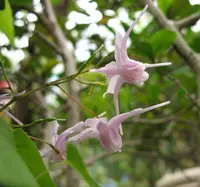
Large-flowered barrenwort, Epimedium grandiflorum, is a compact, clump-forming perennial grown mainly as a groundcover in shaded gardens. It spreads slowly by rhizomes, forming dense mats of foliage over time.
The plant carries delicate, often heart-shaped leaves that may emerge bronze or red-tinted, then mature to green. In spring, it produces airy sprays of relatively large, spurred flowers in shades of white, pink, purple, or yellow.
Epimedium grandiflorum is native to woodland areas in East Asia, especially Japan, where it grows under trees and shrubs. It is valued for its shade tolerance, drought resistance once established, and general toughness.
Gardeners who want to learn how to care for large-flowered barrenwort should note that it prefers partial to full shade, evenly moist but well-drained soil, and protection from harsh afternoon sun.

Care Difficulty
Easy Care

Light Preference
Partial Shade

Water Requirements
Moderate Water

Temperature Preference
Cold Hardy

Hardiness Zone
5–8

Soil Texture
Loamy, Silty, Organic-rich

Soil pH
Acidic (5.5–6.5), Slightly acidic (6.5–7.0)

Soil Drainage
Moist but well-drained

Fertilization
Minimal (feed rarely)
Scan your plant to receive care tips personalized for your specific plant
Available on iOS and Android
This woodland perennial prefers soft, indirect light rather than intense sun.
This plant prefers consistently moist but not saturated soil, especially during active growth.
This hardy perennial tolerates a wide temperature range but grows best in moderate conditions.
This woodland perennial manages well in typical home and outdoor humidity if roots stay evenly moist.
Epimedium grandiflorum grows best in loose, humus-rich soil that stays evenly moist yet drains freely.
This species adapts well to container growing when the pot and substrate are chosen to manage consistent, moderate moisture.
Epimedium grandiflorum benefits from light, steady feeding rather than heavy fertilization.
Pruning Epimedium grandiflorum is mainly done to refresh foliage and support flowering.
This perennial is usually grown in the ground, so focus on careful transplanting rather than frequent repotting.
Epimedium grandiflorum is most commonly propagated by division, with seed used mainly for breeding or patient growers.
This species is generally cold hardy, so winter care is simple in most temperate gardens.

Plant Health Check
Not sure what's wrong with your plant? Check your plant's health inside the app.
This species emerges early in spring in its native Japanese woodlands, taking advantage of bright light before the forest canopy closes and shade intensifies later in the season.
Compared with many other barrenworts, it produces noticeably larger, often spurred flowers in loose clusters, which is why it is widely used as a parent in breeding showier ornamental hybrids.
Despite its delicate appearance, this plant tolerates winter cold in much of temperate North America, forming slowly spreading clumps that create a durable, long-lived groundcover under deciduous trees when gardeners grow Epimedium grandiflorum in suitable shade.

Some cultivated forms of this species are among the earliest flowering perennials in cool-climate gardens, with blooms often appearing when many trees are still leafless and before most other shade perennials have broken dormancy.
This species spreads slowly by short rhizomes, forming clumps that widen over several years. It is generally considered well-behaved, not invasive, and rarely becomes a nuisance if planted with appropriate spacing and normal garden maintenance.
Keep your plants happy and healthy with plant identification, disease detection, and easy care guidance.