Contain Rhizome Spread
Install a rigid, bottomless root barrier 30–45 cm deep around planting areas to prevent the aggressive rhizomes from invading beds, lawns, or pond liners while still allowing adequate moisture movement.

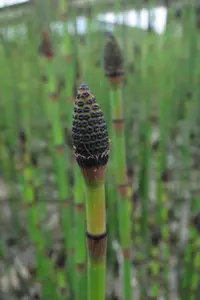
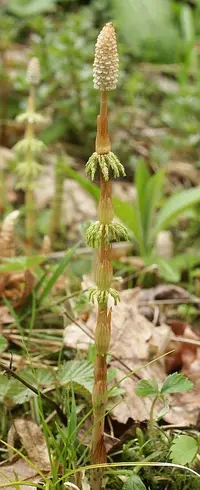
Ferriss' horsetail, Equisetum × ferrissii, is a hybrid horsetail forming upright, jointed, reed-like stems with narrow dark bands at the nodes. It has a distinctly architectural, almost bamboo-like look, but remains much thinner and more delicate. This plant typically occurs in wet habitats such as stream banks, marsh edges, and ditches in parts of North America. Its creeping rhizomes spread quickly, which makes it persistent and sometimes invasive in suitable conditions. The plant prefers consistently moist to wet soil and tolerates shallow standing water, making it suitable for ponds or boggy spots. It handles full sun to light shade and is generally tough once established, but its strong spreading habit is the main challenge when learning how to care for Ferriss' horsetail.

Care Difficulty
Moderate Care

Light Preference
Full Sun

Water Requirements
Aquatic

Temperature Preference
Cold Hardy

Hardiness Zone
4–9

Soil Texture
Loamy, Silty, Organic-rich

Soil pH
Acidic (5.5–6.5), Slightly acidic (6.5–7.0)

Soil Drainage
Waterlogged tolerant

Fertilization
Minimal (feed rarely)
Scan your plant to receive care tips personalized for your specific plant
Available on iOS and Android
This moisture-loving hybrid thrives with consistent light that mimics open, wet habitats.
This species needs constantly moist conditions and does not tolerate drying out.
This hardy horsetail tolerates a wide temperature range but grows best in mild to warm conditions.
This semi-aquatic hybrid prefers constantly moist conditions rather than specific high air humidity.
This rhizomatous rush prefers waterlogged, organic-rich substrates rather than typical potting soil.
This species is well-suited to container culture, especially for controlling spread near ponds or water features.
This wetland hybrid usually needs minimal feeding, especially in rich or mucky soil.
Pruning helps manage the dense, upright clumps of Equisetum × ferrissii and keeps stands tidy.
This horsetail hybrid is most often managed by dividing and transplanting clumps rather than frequent repotting.
New plants are usually produced by division of rhizomes rather than from spores or seeds in this hybrid.
This horsetail is generally cold hardy in temperate climates and needs only basic winter care.

Plant Health Check
Not sure what's wrong with your plant? Check your plant's health inside the app.
This species is a naturally occurring hybrid between Equisetum hyemale and Equisetum laevigatum, combining the stout, evergreen look of hyemale with the more slender, somewhat nodding stems of laevigatum.
Its stem structure shows anatomical traits from both parent species, including relatively thick-walled ridged stems with fewer branches than typical meadow horsetails, which helps botanists confirm its hybrid origin under magnification.
This hybrid is known from scattered sites in parts of North America, especially the upper Midwest, where the ranges and preferred habitats of its two parent species overlap along streams, riverbanks, and other wet, sandy or gravelly soils.
This species spreads strongly by creeping rhizomes and can quickly form dense colonies, especially in wet soils. Use root barriers or containers where spread is a concern, and remove unwanted shoots regularly to keep it contained.
Keep your plants happy and healthy with plant identification, disease detection, and easy care guidance.