Early stand thinning
In dense self-sown patches, thin seedlings to 15–20 cm apart in early spring so remaining plants develop stronger stems and produce more branching flower stalks.

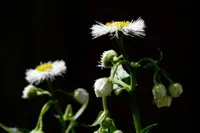
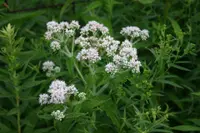
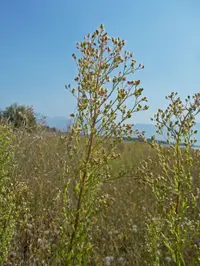
Eastern daisy fleabane (Erigeron annuus) is a short-lived wildflower and meadow plant in the aster family, often behaving as an annual or biennial. It forms upright, branching stems topped with many small, daisy-like flower heads with yellow centers and narrow white to pale pink rays.
This species is native to North America and is common in fields, roadsides, and disturbed ground, where it self-sows freely. It is generally easy to grow, adapting to poor soils and variable moisture, which makes it low-maintenance once established.
To care for eastern daisy fleabane, provide full sun, reasonably well-drained soil, and avoid overfertilizing, since rich conditions can make plants tall and floppy.

Care Difficulty
Easy Care

Light Preference
Full Sun

Water Requirements
Moderate Water

Temperature Preference
Cold Hardy

Hardiness Zone
2–8

Soil Texture
Sandy, Loamy, Rocky

Soil pH
Acidic (5.5–6.5), Slightly acidic (6.5–7.0)

Soil Drainage
Well-drained

Fertilization
Minimal (feed rarely)
Scan your plant to receive care tips personalized for your specific plant
Available on iOS and Android
This species prefers open, bright sites and performs best with consistent direct light.
This plant prefers moderately moist, well-drained soil and is fairly drought tolerant once established.
This species is a hardy wildflower adapted to a wide range of outdoor temperatures.
Erigeron annuus tolerates a wide humidity range and rarely needs special humidity management outdoors.
Erigeron annuus prefers light, well-drained soil that does not stay wet after rain or watering.
This species is suitable for container growing outdoors if the pot is set up to drain and dry efficiently.
This species is a low-maintenance native that usually needs little feeding, especially in garden soil that is not extremely poor.
Pruning Erigeron annuus is simple and mainly aimed at tidiness and extended flowering.
Transplanting eastern daisy fleabane is straightforward when timed and handled to limit root disturbance.
Erigeron annuus is commonly propagated by seed and, less often, by division of existing clumps.
Mature Erigeron annuus in the ground is generally cold hardy in much of the US and needs minimal winter care.

Plant Health Check
Not sure what's wrong with your plant? Check your plant's health inside the app.
This species is native to eastern and central North America and has spread widely as a naturalized plant in parts of Europe and Asia, often along roadsides, fields, and disturbed ground.
Its flower heads have unusually narrow, threadlike white to pale pink ray florets surrounding a yellow center, often with more than 100 rays per head, which gives the blossoms a delicate, feathery appearance.
Although commonly described as an annual, this species can behave as a short-lived perennial in favorable conditions, resprouting from the base and flowering for more than one season.

Genetic and morphological studies have shown that this species can hybridize with closely related fleabanes, which contributes to complex variation within the Erigeron genus and sometimes makes species identification challenging in the field.
This species self-seeds freely and can form loose colonies, especially in open, disturbed soil. Deadhead spent flower heads before seeds mature and maintain mulch or groundcovers in bare areas to limit unwanted spread.
Keep your plants happy and healthy with plant identification, disease detection, and easy care guidance.