Pyrenean Eryngo Care (Eryngium bourgatii)

Also known as: Mediterranean sea holly, Bourgati's eryngo
Pyrenean Eryngo

About Pyrenean Eryngo

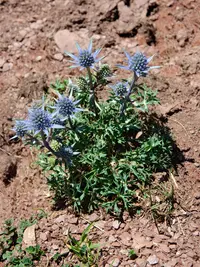
Pyrenean eryngo, Eryngium bourgatii, is a compact, spiny perennial from the carrot family, grown mainly for its striking, thistle-like flowers. It forms tight clumps of deeply cut, often marbled leaves, topped in summer by steel-blue cones surrounded by sharp, silvery bracts.

This species is native to mountainous regions of the Pyrenees and nearby areas, where it grows in rocky, well-drained soils. It prefers full sun, low to moderate moisture, and dislikes heavy, wet ground.

Once established, it is drought tolerant and long lived, so gardeners often find it straightforward to care for Pyrenean Eryngo provided the soil does not stay waterlogged.

Main Plant Requirements

Care Difficulty

Easy Care

Light Preference

Full Sun

Water Requirements

Low Water

Temperature Preference

Cold Hardy

Hardiness Zone

4–9

Soil Texture

Sandy, Loamy, Rocky

Soil pH

Slightly acidic (6.5–7.0), Neutral (7.0)

Soil Drainage

Well-drained

Fertilization

Minimal (feed rarely)

Get Personalized Care Plan

Scan your plant to receive care tips personalized for your specific plant

Available on iOS and Android

How to Care for the Pyrenean Eryngo

This sun-loving perennial forms its best spiky blooms in strong, direct light.

  • Provide 6–8 hours of full sun daily; in hot inland zones, light afternoon shade reduces stress and leaf scorch for Pyrenean Eryngo.
  • Choose an open, unshaded position with exposure from mid-morning to early afternoon, avoiding dense shade from buildings or shrubs.
  • In cooler climates, maximize sun by avoiding north-facing spots; in very hot summers, monitor for bleaching or crispy bracts as signs of excess sun.

This drought-tolerant species prefers infrequent, deep watering in sharply drained soil.

  • Allow the top 5–7 cm of soil to dry completely before watering; established plants in the ground often need no supplemental water once rainfall is consistent.
  • Use gritty, fast-draining soil so water clears the root zone quickly; standing water or heavy clay greatly increases root rot risk for Eryngium bourgatii.
  • In summer heat, watch for floppy, dull leaves as a sign to water; yellowing, mushy stems or a sour soil smell indicate overwatering.

This hardy perennial tolerates a wide temperature range but prefers moderate, dry conditions.

  • Optimal growth occurs around 65–80°F (18–27°C), with strong flowering when summers are warm and not excessively humid.
  • Mature plants tolerate winter lows near 0°F (−18°C) in well-drained soil; winter wet combined with repeated freeze–thaw is more damaging than cold alone.
  • In summer, plants handle heat up to about 90–95°F (32–35°C) if soil is not waterlogged; in prolonged extreme heat, expect some leaf scorch and reduced flowering.

This species tolerates a wide humidity range and rarely needs special humidity management indoors or outdoors.

  • Best growth occurs in 30–60% humidity, typical of most homes and many dry summer climates.
  • Leaves and bracts stay firm and colored even in relatively dry air, so extra humidifying equipment is usually unnecessary.
  • If leaf tips brown while soil is evenly moist, increase humidity slightly with nearby water trays rather than misting the Pyrenean Eryngo.

Eryngium bourgatii prefers lean, very well-drained soil that mimics rocky, mineral garden conditions.

  • Use a sandy or gritty mix, such as 50–60% loam with coarse sand or grit and a small amount of compost for structure.
  • Aim for a slightly alkaline to neutral pH around 7.0–7.5, avoiding strongly acidic mixes often sold for ericaceous plants.
  • Ensure sharp drainage by mixing in horticultural grit or pumice; water should pass through the root zone within seconds, not linger.
  • Avoid heavy clay, peat-heavy, or constantly wet soils, which promote root rot and reduce aeration around the taproot.

This species can be grown in containers if the pot is prepared to stay dry around the taproot.

  • Choose a deep, narrow container to accommodate the taproot while limiting excess surface soil that can stay wet too long.
  • Use a heavy, stable pot material like terracotta or stone to prevent wind from toppling the tall, branched flower stems.
  • Elevate the container on pot feet or bricks so drainage holes stay clear and water does not pool under the base after rain or watering.

This drought-tolerant perennial needs only light feeding, as excessive nutrients reduce flowering and compact growth in Pyrenean Eryngo.

  • Use a balanced, slow-release fertilizer or light compost layer once in spring at the start of active growth.
  • Apply at 1/2 strength compared with label rates to avoid lush, floppy foliage.
  • Do not feed during winter dormancy; nutrient uptake is minimal in cold, low-light periods.
  • In poor soils, a second light feeding in midsummer can support flowering without overstimulating foliage.

Pruning Eryngium bourgatii is simple and helps maintain tidy form and sustained flowering.

  • Cut spent flower stems back to the basal rosette in late summer to early fall to prevent self-seeding and neaten appearance.
  • Remove dead, damaged, or flopping stems at ground level with clean, sharp hand pruners.
  • Leave healthy basal foliage over winter to shield the crown, then tidy any dead leaves in early spring.
  • Avoid heavy reshaping; this species has a naturally architectural form that needs minimal intervention.

This species dislikes root disturbance, so transplant or repot Eryngium bourgatii only when clearly necessary.

  • Look for roots circling the pot drainage holes, stalling growth, or rapid drying of soil as signs a container plant needs a larger pot.
  • Carry out transplanting or repotting in early spring so roots can re-establish before summer heat.
  • Expect to repot every 3–4 years at most, moving only 1 pot size up into a sharply drained, gritty mix.
  • Handle the root ball gently, keep it as intact as possible, water thoroughly once, then allow soil to dry slightly to limit stress and rot risk.

Propagation of Eryngium bourgatii is most reliable from seed, with division done only on well-established clumps.

  • Sow fresh seeds in late summer to early fall in trays of free-draining mix; a cool period improves germination.
  • Provide bright light, good air movement, and moderate moisture; avoid waterlogged conditions around emerging seedlings.
  • Division is possible in early spring, but divide only large, healthy clumps and keep root disturbance minimal.
  • Pot divisions into gritty mix, shade lightly for a few days, then move to full sun as new growth appears.

This hardy perennial tolerates typical temperate winters and generally needs only modest seasonal care.

  • Eryngium bourgatii is hardy in many regions with freezing winters, coping with short periods below 20°F once established.
  • After hard frosts, cut back collapsed flower stems, leaving any firm basal foliage in place.
  • Apply a light, dry mulch around (not over) the crown in colder climates to buffer freeze–thaw cycles.
  • Container plants in very cold zones can be overwintered in a cold, bright, frost-free space to protect roots.

Care Tips

Improve Drainage Mound

Plant on a slight soil mound or in raised positions so excess winter moisture drains away from the crown, which greatly reduces the risk of rot in heavy or clay soils.

Gravel Collar Mulch

Apply a 3–5 cm ring of coarse grit or gravel around the crown instead of organic mulch to keep the base dry, reflect light, and discourage slug damage to emerging shoots.

Support Against Flopping

In windy or very fertile sites, place low, unobtrusive ring supports around the clump in early spring so the stems grow through and stay upright without snapping.

Controlled Self‑Seeding

If you want more plants, leave some seedheads on the plant until they brown and shake them out over the desired area, but remove the rest to prevent random self‑sowing and maintain a planned layout.

Use For Cut Stems

Cut stems for fresh or dried arrangements early in the day once the flower heads are fully colored, and strip lower leaves so the remaining foliage on the plant keeps good airflow and reduces fungal issues while growing Pyrenean Eryngo.

Common Pests and Diseases

Aphids

This pest feeds on young stems and flower stalks, sucking sap and causing distortion and sticky honeydew on leaves and bracts.

Solution

Spray affected areas with a strong jet of water to dislodge colonies, then treat remaining clusters with insecticidal soap or a ready‑to‑use neem oil spray, repeating weekly until no new aphids appear. Encourage natural predators such as lady beetles outdoors and avoid overfertilizing, which promotes soft, aphid‑prone growth when growing Pyrenean Eryngo in richer soil than usual.

Leaf spot

This disease appears as small brown or tan lesions on leaves that may enlarge and merge in humid or overcrowded plantings.

Solution

Remove and discard affected leaves to reduce spore spread, then improve air circulation by spacing plants properly and avoiding overhead watering. In persistent or severe cases, use a labeled copper or sulfur fungicide during extended wet periods, following package directions carefully.

Powdery mildew

This disease causes a white, powdery coating on leaves and stems, usually when plants are crowded or shaded and air movement is poor.

Solution

Increase sun exposure and airflow, water at the base to keep foliage dry, and remove heavily infected leaves. Apply a horticultural oil or potassium bicarbonate product labeled for powdery mildew at the first signs of infection and repeat as directed until new growth stays clean.

Rust

This disease forms small orange or brown pustules on the undersides of leaves, sometimes causing yellowing and early leaf drop.

Solution

Promptly remove and discard infected leaves and any fallen debris around the plant to limit reinfection. In beds with recurring rust, reduce overhead irrigation, thin dense clumps, and consider a preventative treatment with a sulfur or copper‑based fungicide early in the growing season.

Interesting Facts

Naturally variegated bracts

This species is known for its distinctive marbled pattern on the bracts and leaves, with pale veins running through bluish-green tissue, a feature that is much more pronounced than in many other sea hollies.

High-altitude native range

It occurs naturally in the eastern Pyrenees and nearby mountains of northeastern Spain and southern France, where it grows in open, rocky slopes and subalpine meadows at relatively high elevations.

Pollinator magnet structure

The dense, cone-like flower heads surrounded by a star of spiny bracts provide abundant nectar and pollen and are particularly attractive to bees and hoverflies during mid to late summer, making it useful for supporting local pollinator communities.

Botan icon

Did you know?

This species received the Royal Horticultural Society Award of Garden Merit, reflecting its long-standing reliability and ornamental value in cultivation under typical garden conditions.

FAQs about Pyrenean Eryngo

This species is highly attractive to bees, hoverflies, and some butterflies, especially in midsummer. Its nectar-rich, thistle-like flower heads provide reliable forage in dry conditions and work well in wildlife-friendly or low-maintenance gardens.

Grow Healthy Plants with Botan Care

Keep your plants happy and healthy with plant identification, disease detection, and easy care guidance.

Botan plant care app — identify plants on mobile

Explore More Plants