Encourage Successive Bloom
Stagger sowing small patches every 2–3 weeks in spring so flowering overlaps, giving a longer display than a single large sowing that finishes all at once.

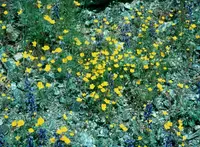
Tufted poppy, Eschscholzia caespitosa, is a small annual wildflower in the poppy family, related to the California poppy. It forms low, compact clumps with finely divided, bluish-green foliage and produces bright yellow, cup-shaped flowers. Plants often grow in rocky or sandy openings, dry slopes, and grasslands in western North America.
This species thrives in sunny, open sites with well-drained, low-fertility soils and does not tolerate heavy, wet conditions. It reseeds easily where it is happy, which makes it relatively simple to care for tufted poppy in dry, mild climates.

Care Difficulty
Easy Care

Light Preference
Full Sun

Water Requirements
Low Water

Temperature Preference
Cool Climate

Hardiness Zone
6–10

Soil Texture
Sandy, Loamy, Rocky

Soil pH
Slightly acidic (6.5–7.0), Neutral (7.0)

Soil Drainage
Well-drained

Fertilization
Minimal (feed rarely)
Scan your plant to receive care tips personalized for your specific plant
Available on iOS and Android
This species thrives in bright, open sites with strong sun exposure.
This drought-adapted annual prefers infrequent, light watering once established.
This plant favors mild, dry conditions and tolerates a moderate range of temperatures.
Humidity is not a significant factor for Eschscholzia caespitosa, which is well adapted to dry air.
Eschscholzia caespitosa prefers light, fast-draining mineral soils that do not stay wet after rain or watering.
This species can be grown in containers if the pot is set up to drain and dry quickly.
Eschscholzia caespitosa usually thrives in lean soil and needs minimal feeding, especially in the ground.
Eschscholzia caespitosa benefits from light, simple pruning to maintain flowering and a neat mound.
This species dislikes root disturbance, so transplanting should be minimal and carefully timed.
New Eschscholzia caespitosa plants are most reliably produced from seed rather than vegetative methods.
In many climates this poppy behaves as an annual and needs little specific winter care.

Plant Health Check
Not sure what's wrong with your plant? Check your plant's health inside the app.
This species grows as a compact tuft of finely divided foliage rather than a single tall stem, a growth form that helps it withstand dry, open habitats in western North America.
The yellow flowers typically open fully in bright sun and close in the evening or during cloudy, cool, or very windy conditions, a pattern that reduces damage to pollen and reproductive structures.
Populations are known from serpentine-derived soils, which are low in nutrients and high in heavy metals, indicating a notable tolerance for chemically stressful substrates compared with many neighboring species.

This species is an important component of some California grassland and foothill wildflower communities, often forming dense local displays that support native pollinators such as solitary bees and small beetles early in the dry-season transition.
This species self-seeds freely in open soil but is not usually aggressive. Seedlings are easy to thin or remove. In mixed beds, leaving some bare ground encourages natural drifts without becoming difficult to manage.
Keep your plants happy and healthy with plant identification, disease detection, and easy care guidance.