Indonesian gum Care (Eucalyptus deglupta)

Also known as: Rainbow Eucalyptus, Rainbow Gum, Mindanao Eucalyptus, Mindanao Gum
Indonesian gum

About Indonesian gum

Indonesian gum, Eucalyptus deglupta, is a fast-growing evergreen tree known for its striking, multicolored bark that peels in patches of green, orange, and reddish brown. It has a tall, upright growth habit and forms a straight trunk with a high canopy in suitable climates.

This species naturally occurs in tropical lowland rainforests of Indonesia, Papua New Guinea, and the southern Philippines. It prefers warm, humid conditions with consistent moisture and well-drained soil.

Due to its size, tropical needs, and sensitivity to cold, it is challenging to grow outside frost-free regions. Understanding how to care for Indonesian gum is important before planting, especially in non-tropical gardens.

Main Plant Requirements

Care Difficulty

Hard Care

Light Preference

Full Sun

Water Requirements

Regular Water

Temperature Preference

Tropical / Frost Sensitive

Hardiness Zone

10–11

Soil Texture

Sandy, Loamy, Organic-rich

Soil pH

Acidic (5.5–6.5), Slightly acidic (6.5–7.0)

Soil Drainage

Moist but well-drained

Fertilization

Minimal (feed rarely)

Get Personalized Care Plan

Scan your plant to receive care tips personalized for your specific plant

Available on iOS and Android

How to Care for the Indonesian gum

Eucalyptus deglupta grows best in strong, direct light typical of tropical and subtropical climates.

  • Provide full sun for 6–8 hours per day; young trees benefit from morning sun with some protection from intense late-afternoon exposure in very hot, dry regions.
  • It tolerates light, high shade from taller trees, but dense shade leads to weak, leggy growth and duller trunk color on Indonesian gum.
  • In cloudy or short-day seasons, ensure the planting site is as open as possible, avoiding north-facing walls or deep shade from buildings.

This fast-growing tree prefers evenly moist but fast-draining soil, especially while young.

  • For in-ground trees, water deeply when the top 5–8 cm of soil feels dry, then allow excess to drain fully before the next irrigation.
  • Reduce frequency in cool or rainy seasons to avoid waterlogged conditions, which can cause root rot, yellowing leaves, and dieback at branch tips.
  • Increase watering during hot, dry periods if leaves start to curl or droop by midday, but improve drainage if you notice standing water or sour-smelling soil.

This species thrives in consistently warm, frost-free climates with modest seasonal variation.

  • Ideal growth occurs around 70–90°F (21–32°C), where rapid shoot and trunk development is supported for most of the year.
  • Avoid exposure below 40°F (4°C); light frost can scorch young foliage, and prolonged drops near 32°F (0°C) may kill young trees.
  • Mature trees tolerate brief heat up to about 100–104°F (38–40°C) if soil moisture is maintained, but hot, dry winds increase leaf scorch risk.

This species prefers moderate to high humidity but usually adapts to typical indoor air if other needs are met.

  • Aim for 40–60% humidity; stable levels matter more than chasing very high numbers.
  • Tolerates short dry-air spells, but leaves may crisp at tips or curl slightly under prolonged low humidity.
  • Use a nearby tray with pebbles and water or group plants together to raise local humidity without wetting foliage.

Eucalyptus deglupta grows best in loose, fast-draining, slightly acidic to neutral soil that still holds some moisture.

  • Use a mix of roughly 50% loam or compost, 30% coarse sand, and 20% perlite or fine bark to balance moisture retention and drainage.
  • Ensure water drains through the profile within a few seconds; soggy or compacted soil encourages root rot and weak growth.
  • Target pH around 6.0–7.0; avoid strongly alkaline mixes that can limit nutrient uptake and cause leaf yellowing.
  • Break up heavy clay with coarse sand and bark, or grow in raised beds or containers where texture and aeration can be controlled.

This species can be grown in containers when kept young or pruned, but it requires careful management due to its vigorous growth.

  • Choose a deep, heavy pot that reduces tipping risk as the plant becomes tall and wind-sensitive.
  • Select a container material that matches your climate; terracotta helps prevent waterlogging in wet regions, while thick plastic retains moisture in hotter, drier areas.
  • Elevate the pot slightly on blocks or feet so drainage holes stay clear and excess water exits quickly after rain or irrigation.

Eucalyptus deglupta grows fast and benefits from light, balanced feeding in active growth.

  • Apply a balanced slow-release fertilizer (around 10-10-10) once in early spring for in-ground trees.
  • For containers, use a half-strength balanced liquid feed every 4–6 weeks during the warm growing season.
  • Avoid high-nitrogen lawn fertilizers near roots, which can cause weak, lanky shoots.
  • Stop feeding in late summer to let growth harden before winter and reduce cold damage risk.

Eucalyptus deglupta responds well to careful structural pruning when young.

  • Carry out main pruning in late winter or very early spring before vigorous growth starts.
  • Remove dead, damaged, rubbing, or crossing branches to improve airflow and light penetration.
  • Select a single strong leader if a tall tree form is desired; shorten competing stems early.
  • Use clean, sharp bypass pruners or a pruning saw, making smooth cuts just outside the branch collar.

This fast-growing tree is usually transplanted from containers to the ground while still young.

  • Transplant in spring when soil is warming and the risk of hard frost has passed.
  • Shift on when roots circle the pot base or growth slows, usually every 1–2 years in youth.
  • Choose a hole 2–3 times wider than the root ball, set the tree at the same depth, and backfill with native soil.
  • Water deeply after planting and keep evenly moist for the first season to limit transplant shock.

Eucalyptus deglupta is most often propagated from seed under warm, bright conditions.

  • Sow fresh seed in late winter–spring in a sterile, free-draining mix kept at 70–75°F.
  • Press seed lightly onto the surface, as light improves germination, and keep the medium just moist.
  • Provide bright, indirect light and good air movement to reduce fungal problems in seedlings.
  • Move seedlings into individual pots once they have several true leaves and a firm root system.

Indonesian gum is frost tender and needs careful winter management in most temperate climates.

  • In USDA zones colder than 10, grow Eucalyptus deglupta in large containers and overwinter indoors.
  • Maintain indoor temperatures above 45–50°F with bright light and reduced watering in winter.
  • For marginal climates outdoors, apply a 5–8 cm mulch layer around the root zone, keeping it off the trunk.
  • Shelter young trees from cold winds using windbreaks or temporary frost cloths during rare cold events.

Care Tips

Root-zone management

Plant into a deep, open site and avoid root disturbance after the first year, since stable, undisturbed roots help this fast-growing tree anchor safely and reduce windthrow risk as it matures.

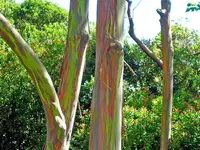
Trunk color enhancement

To promote vivid trunk striping, keep lower branches pruned cleanly over several years and maintain even moisture, as consistent growth and light on the main stem make the bark color changes more pronounced.

Wind and staking strategy

Provide a single, sturdy stake only during the first 1–2 years and allow some movement in the trunk so it can thicken naturally, then remove the stake to prevent a weak, top-heavy structure.

Spacing for canopy health

Allow at least 6–8 ft of clearance to other trees or structures to reduce competition, improve airflow, and limit disease pressure on the foliage and trunk.

Mulch and trunk protection

Apply a 5–8 cm ring of coarse organic mulch around the root zone but keep it 5–8 cm away from the trunk to retain soil moisture while preventing bark rot and pests, which is especially helpful when caring for Indonesian gum in warm, wet regions.

Common Pests and Diseases

Myrtle rust

This disease causes bright yellow powdery pustules on young leaves, shoots, and stems, often followed by leaf distortion, dieback, and defoliation. Symptoms include reduced growth and malformed new flushes, especially in humid, warm conditions.

Solution

Remove and destroy heavily infected shoots to slow spread, and avoid overhead watering to keep foliage as dry as possible. Improve spacing and airflow, and in high‑risk outdoor plantings follow local guidelines for fungicide use registered for myrtle rust, applying thoroughly to young susceptible growth.

Leaf blight

This disease produces brown to dark purple leaf spots that can expand into irregular blighted patches, sometimes with a yellow halo, leading to premature leaf drop on young Eucalyptus deglupta trees. Symptoms include thinning foliage and reduced vigor under prolonged wet conditions.

Solution

Prune and discard affected leaves and twigs, disinfecting tools between cuts to limit spread. Reduce leaf wetness by improving drainage and airflow, water at soil level, and in persistent cases use an appropriate copper- or chlorothalonil-based fungicide according to label directions for myrtaceous trees.

Longhorn borer

These insects bore into stems and trunks, creating galleries in the wood that can cause branch dieback, frass deposits, and structural weakness. Symptoms include oozing sap, exit holes, and sudden wilting of affected branches.

Solution

Promptly prune and destroy infested branches to remove larvae before they complete development, and keep trees unstressed with proper watering and nutrition to reduce susceptibility. For valuable landscape trees, consider trunk or systemic insecticide treatments applied by a licensed professional in regions where eucalyptus borers are established.

Psyllids

These insects feed on sap from tender leaves and shoots, causing leaf curling, pitting, and sticky honeydew that may lead to sooty mold. Symptoms include distorted new growth and fine, white or waxy secretions on the undersides of leaves.

Solution

Hose down foliage with a strong water spray to dislodge nymphs, and prune out heavily infested new growth. Encourage natural predators such as lady beetles, and if needed use insecticidal soap or horticultural oil, making thorough contact with the undersides of leaves while avoiding application in full, hot sun.

Scale insects

These insects appear as small, immobile bumps on stems and leaves, slowly weakening the tree by removing sap and producing honeydew. Symptoms include yellowing leaves, reduced growth, and black sooty mold growing on the honeydew deposits.

Solution

Wipe or gently scrape off accessible scales from small plants, and prune heavily infested twigs. For larger trees, apply horticultural oil during mild weather to smother scale insects, repeating as necessary, and maintain tree health through proper watering and fertilization as part of broader Eucalyptus deglupta care instructions.

Interesting Facts

Naturally deciduous eucalyptus

Unlike most tropical eucalypts, this species can shed all its leaves during dry or cool periods, then quickly reflushes a full canopy once favorable conditions return.

Bark color from pigments

The rainbow trunk effect comes from successive bark layers with differing amounts of chlorophyll and other plant pigments that are exposed as outer strips peel away at different times.

Restricted native range

Although widely planted in tropical regions, it is naturally native only to parts of the Philippines, Sulawesi, New Guinea, and nearby islands, where it typically grows along rivers and in lowland rainforests.

Botan icon

Did you know?

It is one of the very few eucalyptus species that can thrive in true lowland tropical rainforest conditions, making it unusual in a genus otherwise dominated by species adapted to seasonal drought and fire.

FAQs about Indonesian gum

This species is extremely fast-growing, often adding 1.5–3 m per year in ideal tropical or subtropical conditions. Growth slows in cooler or drier climates, in poor soils, or when grown in restricted root space such as containers.

Grow Healthy Plants with Botan Care

Keep your plants happy and healthy with plant identification, disease detection, and easy care guidance.

Botan plant care app — identify plants on mobile

Explore More Plants