Handle Sap Safely
Use gloves and avoid touching your face when cutting or pulling stems, as the milky sap can irritate skin and eyes and tools should be rinsed after use to prevent residue buildup.

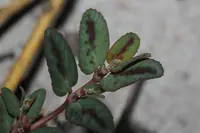
Euphorbia abramsiana, commonly called Abrams' sandmat, is a small, short-lived herb in the spurge family. It usually forms low, spreading mats close to the ground with tiny leaves and inconspicuous, greenish flowers.
This species is native to arid and semi-arid regions of the southwestern United States, often appearing in sandy or disturbed soils. It tends to be a tough, opportunistic plant that germinates quickly after moisture, then completes its life cycle as conditions dry.
Because it is adapted to poor, dry soils and strong sun, it is generally not demanding in cultivation. Gardeners who want to care for Abrams' sandmat should focus on providing sharp drainage and avoiding prolonged, heavy watering.

Care Difficulty
Easy Care

Light Preference
Full Sun

Water Requirements
Low Water

Temperature Preference
Warm Climate

Hardiness Zone
8–11

Soil Texture
Sandy, Loamy, Rocky

Soil pH
Slightly acidic (6.5–7.0), Neutral (7.0)

Soil Drainage
Well-drained

Fertilization
Minimal (feed rarely)
Scan your plant to receive care tips personalized for your specific plant
Available on iOS and Android
This small annual spurge prefers bright, open conditions similar to its native sandy habitats.
This drought-adapted annual prefers infrequent, deeper watering over frequent light applications.
This desert-adapted annual thrives in warm, dry conditions and struggles in prolonged cold or frost.
This small annual euphorbia tolerates a wide humidity range but prefers relatively dry air.
This species prefers very well-drained, sandy to gravelly mineral soil that mimics its native open habitats.
This low, spreading plant is suitable for container growing, especially in shallow, fast-draining pots outdoors.
This small annual Euphorbia from nutrient-poor habitats needs only minimal feeding in cultivation.
Pruning needs for Euphorbia abramsiana are low and mainly focused on cleanliness and shape.
This species is usually grown outdoors, so care focuses more on careful transplanting than frequent repotting.
Propagation of this annual Euphorbia is most practical from seed rather than vegetative methods.
This annual species usually completes its life cycle before winter and needs little specific cold-season care.

Plant Health Check
Not sure what's wrong with your plant? Check your plant's health inside the app.
This species is a very small, short-lived annual native to arid regions of the southwestern United States and northern Mexico, often completing its entire life cycle quickly after seasonal rains.
It typically grows in sparsely vegetated, sandy or gravelly soils such as desert flats and washes, where it occupies small open patches between larger desert plants.
This plant belongs to a taxonomically challenging group of sandmats, where closely related species can look very similar and often require close examination of tiny floral structures for accurate identification.
This species behaves mainly as an annual in cultivation, completing its life cycle in 1 season and dying back. In very mild, dry climates some plants may self-seed so it appears to return each year from new seedlings.
Keep your plants happy and healthy with plant identification, disease detection, and easy care guidance.