Segment support
Use a low ring stake or a few small stones to gently support older clustered stems so they do not snap at the base when the pot is moved or bumped.

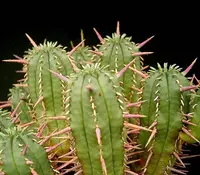
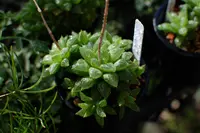
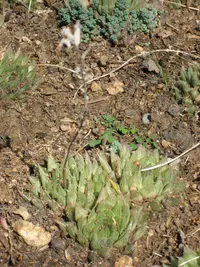
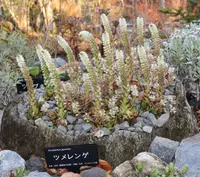
Euphorbia pulvinata, often traded as Euphorbia aggregata, is a compact, clustering succulent from arid regions of South Africa. It forms dense cushions of short, angular, jointed stems with small spines and tiny, inconspicuous leaves. Its growth habit makes it suited to pots and shallow dishes, where it slowly forms a mound-like colony. The plant produces small yellow-green flowers typical of Euphorbia, adding seasonal interest without showiness. This species stays relatively small and grows slowly, which simplifies repotting and space management. It prefers bright light, very well-draining mineral soil, and careful watering, so understanding how to care for Euphorbia pulvinata helps prevent rot and sun damage.

Care Difficulty
Easy Care

Light Preference
Full Sun

Water Requirements
Low Water

Temperature Preference
Tropical / Frost Sensitive

Hardiness Zone
10–11

Soil Texture
Sandy, Loamy, Rocky

Soil pH
Slightly acidic (6.5–7.0), Neutral (7.0)

Soil Drainage
Well-drained

Fertilization
Minimal (feed rarely)
Scan your plant to receive care tips personalized for your specific plant
Available on iOS and Android
This succulent prefers bright, dry conditions with strong but not scorching sun.
Watering should mimic an arid climate with thorough but infrequent soakings.
This plant thrives in warm, dry conditions and dislikes prolonged cold or damp.
This species prefers dry indoor air and does not require elevated humidity.
Euphorbia aggregata needs a very fast-draining, mineral-rich mix to prevent root and stem rot.
This species is well suited to container growing when drainage and stability are prioritized.
This succulent Euphorbia benefits from modest feeding during active growth but does not need heavy fertilization.
Euphorbia aggregata needs only light, targeted pruning to keep clumps healthy and compact.
Container-grown Euphorbia aggregata prefers infrequent repotting, as it tolerates being slightly root-bound.
Euphorbia aggregata is usually propagated from stem cuttings taken during the warm growing season.
Euphorbia aggregata is not fully frost hardy and benefits from basic winter protection in colder climates.

Plant Health Check
Not sure what's wrong with your plant? Check your plant's health inside the app.
This species forms tight, many-branched cushions of 4–6 angled stems that gradually create low, irregular mounds rather than a single central column.
Its small spines are modified stipules, the tiny leaf-like structures at the base of leaves, which in this species harden into short protective prickles along the stem ribs.
The true flowers are minute and grouped into cyathia, a specialized Euphorbia floral structure, surrounded by yellowish to green nectar glands that attract pollinators despite the plant’s overall gray-green, camouflage-like coloration.
This species generally performs better outdoors in bright, dry conditions with excellent drainage. Indoors it stays smaller and needs very strong light. Euphorbia pulvinata indoor care works best near a sunny window in a cool, airy room.
Keep your plants happy and healthy with plant identification, disease detection, and easy care guidance.