Root zone spacing
When planting multiple specimens outdoors, leave at least 40–60 cm between plants so the shallow, spreading root systems are not forced to compete for limited moisture in hot, dry periods.

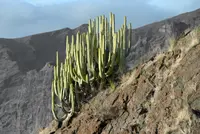
Canary Island spurge, Euphorbia canariensis, is a succulent shrub that forms tall, upright, many-branched columns resembling a cactus. It stores water in its thick, ribbed stems and has small spines along the ridges for protection.
This species is native to the Canary Islands, where it grows in dry, rocky habitats with strong sun and limited rainfall. Its drought tolerance and slow, architectural growth make it suitable for arid gardens and large containers in warm climates.
Because it prefers bright light, very well-drained soil, and minimal watering, it is relatively low-maintenance once established. Understanding these natural conditions helps explain how to care for Canary Island spurge successfully indoors or outdoors.

Care Difficulty
Easy Care

Light Preference
Full Sun

Water Requirements
Low Water

Temperature Preference
Tropical / Frost Sensitive

Hardiness Zone
10–12

Soil Texture
Sandy, Loamy, Rocky

Soil pH
Slightly acidic (6.5–7.0), Neutral (7.0)

Soil Drainage
Well-drained

Fertilization
Minimal (feed rarely)
Scan your plant to receive care tips personalized for your specific plant
Available on iOS and Android
This sun-loving succulent thrives in bright, exposed conditions that mimic its native Canary Islands habitat.
This drought-adapted succulent stores water in its thick stems and prefers infrequent, deep watering.
This species prefers warm, dry conditions and is sensitive to prolonged cold and frost.
This cactus-like succulent prefers dry air and does not need extra humidity.
This species needs a very fast-draining, mineral-rich substrate that stays airy after watering.
This species is suitable for container growing, especially in cooler climates or wet regions.
This drought-adapted succulent needs modest feeding, especially when grown in containers.
Pruning Euphorbia canariensis is mainly corrective, aimed at safety and maintaining structure.
Container-grown plants appreciate infrequent but careful repotting or transplanting.
Propagation is usually done from cuttings, though seeds are also possible for patient growers.
Cold-sensitive plants need thoughtful winter management, especially outside warm climates.

Plant Health Check
Not sure what's wrong with your plant? Check your plant's health inside the app.
This species is one of the characteristic shrubs of the lower dry zones of the Canary Islands and contributes strongly to the visual identity of the islands’ coastal landscapes, sometimes forming large, almost pure stands.
Its stems contain a white, irritant latex that is poisonous if ingested and can cause skin and eye irritation, a typical feature of the Euphorbia genus but especially relevant here because of the plant’s large, exposed surface.
The plant produces small capsules whose seeds are eaten and dispersed by birds, which helps maintain its populations across rocky slopes and coastal cliffs where soil is shallow and patchy.

The species is considered part of the substance and scenery of the Canary Islands and is legally protected within several natural areas because of its ecological importance and its role in defining the native arid vegetation.
Sparse or absent flowering often comes from insufficient light, cool temperatures, or immature age. This species blooms best when mature, consistently warm, and sun-exposed, with lean, well-drained substrate and no heavy fertilizing that encourages only vegetative growth.
Keep your plants happy and healthy with plant identification, disease detection, and easy care guidance.