Rodent protection
In outdoor beds, place a narrow ring of coarse gravel or small stones around the crown to discourage rodents from chewing the fleshy stems and roots during winter dormancy.

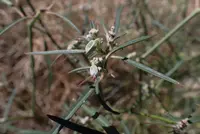
Euphorbia eriantha, commonly called beetle spurge, is a small, drought-adapted perennial from arid regions of the southwestern United States and northern Mexico. It usually forms low, branching clumps with narrow leaves and modest, greenish flowering structures typical of many Euphorbia species.
The plant is adapted to hot, dry habitats and poor, rocky or sandy soils, which makes it suitable for low-water landscapes and naturalistic plantings. Its toughness and modest size can make it relatively straightforward to care for beetle spurge if its need for sharp drainage and dry conditions is respected.
In cultivation it generally prefers full sun, infrequent watering, and soil that does not stay wet for long periods.

Care Difficulty
Easy Care

Light Preference
Full Sun

Water Requirements
Low Water

Temperature Preference
Warm Climate

Hardiness Zone
8–11

Soil Texture
Sandy, Loamy, Rocky

Soil pH
Slightly acidic (6.5–7.0), Neutral (7.0)

Soil Drainage
Well-drained

Fertilization
Minimal (feed rarely)
Scan your plant to receive care tips personalized for your specific plant
Available on iOS and Android
Euphorbia eriantha thrives in bright, direct sun similar to arid, open habitats.
This drought-adapted species prefers infrequent, deep watering and fast-drying soil.
This species prefers warm, arid conditions and does not tolerate hard frost.
This species tolerates typical indoor humidity but grows best in dry to moderately dry air around 30–50%.
This desert euphorbia needs a very fast-draining, mineral-based substrate to prevent root rot.
This species is well suited to container growing when provided with a stable, sharply draining setup.
This drought-adapted species needs only light feeding to maintain healthy growth in cultivation.
Pruning Euphorbia eriantha is mainly corrective, aimed at maintaining a clean, compact form.
This species prefers stable conditions and only occasional repotting or transplanting.
Propagation of Euphorbia eriantha is usually done from cuttings or seeds under warm, dry, bright conditions.
Established plants are relatively cold tolerant but still benefit from simple winter precautions, especially in containers.

Plant Health Check
Not sure what's wrong with your plant? Check your plant's health inside the app.
This species is native to arid regions of the Chihuahuan Desert in northern Mexico and the southwestern United States, where it grows on rocky slopes and gravelly soils with very low organic matter.
Its seed capsules are covered with conspicuous, stiff hairs, which is the feature referenced by the epithet eriantha, meaning woolly-flowered or hairy-flowered, and helps distinguish it from many other spurge species in the region.
In habitat it behaves as a short-lived perennial or sometimes annual, taking advantage of brief periods of moisture to grow and flower quickly before intense heat and drought return.
The milky sap is toxic and irritating. Contact can cause skin redness or eye injury, and ingestion may trigger vomiting or diarrhea in pets and children. Always handle with gloves and keep cut stems away from animals.
Keep your plants happy and healthy with plant identification, disease detection, and easy care guidance.