Encourage Dense Mats
Pinch or lightly clip back overly long runners in late spring to stimulate branching and create a tighter, more weed-suppressing groundcover.

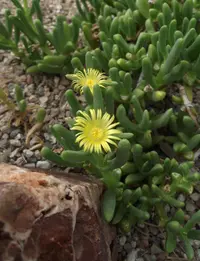
Rocky point ice plant (Malephora lutea) is a low-growing, mat-forming succulent often used as a groundcover in dry, sunny landscapes. It forms dense carpets of fleshy, cylindrical leaves that store water and showy yellow daisy-like flowers that attract pollinators. Native to arid coastal areas of South Africa, it is adapted to hot, dry conditions and poor, sandy or rocky soils. This species suits gardeners looking to care for rocky point ice plant with minimal watering and maintenance in frost-free climates. It prefers full sun, sharp drainage, and is generally easy to grow where winters are mild and soils do not stay wet.

Care Difficulty
Easy Care

Light Preference
Full Sun

Water Requirements
Low Water

Temperature Preference
Warm Climate

Hardiness Zone
9–11

Soil Texture
Sandy, Loamy, Rocky

Soil pH
Slightly acidic (6.5–7.0), Slightly alkaline (7.0–7.5)

Soil Drainage
Well-drained

Fertilization
Minimal (feed rarely)
Scan your plant to receive care tips personalized for your specific plant
Available on iOS and Android
Malephora lutea thrives in bright, direct sun for dense growth and flowering.
Malephora lutea is a drought-tolerant succulent that prefers infrequent, deep watering.
This succulent prefers warm, dry conditions and is sensitive to hard frost.
This succulent tolerates a wide humidity range and usually does not need special humidity control.
Soil for Malephora lutea must be very fast-draining to prevent root rot.
This species is well suited to containers, especially shallow, wide pots or troughs.
This drought-tolerant succulent needs only light feeding to maintain healthy growth and flowering.
Pruning helps Malephora lutea stay compact, dense, and floriferous in garden beds or containers.
This groundcover succulent is usually transplanted outdoors rather than frequently repotted.
Malephora lutea is commonly multiplied from stem cuttings, which root quickly in the right conditions.
This plant is only moderately frost tolerant and needs attention in colder climates.

Plant Health Check
Not sure what's wrong with your plant? Check your plant's health inside the app.
This species is known for its vivid, golden-yellow, daisy-like flowers that open fully in strong sunlight and partially close in low light, an adaptation that protects reproductive structures from excess moisture and low temperatures.
Its fleshy, water-storing leaves show high tolerance to drought and coastal salt spray, which is why it can persist on exposed, sandy, or rocky seaside slopes where many non-succulent plants fail.
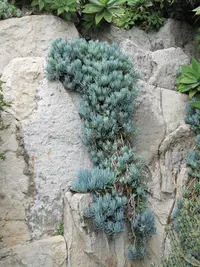
The dense, mat-forming growth habit and shallow, fibrous roots help stabilize loose, well-drained soils, so it is often used in low-water landscaping on banks and retaining walls in Mediterranean and coastal climates.
This species forms a low, spreading mat but is not usually aggressive in dry, poor soils. In warmer coastal climates with minimal competition it can spread more quickly, so use edging or barriers near delicate plantings if needed.
Keep your plants happy and healthy with plant identification, disease detection, and easy care guidance.