Safety-aware handling
Wear gloves and long sleeves when pruning or repotting, and keep paper towels ready to immediately blot and discard any milky sap, which is a skin and eye irritant.

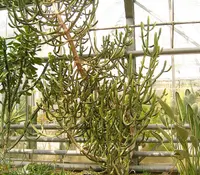
Lowveld naboom (Euphorbia evansii) is a shrubby succulent from southern Africa, where it grows in warm, rocky lowveld regions. It forms many upright, often irregular branches with sparse leaves and a distinctive, sculptural outline. Its stems store water, so the plant tolerates short dry spells and suits low-maintenance collections. However, like many Euphorbia species, it has milky sap that requires careful handling and stable conditions. In cultivation, it prefers bright light, good air movement, and fast-draining, mineral-rich soil. Understanding these features makes it easier to know how to care for Lowveld Naboom at home.

Care Difficulty
Moderate Care

Light Preference
Full Sun

Water Requirements
Low Water

Temperature Preference
Warm Climate

Hardiness Zone
9–11

Soil Texture
Sandy, Loamy, Rocky

Soil pH
Slightly acidic (6.5–7.0), Neutral (7.0)

Soil Drainage
Well-drained

Fertilization
Minimal (feed rarely)
Scan your plant to receive care tips personalized for your specific plant
Available on iOS and Android
This succulent shrub prefers strong light but needs some protection from harsh extremes.
This drought-tolerant species needs infrequent but thorough watering in fast-draining soil.
This species thrives in warm, dry conditions and is sensitive to frost and prolonged cold.
This species handles typical indoor humidity well and rarely needs special adjustments.
Euphorbia evansii prefers a fast-draining, mineral-based substrate that mimics arid, rocky habitats.
This species is well suited to container growing when the pot is chosen to control moisture and support its structure.
Euphorbia evansii benefits from light, controlled feeding rather than heavy fertilization.
Pruning Euphorbia evansii is mainly done to maintain a stable framework and remove problem growth.
This species is usually grown in the ground, so focus on careful transplanting rather than frequent repotting.
Propagation of Euphorbia evansii is commonly done from semi-woody stem cuttings taken in warm seasons.
This species is sensitive to hard frost, so winter care focuses on temperature management and soil drainage.

Plant Health Check
Not sure what's wrong with your plant? Check your plant's health inside the app.
This species is naturally restricted to rocky cliffs and steep slopes in the Lowveld region of South Africa, where it roots into narrow crevices with very fast‑draining, mineral soils.
In habitat it forms a small, much‑branched succulent shrub to low tree rather than a typical cactus‑like column, with water‑storing green stems and reduced leaves that are quickly shed during dry periods.
Like many members of the genus, it produces a copious white latex rich in toxic diterpenoid compounds, which strongly discourage browsing by mammals in its native savanna and bushveld environments.
Yes. The milky sap is toxic and irritating to skin, eyes, and mucous membranes. Ingestion can cause vomiting, diarrhea, and mouth irritation. Always handle with gloves, keep away from children and pets, and avoid sap contact.
Keep your plants happy and healthy with plant identification, disease detection, and easy care guidance.