Latex-safe handling
Wear disposable gloves and long sleeves when cutting or repotting, and keep the milky sap off skin, eyes, pets, and work surfaces by placing the plant on a washable tray or plastic sheet before starting.

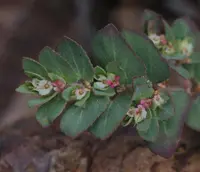
Royal sandmat (Euphorbia indivisa) is a small, drought-tolerant succulent shrub from arid regions of the southwestern United States and northern Mexico. It typically forms low, branching mounds with narrow leaves and small, inconspicuous flowers surrounded by colorful bracts.
This species is adapted to full sun, lean, fast-draining soils, and low rainfall, which makes it well suited to rock gardens and xeriscapes. Its slow to moderate growth and tough constitution appeal to gardeners who prefer minimal-maintenance plants, though young specimens need careful establishment. Understanding how to care for royal sandmat starts with respecting its need for strong light, good drainage, and dry spells between waterings.

Care Difficulty
Moderate Care

Light Preference
Full Sun

Water Requirements
Low Water

Temperature Preference
Warm Climate

Hardiness Zone
9–11

Soil Texture
Sandy, Loamy, Rocky

Soil pH
Slightly acidic (6.5–7.0), Neutral (7.0)

Soil Drainage
Well-drained

Fertilization
Minimal (feed rarely)
Scan your plant to receive care tips personalized for your specific plant
Available on iOS and Android
This sun-loving succulent thrives in bright, open exposures with protection from extreme afternoon heat.
This drought-tolerant succulent prefers infrequent, deep watering in sharply drained soil.
This species prefers warm, dry conditions and is sensitive to frost and prolonged cold.
Humidity is rarely a concern for Euphorbia indivisa, which thrives in relatively dry air.
This species needs a sharply draining, mineral-lean substrate to prevent root and stem rot.
This species is suitable for container growing if the pot prioritizes rapid drainage and root stability.
This drought-adapted species needs only light feeding, as many native plants grow well in lean soils.
Pruning Euphorbia indivisa is mainly about sanitation and maintaining a stable, compact form.
This species is usually grown in the ground, so focus on careful transplanting rather than frequent repotting.
Propagation of Euphorbia indivisa is possible but somewhat specialized and usually done from seeds.
Winter care depends on local climate, as this Euphorbia prefers mild, relatively dry conditions.

Plant Health Check
Not sure what's wrong with your plant? Check your plant's health inside the app.
This species is naturally restricted to a small area of south‑central Texas, where it grows on specific limestone-derived soils and does not occur naturally outside this region.
In the wild it is typically found on thin, rocky soils over limestone, often on exposed slopes and outcrops, indicating strong adaptation to high light and rapid drainage.
Like many spurges, it produces a white latex sap that is irritating and potentially toxic if ingested or if it contacts skin or eyes, which likely helps deter herbivores in its native habitat.
Poor flowering usually relates to insufficient light, nutrient imbalance, or stress from recent repotting or pruning. Check that it receives enough brightness, avoid heavy nitrogen feeding, and keep conditions stable for several weeks to restore normal bloom production.
Keep your plants happy and healthy with plant identification, disease detection, and easy care guidance.