Rotate for symmetry
Rotate the pot 90° every 2–3 weeks so the plant receives light from all sides and develops an even, compact globe instead of leaning toward the brightest direction.

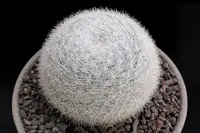
Mammilloydia, commonly treated as Mammillaria candida, is a small globular cactus known for its dense white spines that give it a frosted, snowball-like appearance. Plants usually stay compact and may form small clusters over time.
This species is native to arid regions of northern and central Mexico, where it grows in rocky, well-drained habitats with strong sun and low rainfall. Its drought tolerance and slow growth make it relatively easy to care for Mammilloydia if watering is controlled.
It prefers bright, direct light, very free-draining mineral soil, and infrequent watering that allows the roots to dry between soakings. These traits suit indoor windowsills and dry, sunny spaces when protected from prolonged cold and excess moisture.

Care Difficulty
Easy Care

Light Preference
Full Sun

Water Requirements
Low Water

Temperature Preference
Warm Climate

Hardiness Zone
9–11

Soil Texture
Sandy, Loamy, Rocky

Soil pH
Slightly acidic (6.5–7.0), Neutral (7.0)

Soil Drainage
Well-drained

Fertilization
Minimal (feed rarely)
Scan your plant to receive care tips personalized for your specific plant
Available on iOS and Android
This small cactus prefers bright, direct light that mimics open desert conditions.
Watering for this cactus must stay on the dry side to prevent root and stem rot.
This species prefers warm, dry air with a distinct cooler, but not freezing, winter rest period.
This cactus prefers dry air and rarely suffers from low household humidity.
Mammillaria candida needs a very fast-draining, mineral-based substrate to prevent root rot.
This species is very suitable for container growing.
This cactus needs only light feeding, as many native desert plants grow well in lean soils.
Pruning needs are minimal and mainly focus on hygiene rather than shaping this small cactus.
This slow-growing cactus prefers infrequent repotting in a snug, shallow container with fast-draining soil.
This species is commonly propagated from offsets and seeds under warm, bright, and dry-leaning conditions.
Cool, dry winter conditions encourage compact growth and flowering in Mammilloydia relatives like Mammillaria candida.

Plant Health Check
Not sure what's wrong with your plant? Check your plant's health inside the app.
This species forms a dense, white covering of fine spines that almost completely hides the green stem, an adaptation that reflects intense sunlight and reduces water loss in its native arid habitats of northeastern Mexico.
Mature plants gradually produce many offsets from the base, creating tight, rounded cushions that can span a considerable area on rocky slopes where the species naturally occurs.
In spring to early summer, it produces a ring of small, pale to deep pink funnel-shaped flowers near the stem apex, followed by elongated red fruits that often persist decoratively for months.

Mammillaria candida has been widely used in horticulture as a parent in breeding ornamental Mammillaria hybrids, valued for its dense white spination and compact, clustering growth that strongly influence the appearance of its cultivated offspring.
Flowering is reduced by insufficient light, cool temperatures, or lack of a dry winter rest. Provide bright conditions, a cooler, drier period in winter, and avoid high-nitrogen fertilizer. Mature plants flower more reliably than very young specimens.
Keep your plants happy and healthy with plant identification, disease detection, and easy care guidance.