Encourage Dense Mats
Pinch back overly long or sparse stems in late spring to promote branching and a denser groundcover, and use the cuttings as stem segments for easy replanting in bare spots.

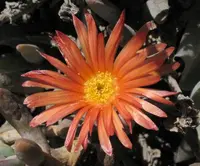
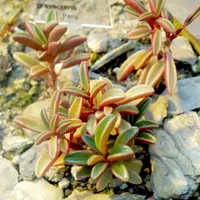
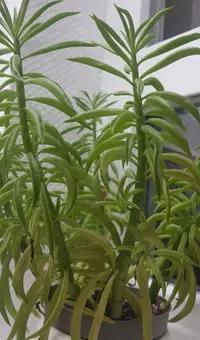
Coppery mesemb (Malephora crocea) is a low, spreading succulent groundcover from arid coastal areas of South Africa. It forms dense mats of fleshy, cylindrical leaves that store water.
In warm climates it is often used to stabilize slopes and cover dry, poor soils, producing bright orange to copper daisy-like flowers. Once established, it tolerates heat and drought very well, which makes it relatively simple to manage in low-rainfall regions.
It prefers strong light, sharply draining sandy or gravelly soil, and infrequent watering. These traits make it useful for people who want to care for coppery mesemb with limited time or irrigation.

Care Difficulty
Easy Care

Light Preference
Full Sun

Water Requirements
Low Water

Temperature Preference
Warm Climate

Hardiness Zone
9–11

Soil Texture
Sandy, Loamy, Rocky

Soil pH
Slightly acidic (6.5–7.0), Slightly alkaline (7.0–7.5)

Soil Drainage
Well-drained

Fertilization
Minimal (feed rarely)
Scan your plant to receive care tips personalized for your specific plant
Available on iOS and Android
Malephora crocea thrives in bright, direct sun and stays most compact with strong light.
This succulent prefers infrequent, deep watering and dry soil between waterings.
This species handles heat well but is sensitive to hard frost and prolonged cold.
Malephora crocea handles a wide humidity range and rarely needs special humidity management indoors or outdoors.
This succulent needs very fast-draining, mineral-based soil to prevent root and stem rot.
This species is well suited to container growing for patios, balconies, and rock-garden displays.
Malephora crocea grows well in lean soil and needs only light feeding to maintain healthy growth and flowering.
Malephora crocea benefits from light, periodic pruning to keep the mat dense and flowering well.
This plant is usually grown as a groundcover but can handle container growth with careful transplanting when truly needed.
This succulent is commonly multiplied from stem cuttings, with seed or division used less often.
This succulent has some cold tolerance but benefits from simple winter precautions in cooler climates.

Plant Health Check
Not sure what's wrong with your plant? Check your plant's health inside the app.
This species naturally occurs on South African coastal slopes and dunes, where its dense, creeping growth helps bind sandy soils and reduce erosion in windy, salt-exposed habitats.
Malephora crocea forms succulent, water-storing leaves and has a shallow, fibrous root system that allows rapid water uptake after brief coastal rains, giving it high survival in hot, arid conditions.
Its bright orange to yellow, daisy-like flowers open mainly in strong light and provide accessible nectar and pollen for bees and other insect pollinators in otherwise sparse, dry environments.

Outside its native range, this plant has naturalized in some Mediterranean-climate regions, where its ability to spread vegetatively from stem fragments has raised invasive potential concerns near fragile coastal habitats.
This species forms a low, mat-like ground cover that spreads steadily but is usually not aggressive in well-managed gardens. It can edge into neighboring spaces, so use edging or periodic trimming where tight boundaries are important.
Keep your plants happy and healthy with plant identification, disease detection, and easy care guidance.