Safe handling routine
Use nitrile gloves and long sleeves when repotting or taking cuttings, and keep paper towels or damp cloths nearby to immediately wipe off any milky sap from skin or tools to reduce irritation risk.

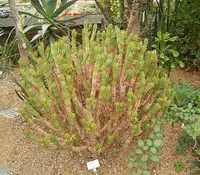
Rock barrelwort, Euphorbia heptagona, is a compact, sculptural succulent from arid regions of southern Africa. It forms clustered, many-angled, cactus-like stems with small, reduced leaves. New growth appears from the tips, slowly building a dense, geometric clump over time.
The plant stores water in its stems, which makes it tolerant of short dry periods but sensitive to overwatering. It prefers bright, indirect to sunny conditions and gritty, fast-draining soil. These traits make it interesting for collectors, but beginners should learn how to care for Rock Barrelwort before adding it to a mixed succulent display.

Care Difficulty
Moderate Care

Light Preference
Full Sun

Water Requirements
Low Water

Temperature Preference
Tropical / Frost Sensitive

Hardiness Zone
10–11

Soil Texture
Sandy, Loamy, Rocky

Soil pH
Slightly acidic (6.5–7.0), Neutral (7.0)

Soil Drainage
Well-drained

Fertilization
Minimal (feed rarely)
Scan your plant to receive care tips personalized for your specific plant
Available on iOS and Android
Euphorbia heptagona thrives in bright, predominantly sunny conditions that mimic its arid habitat.
This drought-tolerant succulent prefers infrequent, thorough watering and fast-drying soil.
This species prefers warm, dry conditions and is sensitive to prolonged cold and frost.
This succulent tolerates typical indoor humidity and rarely needs special adjustments.
This species needs a sharply drained, mineral-rich mix to prevent root and stem rot.
This species is well suited to container growing due to its compact, succulent root system.
Euphorbia heptagona is a light feeder but benefits from modest nutrition during active growth.
Euphorbia heptagona needs only light, targeted pruning to maintain a healthy, compact form.
This succulent prefers a stable pot and only occasional repotting into a slightly larger container.
Propagation of Euphorbia heptagona is most reliable from stem cuttings taken in warm months.
This species is not frost hardy and needs careful winter management in cool climates.

Plant Health Check
Not sure what's wrong with your plant? Check your plant's health inside the app.
This species forms stiff, sharply 7-angled stems with prominent ridges and grooves, which increase structural strength while minimizing surface exposed to intense sun in its native arid habitats.
Each stem angle bears dark, shield-like spine bases that occur in opposing pairs; these modified leaf structures help protect the plant from herbivores in open, dry landscapes.
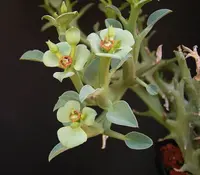
Its flowers are reduced to small cyathia, a specialized euphorbia inflorescence that mimics a single flower but is actually a tight cluster of male and female structures adapted for efficient pollination.

In its native range of southern Africa, this species often grows on rocky, well-drained slopes where its grey-green, angular stems blend visually with stone, providing effective camouflage from grazing animals.
This species generally performs better outdoors in warm, dry climates with plenty of light and excellent drainage. Indoors it stays smaller and is more prone to rot if ventilation is poor or watering is not carefully controlled.
Keep your plants happy and healthy with plant identification, disease detection, and easy care guidance.