


Stabilize the graft
Support the heavy crest by inserting a discreet stake near the base and securing it loosely with soft ties so the graft union is not stressed if the pot is bumped or during transport.

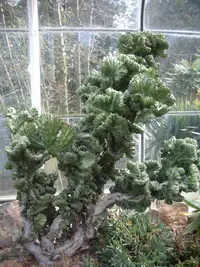
Elkhorn, Euphorbia lactea 'Cristata', is a succulent from arid regions of India and Sri Lanka, grown mainly as an ornamental houseplant. It is usually grafted onto a straight Euphorbia rootstock, forming a wavy, fan-shaped crest that looks like coral or antlers. Growth is slow and compact, so it suits small indoor spaces and containers. The plant stores water in its thick tissues, which makes it drought-tolerant but sensitive to overwatering and poor drainage. It prefers bright, indirect light, a warm environment, and a very gritty, fast-draining soil mix. With attention to watering and light, it is relatively simple to care for Elkhorn.

Care Difficulty
Moderate Care

Light Preference
Bright Indirect Light

Water Requirements
Low Water

Temperature Preference
Tropical / Frost Sensitive

Hardiness Zone
10–11

Soil Texture
Sandy, Loamy, Rocky

Soil pH
Slightly acidic (6.5–7.0), Neutral (7.0)

Soil Drainage
Well-drained

Fertilization
Minimal (feed rarely)
Scan your plant to receive care tips personalized for your specific plant
Available on iOS and Android
This succulent prefers bright, indirect light with some gentle direct sun each day.
This plant stores water in its tissues and needs infrequent but thorough watering.
This species prefers consistently warm, dry conditions without temperature extremes.
This species prefers typical indoor humidity but is not demanding.
This succulent crest needs very sharply draining, mineral-based substrate.
This plant is very suitable for container growing due to its compact root system.
This succulent crest grows best with light, controlled feeding rather than rich soil.
Pruning is mainly used to keep Euphorbia lactea 'Cristata' healthy and safely shaped.
This slow-growing succulent usually needs infrequent repotting in a well-drained cactus mix.
Propagation of this crested euphorbia is possible but moderate to advanced in difficulty due to its sap and grafted forms.
This succulent is very frost-sensitive and needs controlled winter conditions, especially in cold climates.

Plant Health Check
Not sure what's wrong with your plant? Check your plant's health inside the app.
This plant forms a fan-like, wavy crest because its stem tissue divides irregularly, a mutation known as cristation that distorts the normal cylindrical cactus-like form of typical Euphorbia lactea.
Most nursery plants are grafted, with the crested Euphorbia lactea top joined to a different Euphorbia rootstock, often Euphorbia neriifolia, which provides stronger roots and better tolerance of pot culture.
The crest often shows bands of white, gray-green, and sometimes pink or purple along the undulating ridges, a result of reduced chlorophyll and localized pigment accumulation in different tissue layers.

The milky latex of this plant contains toxic diterpenoid compounds that can cause intense skin and eye irritation, so horticultural guidelines strongly recommend gloves and eye protection when pruning or grafting specimens.
This crested form rarely flowers, especially in indoor conditions. It is grown mainly for its sculptural, fan-shaped stem. Even in ideal light and warmth, flowering is unpredictable and usually not a sign of health problems.
Keep your plants happy and healthy with plant identification, disease detection, and easy care guidance.

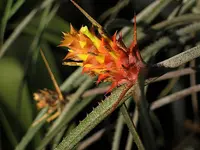
Acanthostachys strobilacea
Acanthostachys strobilacea
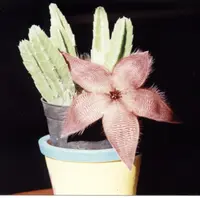
starfish flower
Stapelia hirsuta
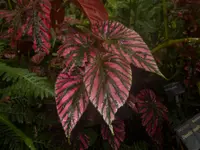
Begonia brevirimosa
Begonia brevirimosa
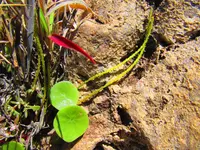
Peperomia monticola
Peperomia monticola
 POPULAR
Parlor Palm
Chamaedorea elegans
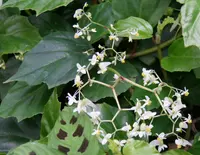
climbing sorrel
Begonia glabra

Peace Lily
Spathiphyllum 'Petite'
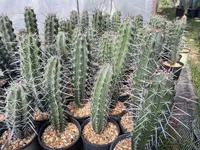
Stenocereus chacalapensis
Stenocereus chacalapensis