Euphorbia ledienii Care

Euphorbia ledienii

About Euphorbia ledienii

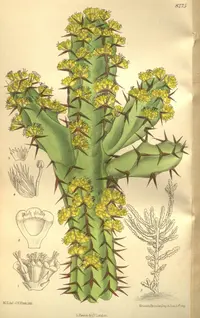
Euphorbia ledienii is a succulent shrub forming tall, upright, many-branched stems with a columnar, cactus-like look. The stems are typically ridged with small, paired spines and sparse leaves. It is native to arid regions of East Africa, where it grows in rocky, well-drained sites with intense sun and limited rainfall. This background makes it drought-tolerant and generally low-maintenance under indoor or greenhouse conditions. Understanding how to care for Euphorbia ledienii mainly involves providing strong light, infrequent but deep watering, and gritty, fast-draining soil to prevent root problems and stem rot.

Main Plant Requirements

Care Difficulty

Easy Care

Light Preference

Full Sun

Water Requirements

Low Water

Temperature Preference

Tropical / Frost Sensitive

Hardiness Zone

10–11

Soil Texture

Sandy, Loamy, Rocky

Soil pH

Slightly acidic (6.5–7.0), Neutral (7.0)

Soil Drainage

Well-drained

Fertilization

Minimal (feed rarely)

Get Personalized Care Plan

Scan your plant to receive care tips personalized for your specific plant

Available on iOS and Android

How to Care for the Euphorbia ledienii

This succulent prefers bright conditions with some protection from harsh midday sun.

  • Provide 6–8 hours of bright light daily, ideally with morning sun and light afternoon shade, especially in hot, dry climates.
  • Outdoors, choose an open spot with filtered light during 11 a.m.–3 p.m. to prevent stem scorch and bleaching; indoors, place near a south- or west-facing window with sheer curtain.
  • If stems elongate, lean, or lose strong color, light is too low; if tissue yellows or crisps on the sunward side, reduce direct sun exposure.

This drought-tolerant species stores water in its stems and needs infrequent, controlled watering.

  • Allow the top 3–5 cm (1–2 in) of soil to dry completely before watering; in warm active growth this may mean roughly every 10–21 days depending on climate and soil.
  • In winter or cool, low-light periods, reduce watering sharply and only water when the soil is fully dry and stems begin to look slightly less turgid.
  • Use very fast-draining, gritty soil and avoid standing water; soft, yellowing, or blackened stem bases signal overwatering, while deep wrinkling indicates prolonged drought.

This plant prefers warm, dry conditions and is sensitive to prolonged cold and frost.

  • Aim for 65–85°F (18–29°C) for steady growth; short heat waves to 95°F (35°C) are tolerated if soil is dry and airflow is good.
  • Protect from temperatures below 40°F (4°C); brief dips to about 32°F (0°C) may damage tissue, and hard frost can kill exposed tips or entire plants.
  • In regions with cold winters, keep Euphorbia ledienii in a frost-free position and avoid sudden temperature swings near open windows, vents, or exterior doors.

This species handles typical indoor humidity well and rarely needs special adjustments.

  • Ideal humidity is 30–50%, similar to most heated or air-conditioned homes.
  • It tolerates dry air; wrinkling or softening of stems usually indicates watering issues, not low humidity.
  • If air is extremely dry and hot, spacing plants apart and improving air flow helps prevent fungal or rot problems.

Euphorbia ledienii prefers a lean, very fast-draining, mineral-based substrate similar to cactus mixes.

  • Use a gritty mix such as 50% cactus potting mix with 30% coarse sand and 20% pumice or perlite for strong aeration.
  • Aim for slightly acidic to neutral pH around 6.0–7.0, which supports nutrient availability without encouraging rot.
  • Ensure water drains through in seconds; compact, peaty, or water-retentive substrates quickly cause root and stem decay.
  • To improve drainage in heavier mixes, increase the proportion of coarse, inorganic particles like pumice, lava rock, or chicken grit.

This species is well suited to container growing due to its compact, upright, succulent habit.

  • Choose a heavy, stable pot if the plant becomes tall and top-heavy so it does not tip over in wind or from accidental bumps.
  • Select a pot only slightly wider than the root ball to reduce the volume of wet mix surrounding drought-adapted roots.
  • Use containers with large, unobstructed drainage holes so water exits quickly and does not pool at the base of the stems.

This drought-tolerant succulent needs only light feeding to support steady growth.

  • Use a balanced liquid cactus or succulent fertilizer at 1/4–1/2 strength during active growth in spring–summer.
  • Apply every 4–6 weeks, only to moist soil, to avoid root burn in Euphorbia ledienii.
  • Skip compost-heavy mixes that stay wet; choose low-organic, gritty substrates instead.
  • Reduce or stop feeding in fall–winter when growth slows or stops.

Pruning is mainly used to keep this shrub-shaped succulent compact and remove damaged tissue.

  • Carry out light pruning in late spring or early summer when growth is active.
  • Remove dead, damaged, or crossing branches to improve structure and light penetration.
  • Shorten overly tall or leaning stems to control height and encourage branching.
  • Wear gloves, use clean sharp pruners, and avoid skin contact with Euphorbia ledienii sap.

Container-grown plants benefit from infrequent but careful repotting to maintain drainage and root health.

  • Repot every 3–4 years or when roots circle the pot, growth slows, or soil drains poorly.
  • Choose late spring as the best time, matching active growth and warmer temperatures.
  • Select a slightly larger pot with ample drainage and a gritty cactus mix to minimize waterlogging stress.
  • Loosen circling roots gently, keep the root ball mostly intact, and withhold water for 2–3 days after shifting Euphorbia ledienii.

This species is usually propagated from stem cuttings rather than seed for consistent form.

  • Take semi-firm stem cuttings in late spring–summer using clean, sharp tools.
  • Allow cut ends and latex sap to dry and callus for several days in a shaded, airy spot.
  • Insert callused cuttings into a dry, gritty cactus mix, then water lightly once to settle soil.
  • Provide bright, indirect light, warm temperatures, and very sparse watering until roots form.

This succulent is frost-sensitive and requires protection in climates with cold winters.

  • In regions below 30–32°F, grow Euphorbia ledienii in containers that can be moved indoors for winter.
  • Place indoors in the brightest possible spot, with cool to mild temperatures and dry soil.
  • For in-ground plants in marginal climates, improve drainage and apply a light gravel mulch around the base.
  • Reduce watering sharply in winter to prevent cold-related root rot.

Care Tips

Stabilize Tall Stems

As stems elongate, place a narrow, breathable stake 2–3 in from the base and secure with soft ties in a loose figure-eight to prevent wind or handling damage without constricting the tissue.

Rotate For Even Form

Turn the pot 90° every 2–3 weeks so light hits different sides, which encourages symmetrical branching and reduces the risk of the plant leaning and becoming top-heavy.

Protect From Latex Sap

When pruning or removing offsets, wear nitrile gloves and eye protection, keep pets and children away, and dab fresh cuts with a dry paper towel to stop the white latex sap from spreading on skin or surfaces.

Use Mineral Topdressing

Apply a 0.5–1 in layer of clean gravel or coarse pumice on the soil surface to keep stem bases dry, reduce fungus gnat activity, and give visual feedback if water is splashing against the crown.

Plan Winter Rest

In cooler months, move the plant to the brightest available spot, avoid repotting or heavy feeding, and slightly reduce watering frequency to match its slower metabolism while still preventing prolonged root desiccation when caring for Euphorbia ledienii.

Common Pests and Diseases

Powdery mildew

This disease causes a white, talc-like coating on stems and leaves, often appearing in humid, stagnant air conditions. Symptoms include slowed growth and dull, distorted new tissue.

Solution

Improve air circulation around the plant, avoid overhead watering, and allow the soil surface to dry well between waterings. Remove heavily affected sections and treat remaining tissue with a sulfur-based or potassium bicarbonate fungicide labeled for succulents, following package directions carefully.

Corky stem canker

This disease produces sunken, brown to dark, corky lesions on the fleshy stems, often starting at previous injury sites or where water sits for long periods. Over time, affected areas may crack and distort the plant’s columnar shape.

Solution

Cut out infected tissue back to firm, healthy green stem with a sterile blade and allow the wound to callus fully in a dry, bright location. Reduce watering, avoid water sitting on stems, and if available, apply a copper-based fungicide lightly to the cut surface to reduce reinfection risk.

Mealybugs

These insects appear as white, cottony clumps tucked into stem ribs, branch junctions, and along new growth. This pest feeds on plant sap, weakening stems and leaving sticky honeydew that can attract sooty mold.

Solution

Isolate the plant, then dab visible insects with cotton swabs dipped in 70% isopropyl alcohol and repeat weekly until no new clusters appear. For larger infestations, use a systemic insecticide labeled for succulent Euphorbia or a horticultural soap spray, ensuring good coverage along ribs and crevices while the plant is in shade until dry.

Red spider mites

These pests are tiny and often invisible at first, but symptoms include fine webbing between ribs, stippled or dull patches on the green tissue, and general loss of vigor. This pest is more frequent in hot, dry indoor air or greenhouse conditions.

Solution

Rinse stems thoroughly with a firm but gentle stream of water, focusing on rib valleys and branch joints, then allow the plant to dry in bright, indirect light. Follow with repeated applications of insecticidal soap or a neem oil product labeled for mites, and raise humidity slightly while maintaining strong air movement to discourage reinfestation.

Scale insects

These insects appear as small, rounded or oval, tan to brown bumps attached firmly to stems, often aligned along ribs. This pest extracts sap, causing yellowing, weak growth, and occasional sooty mold from their honeydew.

Solution

Gently scrape off individual scales with a fingernail or soft brush and wipe stems with a cloth lightly moistened with 70% isopropyl alcohol. For persistent populations, apply a systemic insecticide suitable for succulents and repeat treatments according to label directions, monitoring ribs and branch junctions closely as part of ongoing Euphorbia ledienii care.

Interesting Facts

Hybrid garden origin

Euphorbia ledienii is regarded as a horticultural selection or hybrid form closely related to Euphorbia grandicornis, and is not known from a clearly defined wild population. It is mainly encountered in cultivation rather than in documented natural habitats.

Twisted horned stems

This species is noted for its highly irregular, twisting, 3–4-angled stems with paired, horn-like projections along the ridges, giving it a distinct sculptural appearance compared with straighter-stemmed relatives.

Reduced, short-lived leaves

Like many succulent spurges, it produces small, short-lived leaves on the stem ridges that are quickly shed, so most photosynthesis is carried out by the green, ribbed stems rather than by foliage.

FAQs about Euphorbia ledienii

Lack of blooms usually comes from insufficient light, stress after repotting, or heavy fertilizing that promotes stem growth instead of flowers. Provide stable conditions, bright exposure, and allow a rest period; avoid frequent disturbance or pruning tips excessively.

Grow Healthy Plants with Botan Care

Keep your plants happy and healthy with plant identification, disease detection, and easy care guidance.

Botan plant care app — identify plants on mobile

Explore More Plants