Bird's-nest Bromeliad Care (Nidularium innocentii)

Bird's-nest Bromeliad

About Bird's-nest Bromeliad

Bird's-nest bromeliad (Nidularium innocentii) is a compact tropical epiphyte that often grows on trees in its native Atlantic rainforests of Brazil. It forms a neat rosette of arching leaves that create a central “nest” where colorful bracts and small flowers appear. The foliage is usually glossy green, sometimes flushed or striped with red or purple, giving it strong ornamental value indoors. This species stays relatively low and wide, which suits shelves and tabletops. It adapts well to typical home conditions if given bright, indirect light, moderate humidity, and a free-draining potting mix. Its slow to moderate growth and tolerance of brief neglect make it manageable once you learn how to care for Bird's-nest Bromeliad.

Main Plant Requirements

Care Difficulty

Moderate Care

Light Preference

Bright Indirect Light

Water Requirements

Moderate Water

Temperature Preference

Tropical / Frost Sensitive

Hardiness Zone

10–12

Soil Texture

Loamy, Peaty, Organic-rich

Soil pH

Acidic (5.5–6.5)

Soil Drainage

Moist but well-drained

Fertilization

Light (every 4–6 weeks)

Get Personalized Care Plan

Scan your plant to receive care tips personalized for your specific plant

Available on iOS and Android

How to Care for the Bird's-nest Bromeliad

Nidularium innocentii prefers bright, indirect light that mimics dappled forest shade.

  • Provide 4–6 hours of bright, filtered light each day, such as light through a sheer curtain or under light tree cover outdoors.
  • Allow gentle morning sun but protect from strong midday and afternoon sun, which can scorch leaves and cause brown patches or faded color.
  • In deeper shade growth becomes looser and colors dull; move the plant slightly brighter in winter when natural light levels drop.

Watering should keep the central cup filled and the potting mix lightly moist but never saturated.

  • Keep the rosette cup 1/3–1/2 full with fresh water and flush it every 1–2 weeks to prevent stagnation and salt buildup.
  • Water the mix when the top 2–3 cm are dry, letting excess drain away; leaves curling inward or wrinkling signal thirst, while limp, blackened bases point to overwatering.
  • Reduce watering frequency in cooler months when growth slows, and use a fast-draining mix so roots do not sit in waterlogged conditions.

This species thrives in warm, frost-free conditions similar to a humid subtropical climate.

  • Aim for 65–80°F (18–27°C) for steady growth, with slightly cooler nights improving color and vigor.
  • Protect from cold below 50°F (10°C); short dips to 45°F (7°C) may be tolerated but repeated exposure causes leaf damage and rot risk.
  • In hot spells above 90°F (32°C), increase shade and airflow, and avoid placing the plant near heat-reflective surfaces that can scorch foliage.

This bromeliad prefers consistently moist air and suffers in very dry rooms.

  • Aim for 50–70% humidity, as bird's-nest Bromeliad foliage stays brighter and tips remain intact in this range.
  • Dry air causes brown leaf tips, crispy edges, and slower new rosette growth as clear signs of humidity stress.
  • Increase humidity with a nearby humidifier, pebble tray under the pot, or grouping plants without misting the central cup heavily.

Nidularium innocentii grows best in a loose, airy, organic-rich substrate that drains rapidly yet holds light moisture.

  • Use a mix of roughly 50% fine orchid bark, 25% perlite or pumice, and 25% peat or coco coir for a fibrous, well-aerated structure.
  • Keep pH slightly acidic to neutral (pH 5.5–7.0), avoiding strongly alkaline mixes that reduce nutrient availability and weaken foliage color.
  • Improve drainage and root aeration by avoiding heavy garden soil, adding extra perlite if water lingers longer than 2–3 days after watering.
  • Avoid compacted, waterlogged, or clay-based substrates, which promote root and stem rot in the central rosette area.

This species suits container growing very well, including long-term display in decorative pots.

  • Choose a squat, wider pot rather than a deep one so the shallow roots anchor well and the rosette sits above the rim for better air flow.
  • Use a pot material that matches your watering style, such as terracotta for faster drying or plastic for more even moisture in warm homes.
  • Place the container in a stable outer cachepot or on a broad, level surface to prevent the rosette from becoming top-heavy and tipping over.

Nidularium innocentii benefits from light, controlled feeding during its active growing season.

  • Use a balanced liquid fertilizer (around 10-10-10) diluted to 1/4–1/2 strength, suitable for caring for Bird's-nest Bromeliad.
  • Feed every 4–6 weeks in spring and summer, applying to the tank and lightly to the potting mix.
  • Skip or reduce feeding to 1 light application for the entire period in fall and winter.
  • Avoid slow-release pellets sitting in the central cup, which can burn tissues; use them sparingly in the mix only.

Pruning needs for Nidularium innocentii are minimal and mainly hygiene focused.

  • Remove dead or damaged leaves at the base using clean, sharp scissors to limit disease entry.
  • After flowering, cut the faded central rosette back once offsets are well formed, encouraging energy to shift to pups.
  • Trim only brown leaf tips if needed for appearance, avoiding cutting into healthy green tissue.
  • Disinfect tools with alcohol before and after use to avoid transmitting fungal or bacterial problems.

Container-grown Nidularium innocentii is repotted infrequently, mainly to refresh mix and manage offsets.

  • Repot every 2–3 years or when roots circle the pot and growth slows despite correct light and water.
  • Choose late spring to early summer so the plant can recover under warm, bright, stable conditions.
  • Use a small pot only 2–3 cm wider, with airy bromeliad or orchid-style mix to prevent waterlogging.
  • Gently loosen roots, keep the base above the mix line, water lightly, and keep shaded for 1–2 weeks to reduce stress.

Propagation of Nidularium innocentii is most reliable by separating offsets produced around the mother rosette.

  • Detach pups in late spring or early summer once they reach at least 1/3–1/2 the size of the parent.
  • Use a sterile knife to cut pups with a small root portion, then dust cuts with fungicidal powder if available.
  • Plant pups in a very well-drained bromeliad mix, keeping the central cup and medium just lightly moist.
  • Maintain bright, indirect light, 70–80°F warmth, and high humidity to support steady rooting and establishment.

Nidularium innocentii is frost sensitive and needs protection in climates with cold winters.

  • Keep temperatures above 55°F; exposure near freezing can damage foliage and the central cup.
  • Move containers indoors before nights drop below 50°F, providing bright, indirect light and good air movement.
  • Water less in winter, keeping the mix barely moist and the central cup only lightly filled to prevent rot.
  • In very mild climates, grow in sheltered spots and use a light mulch around the pot or root zone to buffer temperature swings.

Care Tips

Manage central cup

Use a syringe or small squeeze bottle to refresh the water in the central rosette every 2–3 weeks, fully emptying and refilling it to reduce bacterial buildup and mosquito larvae indoors.

Offset management

Once pups reach about 1/3–1/2 the size of the mother plant and have visible roots, slice them off cleanly at the base with a sterilized knife and pot them slightly deep so the rosette is stable but the central cup remains open.

Light-color balance

If foliage turns dull green and loses its banding, move the plant slightly closer to a bright window, but if leaf tips scorch or bleach, pull it back or add a sheer curtain to fine-tune color without stressing the plant.

Root-zone stability

Use a heavy, wide pot or add a top dressing of coarse bark around the base so the shallow root system cannot wobble, which helps rosettes form evenly and reduces mechanical stress on the plant.

Quarantine new arrivals

Keep new bromeliads in a separate room for 2–3 weeks, inspecting leaf bases and the central cup for scale insects or mealybugs before placing them near an existing collection when caring for Bird's-nest Bromeliad.

Common Pests and Diseases

Scale insects

These insects attach to leaves and leaf axils, sucking sap and causing yellowing, reduced vigor, and sticky honeydew on the rosette. Symptoms include small dome-shaped brown or tan bumps that do not brush off easily.

Solution

Remove affected leaves or wipe colonies with a cotton pad dipped in 70% isopropyl alcohol, paying attention to the inner rosette where water collects. For heavier infestations, use an insecticidal soap or horticultural oil labeled for bromeliads and repeat every 7–10 days while also improving light and air movement to reduce stress on the plant.

Mealybugs

This pest hides in the leaf bases and central cup, forming white, cottony clusters and excreting honeydew that can lead to sooty mold. Infested plants may show distorted new growth and gradual decline.

Solution

Flush the central cup thoroughly with lukewarm water, then manually remove visible insects with a cotton swab dipped in 70% isopropyl alcohol. Follow with several treatments of insecticidal soap directed into leaf axils and the cup, allowing the cup to drain afterward to avoid stagnant water conditions.

Bromeliad sucking mites

These pests feed within leaf sheaths and at the base of the rosette, leading to pale, silvery, or stippled patches and distorted or stunted central leaves. Damage is often most visible on new growth emerging from the center of the plant.

Solution

Trim and discard badly damaged leaves and rinse the rosette thoroughly under a strong but gentle stream of water. If symptoms persist, apply a miticide or sulfur-based product labeled for ornamental bromeliads, and reduce overcrowding to maintain good airflow and stable humidity.

Central cup rot

This disease develops when the plant’s water-holding cup stays full of stale water, leading to soft, brown tissue at the base of inner leaves and a foul odor. Symptoms include collapsing central leaves while outer foliage may initially remain green.

Solution

Discard severely affected plants, as recovery is rare once the growing point rots. To prevent problems in healthy plants, empty and refill the cup with fresh water every 5–7 days, avoid keeping the plant cold and wet, and ensure the rosette dries partially between waterings by providing bright light and good air circulation as part of standard Nidularium innocentii plant care.

Leaf spot fungi

This disease causes small, water-soaked lesions on leaves that enlarge into brown or tan spots, sometimes with a yellow halo. Spots often develop where water sits on the foliage for long periods, especially in low airflow conditions.

Solution

Remove and discard affected leaves to reduce spore spread, and avoid overhead misting that leaves the foliage constantly wet. Improve air movement, water early in the day, and if new spots continue to appear, apply a copper-based or other fungicide labeled for ornamental foliage plants, following label directions carefully.

Interesting Facts

Atlantic rainforest specialist

This species is native to the Atlantic rainforest of southeastern Brazil, where it usually grows as an epiphyte or occasionally on the forest floor, relying on the humid, shaded understory microclimate.

Color-changing central rosette

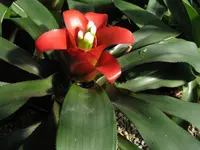
As the plant approaches flowering, the central rosette turns vivid red or purple around the inflorescence, a color change that helps attract pollinators in the dim forest understory.

Leaf tank microhabitat

Its broad, overlapping leaves form a water-holding tank that traps leaf litter and rainwater, creating a small aquatic habitat used by insect larvae and other tiny organisms in its native range.

FAQs about Bird's-nest Bromeliad

This species usually blooms only after reaching maturity and adequate size. Insufficient plant age, lack of stable warmth, low humidity, or nutrient depletion in an old potting mix commonly delay flowering. After blooming, the central rosette naturally declines.

Grow Healthy Plants with Botan Care

Keep your plants happy and healthy with plant identification, disease detection, and easy care guidance.

Botan plant care app — identify plants on mobile

Explore More Plants