Safe handling practices
Wear gloves and long sleeves when pruning or repotting, since the milky sap is irritating, and rinse tools under running water afterward to avoid accidental contact with skin or eyes.


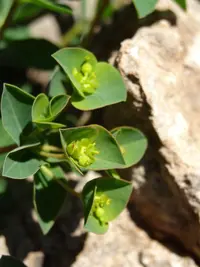
Yellow milkbush (Euphorbia mauritanica) is a small, shrubby succulent from arid regions of southern Africa. It forms dense clumps of many upright, leafless stems with a yellow-green color. The plant produces small, bright yellow cyathia, the cup-shaped structures that function as flowers, mainly in late winter or spring. Its compact, architectural form suits rock gardens, xeriscapes, and large containers in warm climates. This species prefers strong light, sharp drainage, and generally dry conditions, which makes it a good option for experienced beginners willing to learn how to care for Yellow Milkbush. Euphorbia mauritanica is drought tolerant but sensitive to excess moisture and poorly drained soil.

Care Difficulty
Easy Care

Light Preference
Full Sun

Water Requirements
Low Water

Temperature Preference
Warm Climate

Hardiness Zone
9–11

Soil Texture
Sandy, Loamy, Rocky

Soil pH
Slightly acidic (6.5–7.0), Slightly alkaline (7.0–7.5)

Soil Drainage
Well-drained

Fertilization
Minimal (feed rarely)
Scan your plant to receive care tips personalized for your specific plant
Available on iOS and Android
This sun-loving succulent thrives in bright, open positions typical of arid landscapes.
This drought-adapted succulent prefers infrequent, deep watering and fast-drying soil.
This species is adapted to warm, dry climates and handles heat better than cold.
Humidity is rarely a concern for Euphorbia mauritanica, which thrives in dry air typical of heated homes.
Euphorbia mauritanica prefers very fast-draining, mineral-rich soil that mimics arid, rocky habitats.
This species adapts well to container growing when drainage and stability are prioritized.
This drought-adapted succulent needs only light feeding, so fertilization for Yellow Milkbush should stay minimal and dilute.
Pruning Euphorbia mauritanica is mainly done to maintain shape and remove unsound stems, not to control size aggressively.
This species prefers minimal root disturbance, so repotting or transplanting should be infrequent and deliberate.
New plants are most often produced from cuttings, making Euphorbia mauritanica plant care scalable for small collections or landscapes.
Established plants are fairly cold tolerant but benefit from basic winter care in cooler regions.

Plant Health Check
Not sure what's wrong with your plant? Check your plant's health inside the app.
This species naturally occurs on arid coastal and inland dunes in South Africa and Namibia, where its dense root system helps stabilize loose, shifting sands.
In late winter to spring, it produces masses of small, bright yellow cyathia, the specialized flower structures typical of Euphorbia, creating a striking yellow haze over wild populations.
Like many Euphorbia species, it exudes a white latex sap when damaged; this sap is irritating to skin and eyes and helps protect the plant from herbivores.

In its native range, dense stands of this shrub-forming succulent can create almost continuous low thickets, providing important shelter microhabitats for small reptiles and invertebrates in otherwise exposed dune and semi-desert landscapes.
Poor flowering usually comes from insufficient light, overly rich or wet soil, or recent heavy pruning. Provide strong sun, very well-drained lean soil, and avoid cutting stems just before late winter–spring, when flower buds form.
Keep your plants happy and healthy with plant identification, disease detection, and easy care guidance.