


Rotate For Symmetry
Turn the pot 90° every 2–3 weeks so the ribs thicken evenly and the plant does not lean toward the brightest side.

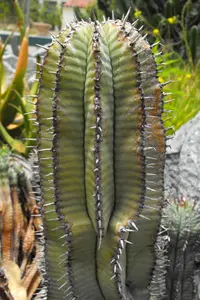
Snowflake spurge (Euphorbia polygona) is a compact succulent shrub with segmented, ribbed stems that form dense clumps over time. The stems are usually blue-green to gray-green and lined with short spines, giving the plant a sculptural, geometric look.
This species is native to arid regions of South Africa, where it grows in rocky, fast-draining soils with intense sun and limited rainfall. Its drought tolerance and slow growth make it relatively easy to maintain if watering is controlled and the roots never sit in soggy soil.
Good airflow, bright light, and a gritty mineral substrate support healthy growth and help prevent rot. Understanding how to care for snowflake spurge mainly involves avoiding overwatering and protecting it from cold, prolonged moisture.

Care Difficulty
Easy Care

Light Preference
Full Sun

Water Requirements
Low Water

Temperature Preference
Tropical / Frost Sensitive

Hardiness Zone
10–11

Soil Texture
Sandy, Loamy, Rocky

Soil pH
Slightly acidic (6.5–7.0), Neutral (7.0)

Soil Drainage
Well-drained

Fertilization
Minimal (feed rarely)
Scan your plant to receive care tips personalized for your specific plant
Available on iOS and Android
This succulent prefers bright, direct sun but benefits from some protection during the hottest hours.
This drought-tolerant succulent needs infrequent, careful watering to avoid root rot.
This species prefers warm, dry conditions and is sensitive to prolonged cold and frost.
Humidity is rarely a concern for Euphorbia polygona, which prefers dry air.
Euphorbia polygona needs a very fast-draining, mineral-rich substrate to prevent root rot.
This species is well-suited to container growing due to its compact, upright form.
This succulent needs only light feeding to maintain compact, healthy growth.
Pruning Euphorbia polygona is minimal and mainly done to remove problem stems or refine shape.
Repotting is infrequent and mainly needed when the root system outgrows its container.
Propagation of this Euphorbia is commonly done from offsets and stem cuttings under warm, bright conditions.
This species dislikes prolonged frost and benefits from simple winter precautions in cooler climates.

Plant Health Check
Not sure what's wrong with your plant? Check your plant's health inside the app.
This species develops strongly ribbed, columnar stems with hard, spine-tipped tubercles that function like armor, helping protect the plant from herbivores in its native South African habitat.
Its small yellowish cyathia, a specialized Euphorbia flower structure, are surrounded by spine shields and are often overlooked because they sit close to the stem and lack showy petals.
The stems often carry a bluish to whitish waxy coating, known as a bloom, which reflects sunlight and reduces water loss in the arid environments where it naturally grows.

In habitat, this species can form dense, many-stemmed clumps over time, creating striking natural colonies that visually dominate patches of the stony, semi-arid landscape where it is native.
Lack of flowering often comes from insufficient light intensity, cool temperatures, or recent repotting stress. Heavy feeding with high‑nitrogen fertilizer can also suppress blooms. Provide strong light, stable warmth, and avoid frequent disturbance to encourage regular flowering.
Keep your plants happy and healthy with plant identification, disease detection, and easy care guidance.

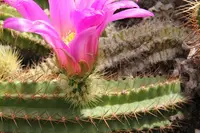
Echinocereus viereckii
Echinocereus viereckii
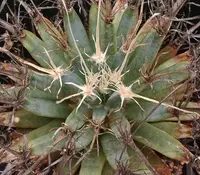
Agave cactus
Leuchtenbergia principis
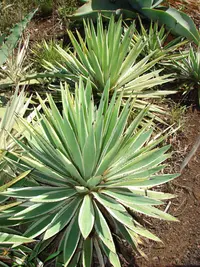
Century Plant
Agave vivipara
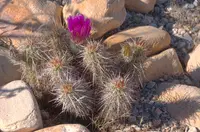
Engelmann's hedgehog cactus
Echinocereus engelmannii

kingcup cactus
Echinocereus triglochidiatus
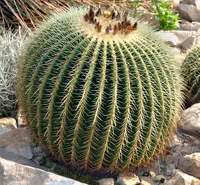
golden barrel cactus
Kroenleinia grusonii
Mammillaria zephyranthoides
Mammillaria zephyranthoides
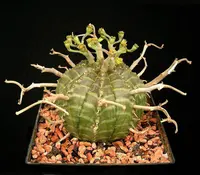
Zebra Milkball
Euphorbia meloformis