Euphorbia regis-jubae Care

Euphorbia regis-jubae

About Euphorbia regis-jubae

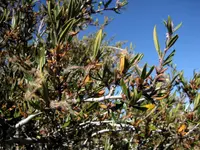
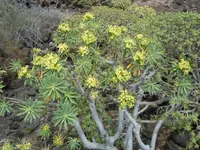
Euphorbia regis-jubae is a drought-tolerant succulent shrub with upright, branching stems and narrow, green leaves clustered near the tips. It produces yellow-green flower-like bracts that give a bright, architectural look.

This species is native to the Canary Islands and nearby regions of North Africa, where it grows in dry, rocky habitats with strong sun. Its tough, water-storing tissues and minimal leaf surface make it well adapted to arid conditions.

These traits generally make it low maintenance in cultivation, as long as excess moisture is avoided. To care for Euphorbia regis-jubae, provide bright light, very well-drained soil, and infrequent but deep watering.

Main Plant Requirements

Care Difficulty

Easy Care

Light Preference

Full Sun

Water Requirements

Low Water

Temperature Preference

Warm Climate

Hardiness Zone

9–11

Soil Texture

Sandy, Loamy, Rocky

Soil pH

Slightly acidic (6.5–7.0), Neutral (7.0)

Soil Drainage

Well-drained

Fertilization

Minimal (feed rarely)

Get Personalized Care Plan

Scan your plant to receive care tips personalized for your specific plant

Available on iOS and Android

How to Care for the Euphorbia regis-jubae

This drought-tolerant shrub thrives in bright, open exposures typical of dry Mediterranean-type climates.

  • Provide 6–8 hours of direct sun daily; full sun is ideal, with morning and midday light promoting dense, compact growth in Euphorbia regis-jubae.
  • In very hot regions, give light afternoon shade or filtered light after 2–3 pm to reduce leaf scorch and bleaching, especially for young plants.
  • In coastal or cooler climates, full sun all day is suitable; in shadier sites, expect looser growth and fewer flowers, a sign light is insufficient.

This species prefers infrequent, deep watering and very fast-draining soil, similar to other arid-climate shrubs.

  • Allow the top 5–8 cm of soil to dry fully before watering; in sandy ground this often means waiting until foliage just begins to lose slight turgor and the soil looks pale and crumbly.
  • In spring–summer, water thoroughly but infrequently, then let excess drain away; in fall–winter, reduce watering sharply and skip if the soil is already dry and cool.
  • Watch for yellowing, soft stems and a sour smell as signs of overwatering, while shriveling stems, crisp leaf tips, and very light soil color indicate underwatering in Euphorbia regis-jubae.

This plant is adapted to mild, dry, frost-free to near-frost-free climates with warm summers and cool, not cold, winters.

  • For active growth, aim for 65–80°F (18–27°C); extended heat up to about 90°F (32°C) is tolerated if soil drains very well and roots are not waterlogged.
  • Minimum tolerance is around 25–28°F (-4 to -2°C) for brief periods; repeated frosts below this can damage stems and kill young plants.
  • In regions with cold winters, protect from frost pockets and cold winds; in very hot inland sites, high temperatures above 95°F (35°C) combined with reflected heat can cause stress and tip burn.

This succulent shrub handles typical indoor humidity easily and rarely needs special humidity management.

  • Best kept at 30–50% humidity, similar to most heated homes and dry offices.
  • Tolerates dry air well; problems usually arise only when combined with overwatering or cold drafts.
  • Humidity stress shows as soft, mushy stems rather than crisp leaf edges, so improve air circulation instead of adding moisture.

This species needs a sharply draining, mineral-based soil to prevent root and stem rot.

  • Use a gritty, sandy mix such as 50–70% inorganic material (pumice, coarse sand, perlite) with 30–50% cactus compost or lean potting mix.
  • Aim for slightly acidic to neutral pH around 6.0–7.0, avoiding strongly acidic or alkaline substrates that can limit nutrient uptake.
  • Improve aeration by including large-particle materials (3–6 mm) and avoiding fine peat or heavy loam that compacts when dry or wet.
  • Avoid dense, water-retentive mixes, glazed cachepots without drainage, and any situation where water lingers around the roots of Euphorbia regis-jubae.

This species adapts well to container growing when planted in a stable, fast-draining setup.

  • Select a heavy, wide-based pot to counter its shrubby, top-heavy form and reduce tipping in wind or on balconies.
  • Choose a relatively shallow container, as roots are fibrous and spreading rather than deep-taprooted, which helps the mix dry evenly.
  • Unglazed clay pots are helpful outdoors in mild climates because they allow faster evaporation, reducing the risk of chronic moisture around roots.

This drought-tolerant shrub needs only light feeding to support steady growth in containers or poor soils.

  • Use a balanced liquid fertilizer (around 10-10-10) at 1/2 strength for Euphorbia regis-jubae in spring and early summer.
  • Apply every 4–6 weeks during active growth if soil is low in nutrients; skip feeding in rich ground.
  • Stop feeding in late summer; do not fertilize in winter dormancy.
  • For long-term pots, mix a small amount of slow-release granules into fresh cactus or gritty mix each spring.

Pruning is mainly used to maintain shape and remove damaged growth on this structured shrub.

  • Best time is late winter to early spring, before strong new growth starts.
  • Cut out dead, diseased, or storm-damaged stems at the base with clean, sharp pruners.
  • Thin crowded shoots to improve air flow and keep the natural dome or fan shape.
  • Wear gloves and eye protection, as the milky sap is irritating to skin and eyes.

This species prefers stable conditions and only occasional repotting or transplanting.

  • Repot container plants every 3–4 years or when roots circle the pot base or emerge from drainage holes.
  • Best time is late winter to early spring, using a slightly larger pot and very free-draining cactus or succulent mix.
  • Handle the root ball gently, disturbing roots as little as possible and keeping the crown at the same depth.
  • Water lightly after repotting, then allow the mix to dry between waterings to limit root stress and rot risk.

This plant is most often propagated from semi-ripe stem cuttings under warm, bright conditions.

  • Take 7–10 cm stem cuttings in late spring to midsummer, choosing firm, non-flowering shoots.
  • Wear gloves and allow the milky sap to dry; let cut ends callus for 1–2 days before planting.
  • Insert cuttings into a gritty, sterile mix, keeping them just moist and in bright, indirect light.
  • Maintain temperatures around 70–75°F and avoid overwatering until strong new roots and growth appear.

This shrub is moderately frost tolerant in mild climates but needs extra care in colder regions.

  • Hardy roughly to 20–25°F when well established and in sharply drained soil.
  • In-ground plants benefit from a 5–8 cm layer of dry gravel or bark mulch around, not touching, the crown.
  • In colder zones, grow Euphorbia regis-jubae in containers and move indoors before hard frost.
  • Place indoor plants in a cool, bright spot and keep soil almost dry during winter.

Care Tips

Safe sap handling

Wear gloves and avoid touching your face or eyes when pruning or repotting, since the milky sap is irritating; immediately rinse skin with plenty of water if contact occurs and allow cuts to dry before returning the plant to strong sun.

Controlled branching

Pinch or cut soft young tips in late spring to encourage a denser, multi-stemmed form, but limit this to 1–2 sessions per year so the plant can heal fully between pruning events.

Root confinement

Use a slightly snug, heavy container with drainage holes to keep roots somewhat restricted, which helps maintain a compact, upright shape and reduces the risk of the plant toppling over in windy or exposed spots.

Winter rain protection

In climates with wet, mild winters, place the pot under an overhang or use a simple cold frame lid to shield the plant from prolonged rain, which reduces the risk of root and crown rot while still allowing good airflow.

Pest-scouting routine

Inspect stems and leaf bases every 2–3 weeks for scale or mealybugs, and if found, isolate the plant and dab pests with cotton swabs dipped in 70% isopropyl alcohol, repeating weekly until no new insects appear; this preventive routine supports long-term Euphorbia regis-jubae care.

Common Pests and Diseases

Aphids

These insects cluster on young shoots and flower stems, sucking sap and causing distorted, sticky growth on stems and cyathia (flower structures). Symptoms include slowed growth and shiny honeydew that can attract sooty mold on nearby surfaces.

Solution

Wash infested stems gently with a strong but controlled stream of water, then spot-treat remaining colonies with insecticidal soap or a ready-to-use neem oil spray, applied in the early morning or evening. Reduce excess nitrogen fertilization that encourages soft, aphid-prone growth and monitor new flushes regularly, especially during spring when growing Euphorbia regis-jubae outdoors in mild climates.

Euphorbia scale

This pest appears as small, immobile, tan to brown bumps on stems, often aligned along ribs, where it feeds on sap and weakens the plant. Symptoms include yellowing patches, poor vigor, and sticky honeydew around heavily infested plants.

Solution

Scrape or gently pry off individual scale insects with a cotton swab or soft brush dipped in isopropyl alcohol, taking care not to damage the green stem tissue. For larger infestations, combine manual removal with repeated applications of horticultural oil or neem oil, and improve light and air movement so the plant maintains strong, more resistant growth.

Spider mites

These pests thrive on euphorbias kept very dry and hot, causing fine speckling on stems and occasional delicate webbing in branch forks. Symptoms include a dull, stippled appearance and gradual loss of vigor, especially in indoor or greenhouse conditions with low humidity.

Solution

Rinse stems thoroughly with lukewarm water to dislodge mites, then apply insecticidal soap or a miticide labeled for ornamental succulents, repeating as needed to catch newly hatched mites. Lower heat stress, avoid placing the plant directly against hot reflective glass, and increase air circulation to make conditions less favorable for mite outbreaks.

Powdery mildew

This disease forms a white, powdery coating on green stems and sometimes on new growth, more often where air is stagnant around the plant. Symptoms include dull, patchy discoloration and, in heavier infections, a slight wrinkling or weakening of affected tissue.

Solution

Remove and discard heavily affected stems or tips, then treat remaining surfaces with a sulfur-based fungicide or a labeled potassium bicarbonate product, following package directions. Space plants to improve airflow, avoid overhead watering in enclosed areas, and ensure the shrub receives strong light, which helps limit powdery mildew development on Euphorbia regis-jubae in containers and dry gardens.

Stem canker

This disease causes localized sunken, brown to black lesions on stems, often starting where mechanical damage, frost injury, or pruning wounds allowed fungal pathogens to enter. Symptoms include progressive girdling of stems above the lesion, leading to wilting and dieback of upper branches.

Solution

Cut out affected stem sections well below the visible lesion with a sterile, sharp tool, and discard all infected material instead of composting. Allow cuts to dry, avoid overhead irrigation that wets stems repeatedly, and keep the plant in an open, well-drained position so wounds dry quickly and disease organisms are less likely to spread.

Interesting Facts

Endemic Canary shrub

This species is naturally restricted to the eastern Canary Islands and nearby islets and coastal areas of western Morocco, where it grows in dry, rocky, maritime habitats exposed to strong sun and wind.

Winter growth pattern

In its native range it grows mainly in the cooler, moister winter months and can partially slow down or pause growth during the hottest, driest part of summer, a seasonal rhythm typical of many Macaronesian shrubs.

Toxic milky latex

Like other spurges, it produces a white latex sap that is toxic and strongly irritant to skin and eyes, a defensive adaptation that deters grazing animals in its arid native scrublands.

Botan icon

Did you know?

The species name regis-jubae honors King Juba II of Mauretania, an ancient North African ruler whose interest in natural history led to some of the earliest written descriptions of plants from the Canary Islands and surrounding regions.

FAQs about Euphorbia regis-jubae

This species usually blooms from late winter to spring, producing showy, chartreuse to yellow bracts around small, inconspicuous true flowers. Good light, a cool, dryish winter rest, and stable conditions support reliable seasonal flowering when growing Euphorbia regis-jubae.

Grow Healthy Plants with Botan Care

Keep your plants happy and healthy with plant identification, disease detection, and easy care guidance.

Botan plant care app — identify plants on mobile

Explore More Plants