


Spine-safe handling
Always wear thick gloves and long sleeves when moving or repotting the plant, and keep tools ready so stems are not handled directly, since the spines are sharp and the latex sap is irritating to skin and eyes.

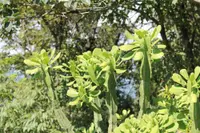
Sullu spurge (Euphorbia royleana) is a succulent shrub or small tree with thick, angled, cactus-like green stems and sparse, short-lived leaves near the tips. It belongs to the spurge family and produces a white, milky latex sap typical of many Euphorbia species.
This plant is native to the western Himalayas, where it grows in dry, rocky slopes and open, sunny habitats. In cultivation it is valued for its drought tolerance and strong architectural form.
Euphorbia royleana grows relatively slowly but is long-lived when kept in bright light, warm conditions, and very well-drained soil. Its tough nature makes it fairly easy to care for Sullu spurge, provided its sensitivity to overwatering and cold is respected.

Care Difficulty
Moderate Care

Light Preference
Full Sun

Water Requirements
Low Water

Temperature Preference
Tropical / Frost Sensitive

Hardiness Zone
10–12

Soil Texture
Sandy, Loamy, Rocky

Soil pH
Slightly acidic (6.5–7.0), Neutral (7.0)

Soil Drainage
Well-drained

Fertilization
Minimal (feed rarely)
Scan your plant to receive care tips personalized for your specific plant
Available on iOS and Android
Euphorbia royleana thrives in strong sun but benefits from some protection during the hottest hours in very hot climates.
This drought-tolerant succulent stores water in its stems and prefers infrequent, thorough watering.
This species prefers warm, dry conditions and reacts poorly to cold, prolonged damp weather.
This species handles typical indoor humidity well and does not need special humidity management for Sullu spurge indoor care.
Euphorbia royleana needs very fast-draining, mineral-rich soil to prevent root and stem rot.
This species is suitable for container growing when the pot is chosen to manage its tall, heavy stems safely.
Euphorbia royleana is a low-demand feeder but responds to light, balanced nutrition during its active season.
Pruning Euphorbia royleana is mainly done to remove damaged tissue and control overall form.
Container-grown or young Euphorbia royleana plants benefit from infrequent, careful transplanting to prevent stress.
New Euphorbia royleana plants are most often produced from stem cuttings under warm, bright conditions.
This species is sensitive to hard frost and benefits from simple, preventive winter care in cold regions.

Plant Health Check
Not sure what's wrong with your plant? Check your plant's health inside the app.
This species forms tall, segmented, cactus-like stems with distinct 3–5-angled ridges that branch in a candelabra pattern, an adaptation that reduces leaf area and limits water loss in its dry Himalayan habitats.
Its stems exude a corrosive white latex rich in diterpenoid esters, which strongly deters herbivores and can cause skin and eye irritation in humans if proper protection is not used.
The plant is naturally distributed along the western Himalayas, often on rocky, exposed slopes and dry hillsides, where it tolerates strong sun, low rainfall, and wide temperature fluctuations.

In parts of its native Himalayan range, the dried, woody stems are traditionally used as low-grade fencing material because their spiny, rigid structure discourages animals from pushing through even long after the plant has died.
Flowering is often reduced by insufficient light, cool temperatures, or recent heavy pruning. Overfeeding with nitrogen can also favor stem growth over blooms. Stable warmth, strong sun, and moderate fertilizer usually improve flower production over time.
Keep your plants happy and healthy with plant identification, disease detection, and easy care guidance.

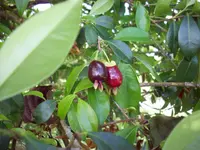
Cherry of the Rio Grande
Eugenia involucrata
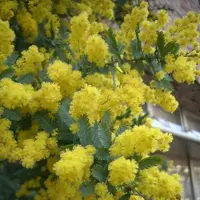
cootamundra wattle
Acacia baileyana

Bird's Nest Snake Plant
Dracaena trifasciata 'Hahnii'
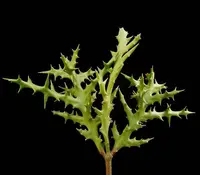
Silver thicket
Euphorbia stenoclada
Baby Toes
Fenestraria rhopalophylla
Moore's zamia palm
Macrozamia moorei
macadamia nut
Macadamia integrifolia

Common pricklypear
Opuntia monacantha