

Controlled summer dormancy
In hot midsummer, sharply reduce or stop watering and move the pot to a slightly cooler, very bright spot to respect the plant’s natural dormancy and prevent the heads from splitting.

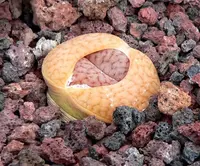
Lithops pseudotruncatella is a small succulent from arid regions of Namibia and South Africa, often called a living stone. It grows as pairs of thick, fused leaves that mimic surrounding pebbles. New leaf pairs emerge from the center as old ones slowly dry and shrink. Flowers are daisy-like, usually white to yellow, and appear from the fissure between the leaves. This species is slow-growing and long-lived when its seasonal rhythm is respected. It is sensitive to overwatering and poor drainage, which makes how to care for Lithops pseudotruncatella different from typical houseplants. It prefers very bright light, minimal moisture, and a fast-draining mineral soil mix.

Care Difficulty
Hard Care

Light Preference
Full Sun

Water Requirements
Low Water

Temperature Preference
Tropical / Frost Sensitive

Hardiness Zone
10–11

Soil Texture
Sandy, Rocky

Soil pH
Slightly acidic (6.5–7.0), Neutral (7.0)

Soil Drainage
Well-drained

Fertilization
Minimal (feed rarely)
Scan your plant to receive care tips personalized for your specific plant
Available on iOS and Android
This species needs bright light that mimics its native open, rocky habitat.
Watering must be sparse and carefully timed to avoid root and body rot.
Stable warm, dry air helps this species maintain compact, healthy growth.
Humidity plays almost no role in caring for Lithops pseudotruncatella compared with light and watering.
Soil must mimic a mineral, fast-drying desert substrate to keep roots healthy.
This species is well suited to container growing when the pot strongly limits moisture retention.
This species is highly adapted to nutrient-poor soils and usually needs no fertilizer in home cultivation.
Lithops pseudotruncatella has no true stems or branches, so structural pruning is not part of normal care.
Repotting is infrequent, focused on renewing the gritty medium rather than giving more root space.
Propagation of Lithops pseudotruncatella is mainly done by seed and is slow but reliable under stable conditions.
Winter care focuses on keeping the plant dry and above freezing while it renews leaves.

Plant Health Check
Not sure what's wrong with your plant? Check your plant's health inside the app.
This species often shows gray to brown upper leaf surfaces with speckled or netted patterns that closely match the quartzite and feldspar gravel of its native Namibian habitats, giving it highly effective visual camouflage against herbivores.
In L. pseudotruncatella, each new pair of leaves develops inside the old one and gradually absorbs moisture and nutrients from it, so the outer leaves shrivel and form a papery sheath by the end of the growth cycle.
Its autumn flowers are typically yellow, daisy-like, and lightly scented, which helps attract specific flying insects in its arid habitat where visual signals alone are less reliable at dusk.

Populations of Lithops pseudotruncatella in nature can be so well camouflaged that trained botanists sometimes mark individual plants with small pebbles or discreet tags during field studies, otherwise they struggle to relocate the same plants among the surrounding stones on later visits.
This species usually flowers only when fully mature, often after several years, and only once per year. Insufficient seasonal rest, stress from frequent repotting, or lack of a cool, dry winter period can all reduce flowering.
Keep your plants happy and healthy with plant identification, disease detection, and easy care guidance.

Silver thicket
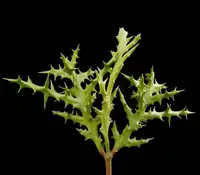
Euphorbia stenoclada
Huernia thuretii
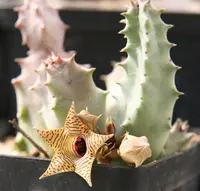
Huernia thuretii
Baby Toes
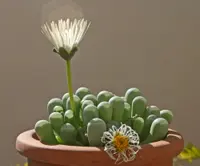
Fenestraria rhopalophylla
royal dewflower
Drosanthemum speciosum
Euphorbia officinarum
Euphorbia officinarum
False Milkballs
Euphorbia pseudoglobosa
Bird's Nest Snake Plant
Dracaena trifasciata 'Hahnii'
Common pricklypear
Opuntia monacantha