Safe handling routine
Use disposable gloves and avoid touching your face when cutting or repotting, then rinse tools and any sap contact areas with soapy water to reduce irritation risk from the toxic latex.

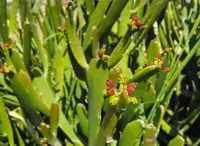
Euphorbia xylophylloides is a shrubby succulent from Madagascar, known for its flattened, leaf-like stems and sparse true leaves. It forms a compact, branched plant with a sculptural look.
In its native habitat it grows in dry, rocky areas with strong light and very fast-draining soil. The plant stores water in its stems and is sensitive to overwatering, which makes it relatively easy for growers who tend to underwater.
Those who want to learn how to care for Euphorbia xylophylloides should focus on bright light, modest watering, and a gritty, well-drained substrate to keep roots healthy.

Care Difficulty
Moderate Care

Light Preference
Partial Sun

Water Requirements
Low Water

Temperature Preference
Warm Climate

Hardiness Zone
10–11

Soil Texture
Sandy, Loamy, Rocky

Soil pH
Slightly acidic (6.5–7.0), Neutral (7.0)

Soil Drainage
Well-drained

Fertilization
Minimal (feed rarely)
Scan your plant to receive care tips personalized for your specific plant
Available on iOS and Android
This drought-tolerant succulent prefers bright, indirect light with some direct sun each day.
This species behaves like a succulent and prefers thorough but infrequent watering.
This plant favors warm, stable conditions and is not frost hardy.
This succulent tolerates typical indoor humidity and rarely needs special humidity management.
This species needs a very fast-draining, mineral-based substrate to prevent root and stem rot.
This species is well suited to container growing when the pot is chosen to control moisture and support its structure.
This drought-adapted succulent needs modest feeding, so focus on light nutrition during active growth only.
Pruning is mainly used to maintain shape and remove unsafe or unhealthy growth on this succulent shrub.
Container-grown plants prefer stable conditions and only infrequent repotting or transplanting.
Propagation of Euphorbia xylophylloides is usually done from stem cuttings under warm, bright conditions.
This species dislikes prolonged frost, so some winter precautions are important in colder climates.

Plant Health Check
Not sure what's wrong with your plant? Check your plant's health inside the app.
This species is naturally restricted to dry deciduous forests of southwestern Madagascar, where it grows on rocky, well-drained substrates in a strongly seasonal climate with a pronounced dry season.
Instead of broad leaves, this plant develops flattened, winglike stem segments (phylloclades) that carry out photosynthesis and help reduce water loss in its arid habitat.
The species is considered threatened in the wild, primarily due to deforestation, land conversion, and degradation of its specialized dry-forest habitat in Madagascar.
This species adapts well to containers as long as drainage is excellent and pots are not oversized. Use a sturdy, heavy pot to prevent tipping, and repot only when roots clearly fill the existing container.
Keep your plants happy and healthy with plant identification, disease detection, and easy care guidance.