Spring clump division
Every 3–4 years in early spring, lift and divide crowded clumps with a sharp spade, replanting outer, more vigorous sections at the same depth to maintain flowering performance and control spread when growing bigleaf aster.

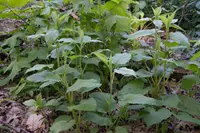
Bigleaf aster, Eurybia macrophylla, is a hardy perennial wildflower native to woodlands and shady slopes in eastern North America. It forms loose colonies from spreading roots and creates a soft groundcover under trees and shrubs.
The plant is known for its large, coarse, heart-shaped basal leaves and airy sprays of pale lavender to white starry flowers in late summer to fall. Its tolerance of shade, poor soils, and competition from tree roots makes it relatively easy to grow in naturalistic gardens.
Gardeners who want to know how to care for bigleaf aster should focus on providing partial shade, consistent but not soggy moisture, and well-drained, moderately rich soil.

Care Difficulty
Easy Care

Light Preference
Partial Shade

Water Requirements
Moderate Water

Temperature Preference
Cold Hardy

Hardiness Zone
3–8

Soil Texture
Loamy, Silty, Organic-rich

Soil pH
Acidic (5.5–6.5), Slightly acidic (6.5–7.0)

Soil Drainage
Moist but well-drained

Fertilization
Minimal (feed rarely)
Scan your plant to receive care tips personalized for your specific plant
Available on iOS and Android
This woodland perennial prefers bright, indirect light and performs best with cool exposure.
This species prefers evenly moist, not soggy, soil that never stays dry for long periods.
This hardy perennial tolerates a wide temperature range typical of temperate climates.
This species tolerates a wide humidity range and rarely needs special humidity control outdoors.
This woodland perennial performs best in loose, moist, well-drained soil with high organic content.
This species can be grown in containers for a few seasons if given ample root space and stable moisture.
Eurybia macrophylla is a low-maintenance native that benefits from modest feeding on poor soils only.
Eurybia macrophylla responds well to light, timely pruning that keeps plants dense and floriferous.
This species is usually grown in the ground, so focus on careful transplanting rather than frequent repotting.
Eurybia macrophylla is most often propagated by division, with seed used when larger numbers are needed.
This woodland perennial is cold hardy through typical northern winters and usually needs minimal winter care.

Plant Health Check
Not sure what's wrong with your plant? Check your plant's health inside the app.
This species often sends up its large basal leaves in spring well before the forest canopy fully closes, allowing it to capture light in shaded deciduous woods where many other asters cannot compete.
Its broad, often heart-shaped basal leaves can reach 15–20 cm across and form dense patches on the forest floor, making it one of the most visually dominant native asters in North American woodlands.
Its late-summer to fall flowers provide nectar and pollen for a wide range of native bees, hoverflies, and butterflies, including specialist aster-feeding insects that rely on woodland populations for part of their life cycle.

This species readily hybridizes in the wild with related woodland asters such as Eurybia divaricata, and these natural hybrids can create complex intermediate forms that make field identification challenging even for experienced botanists.
This species spreads steadily by rhizomes and self-seeding, forming broad colonies over time. It is usually manageable in home gardens, but edging, dividing clumps, and removing unwanted seedlings help keep it within bounds.
Keep your plants happy and healthy with plant identification, disease detection, and easy care guidance.