Sturdy stem support
Install low hoops, mesh, or individual stakes when plants are 10–15 cm tall so stems grow straight and are less likely to snap in wind or heavy rain.

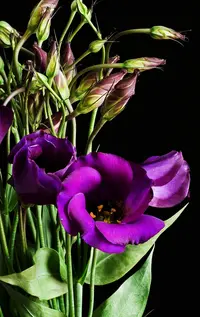
Showy prairie gentian, Eustoma russellianum, is a herbaceous perennial often grown as an annual for its large, rose-like, funnel-shaped flowers. Blooms appear in soft pastels or vivid purples on tall, slender stems with bluish-green foliage.
This species is native to prairies and open grasslands of the southern United States and northern Mexico, where it thrives in sunny, well-drained sites. It prefers consistent moisture without waterlogging and benefits from fertile, loose soil.
The plant is visually delicate but not always easy to grow, as it resents root disturbance and prolonged wet or cold conditions. Gardeners who learn how to care for showy prairie gentian often treat it as a high-value feature plant rather than a low-maintenance staple.

Care Difficulty
Hard Care

Light Preference
Full Sun

Water Requirements
Moderate Water

Temperature Preference
Warm Climate

Hardiness Zone
8–10

Soil Texture
Sandy, Loamy, Organic-rich

Soil pH
Acidic (5.5–6.5), Slightly acidic (6.5–7.0)

Soil Drainage
Well-drained

Fertilization
Moderate (every 2–4 weeks)
Scan your plant to receive care tips personalized for your specific plant
Available on iOS and Android
This species needs bright outdoor light and is sensitive to extremes of shade or intense heat.
Eustoma russellianum prefers evenly moist, well-drained soil and reacts poorly to both drought and soggy conditions.
This plant performs best in mild conditions and is sensitive to both frost and extreme heat.
This species prefers moderate humidity and reacts quickly to very dry indoor air.
Eustoma russellianum needs airy, sharply drained, yet moisture-retentive soil to maintain deep roots and prevent rot.
This species grows well in containers when root depth, drainage, and stability are carefully managed.
Eustoma russellianum responds well to moderate feeding during its active growing and flowering season.
Pruning Eustoma russellianum focuses on maintaining flower production and removing weak growth.
Transplanting or limited repotting helps maintain healthy roots and strong flowering in container-grown plants.
Propagation of Eustoma russellianum is usually done from seed rather than cuttings or division.
Winter care for this tender perennial is important in regions with freezing temperatures.

Plant Health Check
Not sure what's wrong with your plant? Check your plant's health inside the app.
This species is naturally distributed from the Great Plains of the central United States down into northern Mexico, where it grows in open prairies, calcareous grasslands, and disturbed sites with well-drained soils.
Its showy, rose-like blooms are technically fused corollas with a tubular base and flaring lobes, and the plant is often used in research and breeding programs for cut flowers because of its long-lasting floral tissues and wide range of selected colors.
In its native range it behaves as a short-lived perennial or biennial, forming a rosette in the first season and flowering later, even though it is usually grown as an annual in commercial cut-flower production and home gardens.

Modern lisianthus cut-flower cultivars, popular in the global floral trade, were all developed from this single wild prairie species through intensive breeding that focused on traits such as double petals, novel colors, and extended vase life.
Lack of flowering usually comes from stress: high heat, root disturbance, cramped pots, or heavy feeding with high-nitrogen fertilizer. Keep conditions stable, avoid repotting in bud, and use a balanced or slightly high-phosphorus fertilizer during the growing season.
Keep your plants happy and healthy with plant identification, disease detection, and easy care guidance.