Use Fresh Pine
Attach freshly cut, disease-free pine branches or small logs instead of old, decaying wood, as Exidia saccharina colonizes fresh pine sapwood more reliably and fruits more consistently.

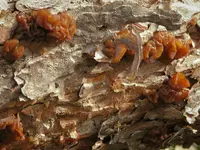
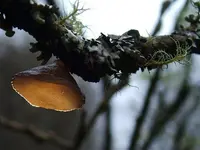
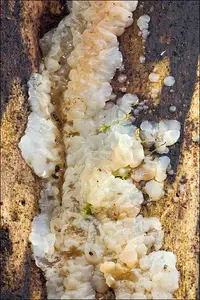
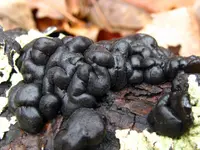
Pine jelly (Exidia saccharina) is a jelly fungus that grows on dead or dying conifer wood, especially pine. It forms soft, gelatinous patches that look like amber or pale brown blobs on bark and branches. This species appears mainly in cool, moist forests across parts of Europe and North America. It usually develops in clusters, merging into irregular cushions rather than distinct mushroom caps. Exidia saccharina relies on consistently damp conditions and shaded sites, which makes cultivation challenging outside very controlled environments. Hobbyists who try to care for pine jelly often focus on maintaining cool, humid, low-light setups with decaying conifer wood as the substrate.

Care Difficulty
Moderate Care

Light Preference
Shade

Water Requirements
Keep Soil Moist

Temperature Preference
Cool Climate

Hardiness Zone
Unknown

Soil Texture
Loamy, Silty, Organic-rich

Soil pH
Acidic (5.5–6.5)

Soil Drainage
Waterlogged tolerant

Fertilization
Minimal (feed rarely)
Scan your plant to receive care tips personalized for your specific plant
Available on iOS and Android
This wood-inhabiting jelly fungus prefers low to moderate forest light rather than direct sun.
This species depends on consistently moist, not flooded, wood rather than direct watering of the fungus itself.
This jelly fungus is adapted to cool to mild outdoor woodland conditions and tolerates a fair temperature range.
This jelly fungus prefers consistently moist, humid conditions to develop well.
This species fruits on decaying conifer wood, so artificial soil should imitate loose, woody forest litter rather than dense mineral ground.
This fungus is only moderately suitable for containers and performs best when the container mainly acts as a holder for colonized conifer wood.
Exidia saccharina, often called pine jelly, usually needs no fertilizer when colonizing naturally decaying conifer wood.
Pruning Exidia saccharina is rarely necessary and is mainly done for hygiene or display.
Exidia saccharina is typically grown on dead conifer wood, so transplanting focuses on moving the colonized substrate rather than the organism itself.
Propagation of Exidia saccharina in home settings is uncommon and technically demanding.
Exidia saccharina is naturally cold hardy in temperate forests and generally needs no special winter care.

Plant Health Check
Not sure what's wrong with your plant? Check your plant's health inside the app.
This jelly fungus is strongly associated with dead or decorticated pine wood, especially Scots pine, and is rarely found on hardwoods or other conifers. Its occurrence is often used as an indicator that the substrate is specifically pine rather than mixed conifer.
Mature fruitbodies often develop a white, sugar-like crystalline coating on their surface. These encrusting crystals are a key field character that helps separate it from similar brown or orange Exidia species lacking this feature.
It typically fruits in cool, moist conditions from late autumn through winter into early spring. The gelatinous tissue can dry and shrink in between rains, then rehydrate and resume spore release when moisture returns.

Molecular research has shown that this species, once confused with other brown jelly fungi, is genetically distinct and helped clarify species limits within the Exidia genus through DNA sequencing studies.
This jelly fungus is generally considered inedible or of very poor culinary value due to its tough, rubbery texture and limited flavor. It is not used as a common food and is best left on the host wood.
Keep your plants happy and healthy with plant identification, disease detection, and easy care guidance.