Host tree selection
Introduce the fungus only under compatible hosts such as oaks and related hardwoods, and avoid conifers or heavily compacted lawn areas where mycorrhizal partnership is unlikely to establish.

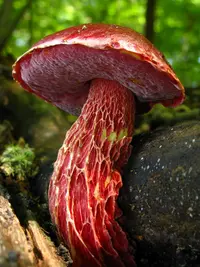
Frost's bolete, Exsudoporus frostii, is a mycorrhizal mushroom, not a leafy houseplant. It forms a partnership with tree roots, exchanging nutrients with its host. The fruiting body is thick, with a bright red to scarlet cap, yellow pores that bruise blue, and a sturdy red stem.
This species naturally occurs in eastern North America, usually with oaks and other hardwoods in warm, humid forests. It cannot complete its life cycle indoors because it depends on living trees, so attempts to care for Frost's Bolete in pots are unlikely to succeed.
In nature it favors well-drained, slightly acidic forest soils with consistent moisture and dappled light on the forest floor.

Care Difficulty
Hard Care

Light Preference
Partial Shade

Water Requirements
Keep Soil Moist

Temperature Preference
Warm Climate

Hardiness Zone
Unknown

Soil Texture
Loamy, Sandy, Organic-rich

Soil pH
Strongly acidic (4.5–5.5), Acidic (5.5–6.5)

Soil Drainage
Moist but well-drained

Fertilization
Minimal (feed rarely)
Scan your plant to receive care tips personalized for your specific plant
Available on iOS and Android
This mycorrhizal mushroom prefers bright woodland conditions rather than direct, open-field sun exposure.
This species depends on consistently moist, well-drained soil rather than frequent surface wetting.
This mushroom fruits best in warm, humid conditions typical of late spring to early fall in its native range.
Humidity is not a meaningful care factor because this fungus is an outdoor ectomycorrhizal partner of trees, not a houseplant.
This ectomycorrhizal fungus relies on naturally structured forest soil rather than a conventional potting mix.
This species is not suitable for true container growing because it depends on living tree roots in the ground to complete its life cycle.
This ectomycorrhizal fungus relies on its tree partner for nutrients and generally does not need direct fertilization.
Pruning is not applicable to Exsudoporus frostii, since it is a mycorrhizal fungus producing temporary fruiting bodies rather than persistent stems or foliage.
This species is not suited to conventional repotting, as the fungus depends on a living host tree and complex soil community.
Intentional propagation of this mycorrhizal bolete is difficult and rarely controlled in garden conditions.
This woodland fungus is naturally cold hardy in its native range and usually needs no specific winter care.

Plant Health Check
Not sure what's wrong with your plant? Check your plant's health inside the app.
Young pore surfaces and caps often produce bright red, viscous droplets that can bead on the surface, a feature that inspired both the genus name Exsudoporus and the common name apple bolete.
This species forms ectomycorrhizal partnerships mainly with oaks and some related hardwoods in acidic, sandy to loamy soils, and its distribution closely follows suitable host tree communities in eastern North America and parts of Mexico.
When the bright red flesh or pores are cut or bruised, they quickly stain blue due to oxidation of specific fungal pigments, a diagnostic reaction used by mycologists to distinguish it from similar red-capped boletes.

Molecular studies in the 2010s showed that this fungus was distinct enough from other red-capped boletes to be moved out of Boletus and formally placed in the newly described genus Exsudoporus, making it one of the species that helped define the modern concept of this genus.
This species is considered edible in some regions, but accurate identification is critical because similar red-pored boletes can be toxic. Only experienced foragers should eat it, and local regulations and expert confirmation are strongly recommended.
Keep your plants happy and healthy with plant identification, disease detection, and easy care guidance.