Use suitable substrate
Provide fresh, undecayed hardwood branches or logs (not conifers or treated wood) with bark still attached, as this fungus specializes in decomposing relatively hard, lignified tissue rather than soft compost-like material.

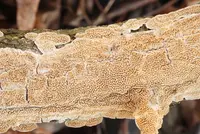
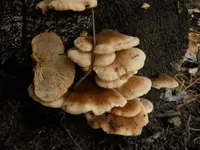
The Milk-white Toothed Polypore, Irpex lacteus, is a wood-decay fungus, not a typical houseplant. It forms thin, spreading crusts on dead or dying hardwood. The underside shows small tooth-like spines instead of gills, usually in creamy white shades that age to duller tones.
This species is common in temperate regions, often found on fallen branches, logs, and occasionally on dead areas of standing trees. It plays an important role in breaking down lignin and cellulose in wood. In cultivation, it is usually grown by fungus enthusiasts on prepared wood or sterilized substrates. Those who want to care for Milk-white Toothed Polypore should provide consistently moist, shaded conditions and woody material for it to colonize.

Care Difficulty
Moderate Care

Light Preference
Shade

Water Requirements
Keep Soil Moist

Temperature Preference
Cool Climate

Hardiness Zone
Unknown

Soil Texture
Loamy, Organic-rich

Soil pH
Acidic (5.5–6.5), Slightly acidic (6.5–7.0)

Soil Drainage
Moist but well-drained

Fertilization
Minimal (feed rarely)
Scan your plant to receive care tips personalized for your specific plant
Available on iOS and Android
This wood-decaying fungus prefers shaded forest conditions rather than direct sun exposure.
This fungus depends on consistent wood moisture rather than direct watering of the fruiting bodies.
This species tolerates a broad temperate range but grows best in cool to mild conditions.
This wood-decay fungus prefers consistently moist, high-humidity conditions rather than dry indoor air.
Irpex lacteus grows on wood rather than mineral soil, so the focus is on the substrate’s texture, aeration, and moisture behavior.
This species can be grown in containers only as a support for colonized wood rather than as a conventional potted plant.
Irpex lacteus is a wood-decaying fungus that does not need intentional fertilizing in garden or indoor culture.
Pruning is generally unnecessary for Irpex lacteus, as it is a decomposer fungus rather than a conventional ornamental plant.
This fungus is not typically repotted, but it can be moved by transferring the colonized wood it grows on.
Propagation of Irpex lacteus is usually left to natural spore spread rather than deliberate methods.
This species is cold hardy and normally needs no special winter care in outdoor conditions.

Plant Health Check
Not sure what's wrong with your plant? Check your plant's health inside the app.
This fungus forms a white crust with short, tooth-like spines rather than typical mushroom gills or pores, greatly increasing the surface area where spores are produced and released.
It is a common white-rot fungus on dead hardwoods, breaking down lignin and cellulose and helping recycle nutrients in temperate forests, especially on fallen branches and logs.
As it matures, the spines often become elongated and torn, creating a ragged, comb-like texture that helps field mycologists distinguish it from similar crust fungi.

Irpex lacteus is frequently used as a model organism in wood-decay research because its enzymes can degrade persistent pollutants such as synthetic dyes, making it of interest for studies on biological remediation of industrial wastewater.
This fungus can spread extensively across dead wood, forming new brackets from a central infection. It does not invade living, healthy trees but can rapidly colonize fallen logs, branches, lumber, and other cellulose-rich materials in contact.
Keep your plants happy and healthy with plant identification, disease detection, and easy care guidance.