Oriental Beech Care (Fagus orientalis)

Oriental Beech

About Oriental Beech

Oriental beech, Fagus orientalis, is a large, long-lived deciduous tree valued for its smooth gray bark and dense, spreading crown. It is typically grown as a landscape or woodland tree, not as a small garden specimen.

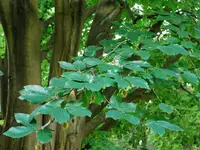
This species is native to Eastern Europe and Western Asia, where it forms dominant forests on cool, moist mountain slopes. Leaves are oval, glossy green, and form deep shade under the canopy.

Oriental beech grows best in temperate climates with consistent moisture and well-drained, fertile soil. Understanding how to care for Oriental Beech mainly involves giving it enough space, stable moisture, and protection from extreme heat or drought.

Main Plant Requirements

Care Difficulty

Moderate Care

Light Preference

Full Sun

Water Requirements

Moderate Water

Temperature Preference

Cold Hardy

Hardiness Zone

5–7

Soil Texture

Loamy, Clay, Organic-rich

Soil pH

Acidic (5.5–6.5), Slightly acidic (6.5–7.0)

Soil Drainage

Moist but well-drained

Fertilization

Minimal (feed rarely)

Get Personalized Care Plan

Scan your plant to receive care tips personalized for your specific plant

Available on iOS and Android

How to Care for the Oriental Beech

This temperate woodland tree prefers stable, moderate light conditions for balanced growth.

  • Provide 4–6 hours of direct morning sun with light shade or dappled light in the afternoon, especially in hotter regions.
  • Young Oriental Beech trees benefit from partial shade, while mature trees tolerate more sun if soil remains evenly moist.
  • Watch for leaf scorch on exposed southwest sides in summer and thinning, elongated shoots in deep shade, then adjust nearby shading or competing trees.

This species prefers consistently moist, well‑drained soil rather than frequent, shallow watering.

  • Allow the top 3–5 cm of soil to dry slightly, then water deeply so moisture reaches the full root zone, especially during the first 3–5 years after planting.
  • Reduce watering frequency in fall and winter, but avoid complete drying; in summer droughts, irrigate during long rain‑free periods and monitor leaf turgor.
  • Ensure soil drains freely; soggy conditions cause yellowing leaves and dieback, while crisp, browning leaf edges and premature leaf drop indicate underwatering.

This hardy deciduous tree is adapted to cool to warm temperate climates with distinct seasons.

  • Active growth is strongest in spring and early summer at 60–75°F (16–24°C), with dormancy in winter improving long‑term vigor.
  • Mature trees typically tolerate winter lows down to about -20°F (-29°C), though late spring frosts can damage new leaves and young shoots.
  • In hot spells above 90°F (32°C), the tree copes better when roots are mulched, soil moisture is stable, and exposure to intense late‑afternoon sun is limited.

This species is fairly tolerant of varied outdoor humidity and does not usually need special humidity management.

  • Performs well in 40–70% humidity, typical of many temperate outdoor climates.
  • Tolerates brief drier air, but prolonged hot, very dry winds can brown leaf edges on Oriental Beech.
  • Windbreaks, mulching, and avoiding heat-reflective hardscape nearby help reduce humidity stress around the canopy.

Fagus orientalis develops best in deep, moist, well‑structured soil with consistent aeration.

  • Use a loamy soil with a mix of mineral particles and organic matter so roots can anchor deeply without compaction.
  • Aim for slightly acidic to neutral pH around 5.5–7.0 to support nutrient uptake and mycorrhizal fungi.
  • In heavy clay, incorporate compost plus 20–30% coarse sand or fine grit into the top 30–40 cm to improve drainage and oxygen movement.
  • Avoid shallow, highly compacted, or waterlogged ground, which encourages root rot and weak anchorage over time.

This tree is only suitable for short‑term or bonsai‑style container culture, not long‑term full‑size growth.

  • Select a wide, heavy container to counterbalance the developing crown and prevent tipping in strong winds.
  • Use a deep, structured mix (for example 50% loam, 30% compost, 20% grit) to give roots stability without waterlogging.
  • Place the pot where strong sun and wind do not heat or dry the container sides excessively, which can stress fine roots.

This tree usually thrives in average garden soil and needs only modest feeding when establishing or under stress.

  • Apply a balanced slow-release fertilizer (around 10-10-10) once in early spring for young or nutrient-poor-site trees.
  • Use a light surface dressing of well-rotted compost over the root zone instead of heavy granular doses.
  • Avoid summer high-salt fertilizers; keep products at half the label strength for trees.
  • Stop feeding Fagus orientalis by late summer to allow wood to harden before winter.

Pruning Fagus orientalis is mainly structural and corrective rather than frequent shaping.

  • Carry out light pruning in late winter to early spring, before active growth.
  • Remove dead, diseased, crossing, or inward-growing branches first to improve airflow and structure.
  • Limit heading cuts; instead, use thinning cuts back to a side branch to maintain natural form.
  • Work with clean, sharp bypass pruners or a pruning saw, making smooth cuts just outside the branch collar.

This beech is seldom kept long-term in containers, so care focuses on careful outdoor transplanting.

  • Plan major transplanting of Fagus orientalis in late autumn or early spring while dormant.
  • Move only when root growth fills the planting hole area, growth slows, or roots circle a nursery container.
  • Dig a wide root ball, keep soil intact, and replant at the same depth in well-drained, slightly acidic soil.
  • Water thoroughly after transplanting, then maintain even moisture and mulch lightly to reduce root stress.

Propagation of Fagus orientalis is slower and usually done from seeds by nurseries rather than casual gardeners.

  • Collect ripe nuts in autumn and sow fresh, or cold-stratify at 34–41°F for 3–4 months before spring sowing.
  • Use deep trays or pots with a free-draining, slightly acidic medium and keep evenly moist, not waterlogged.
  • Provide bright light, cool conditions, and protection from rodents that may eat germinating seeds.
  • Allow seedlings to establish for 2–3 years before planting them out, hardening them off gradually.

Mature Fagus orientalis is cold hardy in much of the temperate US and usually needs minimal winter care.

  • Apply a 5–8 cm mulch layer over the root zone in late autumn, keeping mulch off the trunk.
  • Shelter young trees from drying winter winds with a temporary windbreak if sites are very exposed.
  • For container-grown saplings, move pots into an unheated garage or cold frame to avoid root freeze-thaw cycles.

Care Tips

Establish strong leader

In the first 5–8 years, select one straight central stem and remove or shorten competing uprights in late winter to build a stable single-leader structure that resists storm damage later.

Protect surface roots

Plan planting beds or a permanent mulch ring out to at least the canopy drip line so surface feeder roots are not compacted by foot traffic or damaged by lawn equipment.

Wind and snow management

In exposed sites, use temporary windbreak netting and avoid heavy crown thinning so the tree develops a flexible, evenly branched canopy that tolerates wind and wet snow loads.

Monitor bark sensitivity

Shield the southwest-facing trunk from sudden sun exposure after thinning or nearby tree removal by using a light-colored trunk guard or shade cloth for 2–3 seasons to prevent sunscald.

Understory planning

Choose deep-shade-tolerant groundcovers instead of turf beneath mature trees, as dense shade and a dry root zone under the spreading canopy make lawn maintenance under a large specimen unrealistic when growing Oriental Beech.

Common Pests and Diseases

Beech scale

This pest feeds on bark and twigs, appearing as small white, woolly spots that weaken the tree and open the way for fungal infection. Symptoms include roughened bark, dieback of fine branches, and overall decline in vigor.

Solution

Brush or wash infested bark with a stiff brush and water on smaller trees, and prune out heavily infested twigs. For larger specimens, use horticultural oil during the dormant season to reduce populations and monitor closely to prevent beech bark disease from becoming established.

Beech bark disease

This disease is a complex of beech scale insect damage and fungal infection (often Neonectria species) that causes cankers, cracked bark, and progressive dieback. Symptoms include rough, blistered bark, bleeding spots, and eventual branch or tree death if unmanaged.

Solution

Remove and destroy severely cankered branches, and avoid wounding the trunk to limit fungal entry. Control beech scale where possible, maintain overall tree vigor through proper watering and mulching, and consult an arborist for fungicide use on high‑value trees in early stages of infection.

Leaf spot

This disease causes brown or black spots on leaves, sometimes with a yellow halo, leading to premature leaf drop in humid or wet seasons. Symptoms include scattered spotting across the canopy and thinning foliage by late summer.

Solution

Rake and dispose of fallen leaves to reduce fungal spores and improve air circulation by selectively thinning nearby vegetation. In high‑value plantings with repeated issues, apply a registered foliar fungicide at bud break and repeat as labeled during prolonged wet periods as part of broader Fagus orientalis care instructions.

Beech leaf-mining weevil

These insects create winding or blotchy mines inside leaves, causing them to distort, brown, and drop early. Heavy infestations can reduce photosynthesis and weaken young trees.

Solution

Collect and destroy fallen leaves in autumn to remove overwintering stages and reduce pressure the following year. For young or high‑value trees with persistent damage, consider targeted systemic insecticides applied by a professional, timed to early larval activity, and support recovery with proper watering and mulch.

Powdery mildew

This disease produces a white, powdery coating on leaves, especially in shaded or crowded conditions, which can lead to distorted growth and reduced vigor. Symptoms include dull, grayish foliage and premature leaf yellowing later in the season.

Solution

Increase light and airflow by pruning nearby plants or selective thinning of interior branches, and avoid overhead watering in the evening. On young landscape trees, treat early infections with a labeled fungicide or horticultural oil, repeating as needed according to directions while monitoring for new growth infection.

Interesting Facts

Dominant Eurasian canopy

Oriental beech forms vast, almost pure stands in parts of Turkey, the Caucasus, and northern Iran, where its dense canopy structure strongly shapes understory plant communities and local microclimates.

Hybridization with European beech

In regions like the Balkans and parts of Western Europe, Oriental beech readily hybridizes with Fagus sylvatica, creating intermediate forms that are studied for insights into gene flow and climate adaptation in beech forests.

Key montane forest builder

This species is a primary framework tree in moist montane forests from sea level up to high elevations in its native range, where it stabilizes slopes, influences soil formation, and supports diverse fungi, lichens, and invertebrates.

Botan icon

Did you know?

Large, old oriental beech trees often host intricate communities of specialized wood-decaying fungi and cavity-nesting birds, and some veteran individuals in the Caucasus region are estimated from growth ring studies to be close to 300 years old, making them important long-term ecological reference points.

FAQs about Oriental Beech

Growth is moderate. In suitable outdoor conditions, this tree commonly adds about 30–60 cm in height per year once established. Young trees may grow a bit faster, while very old specimens slow down noticeably.

Grow Healthy Plants with Botan Care

Keep your plants happy and healthy with plant identification, disease detection, and easy care guidance.

Botan plant care app — identify plants on mobile

Explore More Plants