Install Strong Support
Provide a sturdy trellis, wire mesh, or fence before the plant starts its rapid spring growth so the vines can be loosely tied and directed upward instead of smothering nearby plants or collapsing under their own weight.

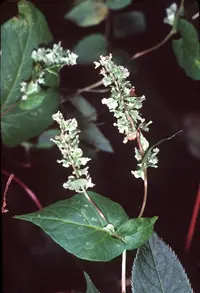
Climbing false buckwheat (Fallopia scandens) is a fast-growing, twining vine in the knotweed family, often found scrambling over shrubs, fences, and woodland edges. It produces slender, angular stems, heart-shaped leaves, and loose clusters of small greenish-white flowers that mature into papery, three-sided fruits.
This species is native to North America and commonly occurs along riverbanks, disturbed sites, hedgerows, and open woodlands. It can spread rapidly in favorable conditions, so it is considered vigorous and sometimes weedy.
Fallopia scandens is generally easy to maintain where spreading is acceptable. It prefers sun to light shade, moderately moist soil, and some support for climbing, which guides how to care for climbing false buckwheat in garden settings.

Care Difficulty
Easy Care

Light Preference
Partial Sun

Water Requirements
Moderate Water

Temperature Preference
Cold Hardy

Hardiness Zone
4–8

Soil Texture
Sandy, Loamy, Silty

Soil pH
Acidic (5.5–6.5), Slightly acidic (6.5–7.0)

Soil Drainage
Moist but well-drained

Fertilization
Minimal (feed rarely)
Scan your plant to receive care tips personalized for your specific plant
Available on iOS and Android
This vigorous native climber thrives in bright outdoor conditions with some protection from harsh midday sun.
This twining vine prefers evenly moist, well-drained soil rather than constant wetness or drought stress.
This hardy perennial vine grows best in temperate outdoor climates with cool to warm summers and cold winters.
This species is generally tolerant of average outdoor humidity and does not require special moisture in the air.
Fallopia scandens thrives in moderately moist, well-structured soil that does not stay waterlogged.
This species can be grown in containers if the pot supports its vigorous climbing habit.
This vigorous native vine usually needs only light feeding, especially in richer soils.
Pruning helps manage the size and vigor of Fallopia scandens, especially in small gardens or near structures.
This vine is more often transplanted in the ground than grown long term in containers.
Fallopia scandens spreads readily, and propagation methods should be chosen carefully to avoid unwanted invasiveness.
This hardy perennial vine usually overwinters well in most temperate climates with minimal intervention.

Plant Health Check
Not sure what's wrong with your plant? Check your plant's health inside the app.
This species climbs by twining its flexible stems clockwise around nearby supports, a growth pattern driven by differential cell expansion on opposite sides of the stem.
Its fruits are small, 3-angled achenes often enclosed by persistent, papery tepals that help them travel short distances by wind and water along river corridors.
Fallopia scandens is strongly associated with moist, nutrient-rich habitats such as floodplains, riparian thickets, and disturbed stream banks, where periodic flooding helps it spread and maintain dense stands.

In some regions of North America, this native vine forms dense tangles that can climb several meters into shrubs and young trees, creating shaded understories that significantly alter light conditions for ground-layer plants and seedlings.
This vine spreads quickly by twining stems and abundant seed, especially in moist, disturbed sites. It can smother nearby vegetation and natural areas, so monitor edges, remove unwanted seedlings, and cut back regularly to keep it contained.
Keep your plants happy and healthy with plant identification, disease detection, and easy care guidance.