Secure Rock Placement
Anchor the plant between stable rocks or in a heavy, well-drained container mix so the shallow roots and stiff leaves are not rocked loose by wind or handling.

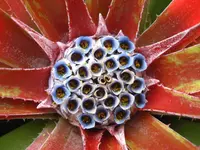
Rhodostachys (Fascicularia bicolor) is a small terrestrial or epiphytic bromeliad valued for its rosette of stiff, arching leaves and striking central color display. The foliage is usually gray-green, with the inner leaves turning bright red around a tight cluster of blue and white flowers when in bloom.
This species is native to Chile, where it grows in rocky, coastal, and sometimes cooler conditions, making it more cold-tolerant than many tropical bromeliads. Its compact size, slow growth, and tolerance of lower temperatures can make it relatively straightforward to care for Rhodostachys in suitable light and well-drained, airy substrate.
It prefers bright light, moderate moisture with good drainage, and protection from prolonged hard frost, which aligns well with many mild-climate outdoor or bright indoor settings.

Care Difficulty
Moderate Care

Light Preference
Full Sun

Water Requirements
Low Water

Temperature Preference
Warm Climate

Hardiness Zone
8–10

Soil Texture
Sandy, Loamy, Rocky

Soil pH
Acidic (5.5–6.5), Slightly acidic (6.5–7.0)

Soil Drainage
Well-drained

Fertilization
Minimal (feed rarely)
Scan your plant to receive care tips personalized for your specific plant
Available on iOS and Android
Fascicularia bicolor prefers bright, cool conditions with several hours of direct sun each day.
Fascicularia bicolor prefers light, infrequent watering that mimics its dry, rocky habitats.
This hardy bromeliad prefers mild, cool-temperate conditions with good air movement.
Fascicularia bicolor handles a wide humidity range but benefits from moderately moist air.
This bromeliad prefers very free-draining, airy soil that dries quickly after watering.
This species adapts well to container growing outdoors in mild climates.
Fascicularia bicolor is a low‑nutrient bromeliad that benefits from light feeding in active growth but resents heavy fertilization, similar to many Rhodostachys relatives.
Pruning Fascicularia bicolor focuses on hygiene and maintaining a tidy rosette rather than reshaping the plant.
Fascicularia bicolor is often grown in the ground or on rocks, but container plants sometimes need careful transplanting.
Fascicularia bicolor is most commonly propagated by division of offsets rather than from seed.
Fascicularia bicolor is relatively cold hardy but benefits from simple winter protection in harsher climates.

Plant Health Check
Not sure what's wrong with your plant? Check your plant's health inside the app.
This bromeliad is native mainly to coastal central Chile, where it naturally anchors into rocky cliffs, coastal bluffs, and stone walls rather than forest canopies like many other bromeliads.
Unlike most bromeliads, it tolerates brief light frosts and relatively low temperatures, which has allowed gardeners to grow Fascicularia bicolor outdoors in mild maritime climates such as parts of the UK and coastal Pacific Northwest.
Its stiff, spiny leaves form a tight rosette that creates a small water-holding tank, providing microhabitat for insects and other small organisms in its native rocky environments.

When the central rosette approaches flowering, the inner leaves can turn an intense scarlet while the center develops a tight cluster of blue and white flowers, creating a naturally occurring red, white, and blue target that strongly contrasts with the gray-green outer foliage.
Flowering usually occurs only once on a mature rosette, often after several years. Lack of blooms often relates to insufficient light, too much nitrogen fertilizer, or the plant simply not being old enough yet.
Keep your plants happy and healthy with plant identification, disease detection, and easy care guidance.