Root disturbance control
Plant in a permanent position and avoid digging, replanting, or heavy cultivation around the root zone, because damaged proteoid roots recover poorly and can trigger plant decline.

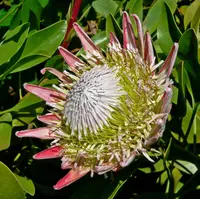
The king protea, Protea cynaroides, is a woody shrub known for its large, architectural flower heads and thick, leathery leaves. It is the national flower of South Africa and naturally grows in nutrient-poor, well-drained soils of the fynbos shrublands.
Plants form a low, spreading habit with stout stems and long-lived flower heads that suit dramatic cut-flower use. They evolved to tolerate dry periods, strong sun, and occasional fire, which means they dislike rich, wet, or heavy soils.
These adaptations make them somewhat challenging in typical garden conditions, especially where summers are humid or soils stay moist. Understanding how to care for king protea starts with providing sun, sharp drainage, and low-fertility soil.

Care Difficulty
Hard Care

Light Preference
Full Sun

Water Requirements
Low Water

Temperature Preference
Warm Climate

Hardiness Zone
9–11

Soil Texture
Sandy, Loamy, Rocky

Soil pH
Strongly acidic (4.5–5.5), Acidic (5.5–6.5)

Soil Drainage
Well-drained

Fertilization
Minimal (feed rarely)
Scan your plant to receive care tips personalized for your specific plant
Available on iOS and Android
Protea cynaroides needs abundant direct sun to form strong stems and full flowers.
This species prefers infrequent, deep watering in very free-draining soil.
This shrub thrives in mild, Mediterranean-type climates with cool wet winters and warm dry summers.
Humidity is not a major factor for Protea cynaroides, which is adapted to dry, breezy environments.
Protea cynaroides needs very free-draining, low-nutrient soil to prevent root rot and support long-term health.
This species can be grown in containers if drainage is excellent and the pot is managed for its deep, sensitive roots.
Protea cynaroides is adapted to nutrient-poor soils and needs very light feeding to stay healthy in cultivation.
Pruning Protea cynaroides is useful for maintaining shape and encouraging strong flowering wood.
Protea cynaroides is usually grown in the ground, but container plants or young shrubs sometimes need careful transplanting.
Propagation of Protea cynaroides is possible but technically demanding, especially for home growers.
Winter care for Protea cynaroides depends strongly on climate, as this species dislikes prolonged freezing conditions.

Plant Health Check
Not sure what's wrong with your plant? Check your plant's health inside the app.
Protea cynaroides is the national flower of South Africa and appears on the country’s coat of arms and some coins, reflecting its symbolic importance for resilience and biodiversity.
This species is native to the fynbos shrublands of the Western and Eastern Cape, where its woody flower heads and underground bud reserves allow it to survive and re-sprout after periodic wildfires.
The large, bowl-shaped flower heads produce copious nectar and are mainly pollinated by nectar-feeding birds such as Cape sugarbirds and sunbirds, which transfer pollen as they feed among the tightly packed florets.

The individual flower head of Protea cynaroides is actually a composite structure made up of hundreds of small tubular flowers surrounded by colorful bracts, and in ideal conditions these heads can reach more than 30 cm across, making it one of the largest-flowered members of the Proteaceae family.
Lack of blooms usually comes from plants being too young, insufficient light, excess fertilizer, or pruning at the wrong time. Flowers form on older wood, so avoid heavy pruning and prioritize stable, low-phosphorus Protea cynaroides care.
Keep your plants happy and healthy with plant identification, disease detection, and easy care guidance.