Summer rain strategy
If kept outdoors in summer, move the pot under clear shelter during extended rainy periods to prevent the rosette center from staying wet and rotting.

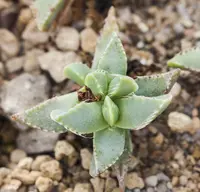
Cat tigerfig, Faucaria felina, is a small clumping succulent from arid regions of South Africa. It forms low rosettes of thick, triangular leaves with tooth-like edges that resemble an open animal mouth. The leaves often have pale spots and rough textures that break up sunlight and reduce water loss.
This plant stays compact and slow-growing, which makes it suitable for containers, windowsills, and small indoor collections. Its main needs are strong light, minimal watering, and a gritty, free-draining soil mix. These traits generally make it easy to care for Cat Tigerfig if overwatering is avoided.

Care Difficulty
Easy Care

Light Preference
Full Sun

Water Requirements
Low Water

Temperature Preference
Tropical / Frost Sensitive

Hardiness Zone
10–11

Soil Texture
Sandy, Loamy, Rocky

Soil pH
Slightly acidic (6.5–7.0), Neutral (7.0)

Soil Drainage
Well-drained

Fertilization
Minimal (feed rarely)
Scan your plant to receive care tips personalized for your specific plant
Available on iOS and Android
This compact South African succulent thrives with bright, direct light but benefits from some protection in extreme sun.
This drought-tolerant succulent prefers thorough but infrequent watering in fast-draining soil.
This species prefers warm, dry conditions and has limited tolerance to frost or prolonged cold.
Humidity is rarely a concern for this drought-adapted succulent.
Faucaria felina prefers a very fast-draining, mineral-based mix that mimics dry, rocky habitats.
This small succulent is very suitable for container growing.
This small succulent has low nutrient needs but responds well to light feeding in active growth.
Pruning needs for Faucaria felina are minimal and focus on cleanliness and compact shape.
This succulent prefers tight pots and only needs repotting when clearly root-bound or declining.
Faucaria felina is commonly propagated by division of offsets and from seed in suitable warm conditions.
This succulent is not frost hardy and needs careful winter care in most temperate climates.

Plant Health Check
Not sure what's wrong with your plant? Check your plant's health inside the app.
This species has opposite pairs of thick triangular leaves edged with stiff, tooth-like projections that mimic an open animal jaw, which likely evolved as camouflage among rocky, spiky vegetation in its native habitat of South Africa’s Eastern Cape.
Unlike many succulents that bloom in spring or summer, this species typically produces its yellow, daisy-like flowers in autumn, opening in bright light during the day and closing again toward evening.
Its compact rosettes store water in highly succulent leaves, allowing the plant to survive long dry periods in shallow, stony soils where moisture is brief and unpredictable.

In the wild, this species often grows tightly wedged in rock crevices or gravel pockets, so that only the top of the leaf pairs is visible at soil level, which reduces water loss and makes the plant less noticeable to herbivores.
Growth is slow, typically forming small clumps over several years rather than quickly filling a pot. It mainly adds size in the warmer months, then almost stops in winter dormancy, which is normal for this succulent.
Keep your plants happy and healthy with plant identification, disease detection, and easy care guidance.