


red fescue Identification (Festuca rubra)

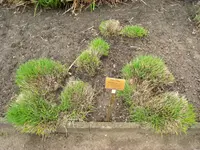
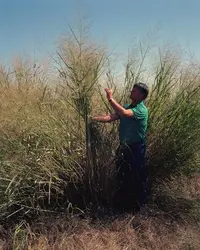
Recognize red fescue by its dense, tufted growth, very narrow folded leaves, and fine flowering stems that rise above the foliage. Leaves are usually less than 1/16 inch (2 mm) wide and mostly basal, forming low clumps or loose spreading patches.

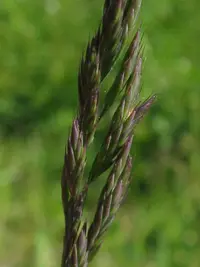
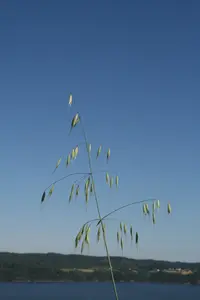
The seedheads are open, narrow panicles with small, laterally flattened spikelets.

Festuca rubra Identification

Scan to Confirm red fescue

Not sure about your plant ID? Upload a photo and check it with Botan.

Clear images work best. Avoid photos taken too close or too far away

  • 1 free identification
  • No sign-up
  • 30,000+ plants in database

Check the plant’s fine texture and low, tufted form first.

  • Leaves are very narrow, threadlike blades, usually less than 1/16 inch (2 mm) wide.
  • Growth forms dense clumps, often with short creeping stems that spread between tufts.
  • Leaf bases and lower sheaths sit close to the ground, creating a tight, grassy mat.
  • Flowering stems rise above the leaves, often reaching about 8-24 inches (20-60 cm) tall.
  • Seed heads are open, airy panicles with many small spikelets held on fine branches.

Use the combination of fine leaves, tufted growth, and open seed heads to confirm Festuca rubra.

Festuca rubra shows useful visual shifts from fine seedlings to airy flowering clumps.

  • Seedling: Seedlings appear as a few very narrow, folded blades rising singly from the base, without a tufted crown or obvious spreading habit.
  • Young plant: The plant forms a small tuft of threadlike leaves, and creeping rhizomes may begin producing nearby shoots, unlike the isolated seedling stage.
  • Mature plant: Mature red fescue forms dense tufts or loose patches, with many basal leaves and slender upright culms reaching about 1-3 feet (30-90 cm).
  • Flowering stage: Open, branched panicles lift above the leaves, giving a lighter outline; small spikelets line the branches, making the clump look less strictly tufted.

In late spring to early summer, Festuca rubra is easier to spot when its flowering stems rise above the fine, narrow leaves. The open flower clusters give patches a lighter, airier look than when seen only in leaf. In colder months, foliage often stays present but may look duller or brown-tipped, especially after frost, so tufts can appear less bright and neat than in the growing season.

A few fine-leaved turf grasses are often mistaken for red fescue.

hard fescue(Festuca brevipila)

Both form dense, fine-textured tufts. Hard fescue is usually more blue-gray and stiffer, while red fescue is greener and often spreads by short rhizomes, meaning underground stems.

Chewings fescue(Festuca rubra subsp. commutata)

This is very close in appearance because it is a tufted form within the red fescue complex. It lacks the obvious creeping rhizomes seen in many red fescue plants.

sheep fescue(Festuca ovina)

Both have very narrow leaves and a bunching habit. Sheep fescue usually stays in tighter, smaller clumps and lacks the creeping spread that is common in red fescue.

Festuca rubra is native across much of the temperate and colder Northern Hemisphere, including North America, Europe, and northern Asia. That broad but well-documented range helps most when a fine-leaved fescue is found in cool regions rather than tropical or arid settings. In the wild it occurs in grasslands, coastal dunes, meadows, open woodlands, and alpine or subalpine turf. Seeing it in cool coastal sites, upland pasture, or mountain grassland can help narrow identification among similar lawn and meadow grasses.

Does Your Plant Match?

Use Botan to compare a photo and help identify or confirm the plant before you label it or choose the next steps.

FAQ

The quickest clue is its very fine, bristle-like leaf blades paired with a bunching to gently spreading habit from short rhizomes. For red fescue identification, look for narrow leaves and a delicate, open seedhead.

More Plant Identification Guides

Know What Plant You Have

Identify it from a photo with Botan, then review plant details, care information, and common problems for that species.

Botan app identifying a plant from a photo
How to Mulch in the Fall and When to Wait Until Spring

5 min read · 12 Nov 2026

How to Mulch in the Fall and When to Wait Until Spring

In the fall, mulch gives the roots of trees and shrubs insulation and more stable conditions through winter. In the spring, it mainly suppresses weeds and keeps moisture in the soil during the growing season.

Beginner Guides
How to Mulch in the Fall and When to Wait Until Spring
Dill Companion Plants – What to Grow Next to Dill

9 min read · 17 Jul 2026

Dill Companion Plants – What to Grow Next to Dill

Dill is an easy-to-grow plant that gets along well with many vegetables. This guide describes 15 plants that can be planted alongside it, a few to avoid, and mistakes that can quietly sabotage the entire process.

Plant Recommendations
Dill Companion Plants – What to Grow Next to Dill
Best Fertilizer for Vegetable Gardens – What to Use for Each Plant

11 min read · 20 Jul 2026

Best Fertilizer for Vegetable Gardens – What to Use for Each Plant

Here, you’ll find the right fertilizer formula for vegetables in your garden. Learn how to adjust feeding correctly throughout the growing cycle, spot nutrient deficiencies by their symptoms, and keep your plants healthy and prolific.

Plant Recommendations
Best Fertilizer for Vegetable Gardens – What to Use for Each Plant