Structured branch training
Use soft plant ties to spread main branches outward from the trunk while young, checking and adjusting every 4–6 weeks so the canopy develops a balanced, tree-like form without bark damage.

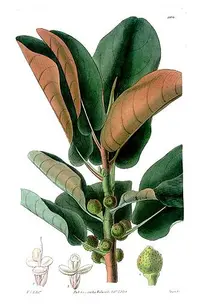
Port Jackson fig, Ficus rubiginosa, is an evergreen fig tree native to eastern Australia. It often grows as a spreading tree with a dense, rounded canopy and glossy green leaves. In nature it can form buttress roots and aerial roots, especially in humid, mild climates.
As a container or bonsai subject, it stays much smaller but keeps its compact branching and thick, textured trunk. It adapts well to indoor and patio conditions when given bright light and moderate, consistent moisture. Understanding how to care for Port Jackson fig focuses mainly on providing stable light, avoiding waterlogging, and using a well-drained growing mix.

Care Difficulty
Moderate Care

Light Preference
Full Sun

Water Requirements
Moderate Water

Temperature Preference
Warm Climate

Hardiness Zone
9–11

Soil Texture
Sandy, Loamy, Clay

Soil pH
Slightly acidic (6.5–7.0), Neutral (7.0)

Soil Drainage
Well-drained

Fertilization
Minimal (feed rarely)
Scan your plant to receive care tips personalized for your specific plant
Available on iOS and Android
Ficus rubiginosa thrives in bright light with some protection from intense midday sun.
Ficus rubiginosa prefers evenly moist, well-drained soil and does not tolerate prolonged waterlogging.
This fig grows best in mild, frost-free climates with warm summers and cool, not cold, winters.
This species handles a wide humidity range but grows best with moderate moisture in the air.
Ficus rubiginosa prefers a fast-draining, airy mix that still holds moderate moisture.
This species adapts well to container growing, including long-term culture as a patio or indoor tree.
Ficus rubiginosa responds well to modest, consistent feeding during the warm growing season.
Ficus rubiginosa benefits from thoughtful pruning to control size and maintain a strong framework.
Container-grown Ficus rubiginosa and young landscape trees need occasional repotting or transplanting to support healthy root development.
Ficus rubiginosa is commonly propagated from cuttings and, less often, from seed or air layering.
Ficus rubiginosa is frost sensitive and needs protection in climates with cold winters.

Plant Health Check
Not sure what's wrong with your plant? Check your plant's health inside the app.
The specific name rubiginosa refers to the rusty-brown hairs on the underside of the leaves, a feature that helps distinguish this species from many other fig trees.
In its native range in eastern Australia, this species is pollinated almost exclusively by the tiny fig wasp Pleistodontes imperialis, an example of the tight mutualism between figs and their specific wasp partners.
Ficus rubiginosa often starts life as a seed lodged in rock crevices or tree forks; its roots then thicken and exploit small cracks, gradually widening them and sometimes splitting rock over many years.

In suitable climates, Ficus rubiginosa can develop massive surface roots and a broad, spreading crown that provide important habitat structure for urban wildlife, and the species has become a notable street and park tree in cities such as Sydney due to its resilience to wind, pruning, and air pollution.
Growth is moderately fast in warm, frost-free climates, often adding 30–60 cm of height per year outdoors. In containers or cooler areas it grows more slowly, especially if root-bound or pruned regularly for size control.
Keep your plants happy and healthy with plant identification, disease detection, and easy care guidance.