Host selection
Establish cultures only on non-structural hardwood logs or stump sections, as this wood-decay fungus can significantly weaken living or structural trees if introduced to unsuitable hosts.

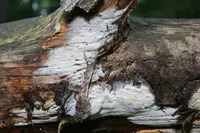
Flavidoporia pulvinascens is not a leafy houseplant but a crust-like wood decay fungus that forms cushiony patches on dead or weakened trees. It typically appears as low, irregular, yellowish to ochre growth tightly attached to the wood surface.
This species is native to forested regions, where it contributes to the breakdown of woody material and nutrient cycling. It can indicate advanced internal wood decay, so it is more relevant to arborists and forest managers than to casual home growers.
Those who want to understand how to care for Flavidoporia pulvinascens mainly focus on providing suitable woody substrates, stable moisture, and shaded, forest-like conditions rather than traditional pot culture.

Care Difficulty
Moderate Care

Light Preference
Partial Shade

Water Requirements
Moderate Water

Temperature Preference
Warm Climate

Hardiness Zone
Unknown

Soil Texture
Loamy

Soil pH
Slightly acidic (6.5–7.0)

Soil Drainage
Well-drained

Fertilization
Minimal (feed rarely)
Scan your plant to receive care tips personalized for your specific plant
Available on iOS and Android
This fungus develops best in stable, low to moderate light similar to shaded woodland conditions.
Moist but not waterlogged conditions support steady colonization of the woody substrate.
Stable, cool to mild temperatures suit this wood-decay fungus best.
This wood-decay fungus has no meaningful humidity requirements for cultivated care under normal outdoor conditions.
This species develops on dead or decaying wood rather than in mineral soil, so conditions should mimic coarse, woody debris.
This species is not well suited to ornamental container growing, though it can be maintained experimentally on wood in controlled containers.
This wood-decaying fungus typically grows on nutrient-rich host trees and does not benefit from supplemental fertilization in cultivation.
Active pruning is not part of standard management for Flavidoporia pulvinascens, since it functions as a wood-decay fungus rather than a foliage or flowering plant in cultivation.
As a wood-inhabiting fungus, it is not maintained in pots and is managed through host wood removal rather than classic repotting or transplanting.
Intentional propagation is not recommended, as this fungus is typically considered a wood-decay or potential pathogen rather than an ornamental or crop species.
No specific winter care is applied, since this fungus is adapted to natural outdoor temperature cycles and persists in or on wood year-round.

Plant Health Check
Not sure what's wrong with your plant? Check your plant's health inside the app.
This crust-forming polypore is mainly associated with eucalyptus and other hardwoods, where it causes a white rot that selectively breaks down lignin and leaves the wood lighter in color and more fibrous.
Mature fruiting bodies form thick, cushiony patches that are resupinate, meaning they lie flat and adherent to the wood surface rather than forming stalked or bracket-like structures.
The fertile surface is covered with very small, tightly packed pores that release basidiospores; this fine pore layer is a key microscopic character used by mycologists to identify this species with confidence.
This wood-decay fungus is not considered edible. It is tough, corky, and lacks culinary value. There is limited toxicological data, so it should be treated as inedible and left on host wood rather than harvested for food.
Keep your plants happy and healthy with plant identification, disease detection, and easy care guidance.