

Select suitable hosts
Install hardwood logs or stumps from fir or spruce species known to host this fungus, avoiding chemically treated or freshly chainsaw-oiled wood that can inhibit colonization.

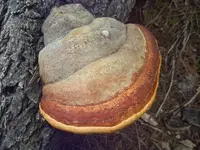
Red belt conk, Fomitopsis schrenkii, is a perennial bracket fungus rather than a leafy plant. It forms hard, shelf-like fruiting bodies on conifer trunks and logs. The surface often shows clear color zoning, with reddish to brown bands and a pale margin, and it can persist on wood for many years.
This species is native to western North America, especially in montane and subalpine forests. It naturally colonizes dead or weakened trees and plays a role in wood decay. In cultivation, it is slow-growing and best suited to advanced growers interested in wood-decomposing fungi. Those who want to learn how to care for Red Belt Conk should focus on providing stable moisture and well-decayed conifer wood rather than conventional soil.

Care Difficulty
Moderate Care

Light Preference
Partial Shade

Water Requirements
Keep Soil Moist

Temperature Preference
Cool Climate

Hardiness Zone
Unknown

Soil Texture
Loamy, Organic-rich, Rocky

Soil pH
Acidic (5.5–6.5)

Soil Drainage
Moist but well-drained

Fertilization
Minimal (feed rarely)
Scan your plant to receive care tips personalized for your specific plant
Available on iOS and Android
This wood-decaying fungus prefers stable, forest-like light similar to its native conifer habitats.
Moisture availability matters more than direct watering because this fungus usually colonizes dead or dying wood.
This species is adapted to cool to temperate forest conditions with significant seasonal temperature swings.
This wood-decay fungus tolerates a wide humidity range but fruits best in consistently moist air.
Fomitopsis schrenkii naturally colonizes conifer wood, not mineral soil, but substrate preparation still matters.
This species is only moderately suitable for container growing and is best managed on log sections placed in sturdy tubs or boxes.
This wood-decay fungus naturally colonizes host trees and does not require routine fertilization in cultivation or the wild.
Pruning is generally unnecessary for Fomitopsis schrenkii, which forms hard, perennial brackets on host trees.
This fungus is seldom grown in pots; management focuses on when to remove or relocate colonized wood rather than classic repotting.
In managed settings, Fomitopsis schrenkii is propagated mainly by introducing cultured mycelium or spore inoculum into suitable conifer wood.
This perennial conk is highly cold hardy and typically requires no special winter protection on outdoor host trees.

Plant Health Check
Not sure what's wrong with your plant? Check your plant's health inside the app.
This species is native to high-elevation conifer forests of the southern Rocky Mountains, where it primarily colonizes dead or stressed conifers such as spruce and fir, contributing to wood decomposition in these ecosystems.
For many years it was grouped under the red-belted conk complex, but DNA studies and detailed morphology led to its formal recognition as a distinct species, reflecting how fungal taxonomy is being reshaped by molecular tools.
Mature fruiting bodies form thick, woody shelves with a characteristic reddish band near the growing edge, which helps separate it in the field from similar brown- or gray-zoned bracket fungi on conifers.

This bracket fungus can persist on the same log for many years, adding new pore layers annually and forming multi-layered, woody shelves that allow mycologists to estimate the age of individual conks by counting these growth layers, similar to tree rings.
This bracket fungus spreads slowly through wood, not soil. It colonizes stressed or dead conifers via spores and can gradually extend along a trunk, but it does not run through gardens or lawns like invasive plants.
Keep your plants happy and healthy with plant identification, disease detection, and easy care guidance.

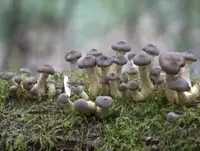
mullet honey fungus
Armillaria cepistipes
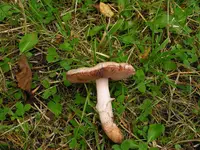
Scaly Wood Mushroom
Agaricus langei
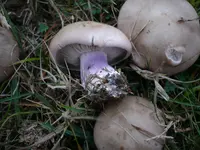
Field Blewit
Lepista saeva
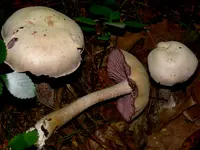
Purple-and-White Deceiver
Laccaria ochropurpurea
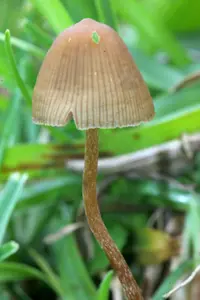
Psilocybe mexicana
Psilocybe mexicana
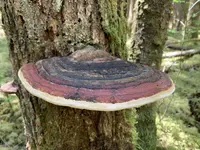
Northern Red Belt
Fomitopsis mounceae
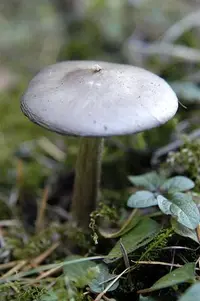
Melanoleuca strictipes
Melanoleuca strictipes
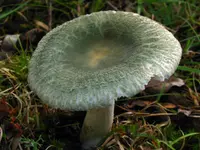
Blue-green Cracking Russula
Russula parvovirescens