Host tree matching
Survey the site for compatible hardwood hosts such as oaks or beeches and focus inoculation efforts around the dripline of these trees, since this species depends on forming mycorrhizal partnerships with their roots.

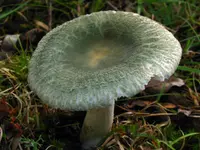
Russula parvovirescens, commonly called blue-green cracking russula, is an ectomycorrhizal mushroom that forms a symbiotic relationship with tree roots. It is not a houseplant but a wild forest fungus.
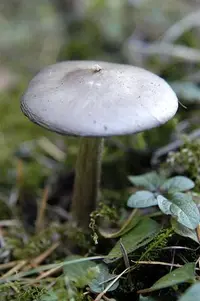
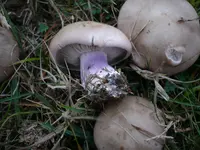
The cap is pale blue-green with a distinctive cracked pattern that exposes white flesh, while the gills are white to cream and the stem is stout and smooth. It typically appears on the ground in mixed hardwood forests in eastern North America, often near oaks.
As a mycorrhizal species, it is difficult to cultivate artificially because it depends on specific tree partners and soil life. Information on how to care for Blue-green Cracking Russula at home is very limited, and most encounters are with wild specimens only.

Care Difficulty
Hard Care

Light Preference
Partial Shade

Water Requirements
Keep Soil Moist

Temperature Preference
Warm Climate

Hardiness Zone
Unknown

Soil Texture
Loamy, Silty, Organic-rich

Soil pH
Strongly acidic (4.5–5.5), Acidic (5.5–6.5)

Soil Drainage
Moist but well-drained

Fertilization
Minimal (feed rarely)
Scan your plant to receive care tips personalized for your specific plant
Available on iOS and Android
Russula parvovirescens fruits best in bright, dappled woodland light rather than direct, open sun.
Russula parvovirescens requires consistently moist, not waterlogged, forest soil to form healthy fruiting bodies.
This woodland fungus prefers mild conditions and is sensitive to both hard frost and prolonged extreme heat.
Humidity is not a meaningful factor for Russula parvovirescens, which grows as a wild ectomycorrhizal mushroom rather than a cultivated houseplant.
Russula parvovirescens grows in undisturbed forest soil, not in prepared potting media, so soil manipulation is rarely useful.
This species is not suitable for typical container growing, as it depends on living tree roots and complex forest soil conditions.
This ectomycorrhizal mushroom relies on its tree partners for nutrients and usually does not benefit from direct fertilization.
Pruning is not applicable to Russula parvovirescens, as it is a wild mushroom fruiting from underground mycelium rather than a plant with branches or stems.
This fungus is not suited to typical repotting; it forms a symbiotic relationship with tree roots in soil.
Propagation of Russula parvovirescens is specialized and rarely undertaken by home growers.
This woodland mushroom is naturally cold hardy in its native range and needs no specific winter care in the ground.

Plant Health Check
Not sure what's wrong with your plant? Check your plant's health inside the app.
The cap shows a characteristic green to blue-green surface broken into pale patches, creating a mosaic or cracked pattern that helps distinguish it from other green Russula species in the field.
This species forms ectomycorrhizal associations with hardwoods, especially oaks, exchanging mineral nutrients and water from the soil for sugars produced by the tree through photosynthesis.
It is primarily known from eastern North America, especially in deciduous forests, and is not the same as the superficially similar European green-cracking russula species found across the Atlantic.
This species is considered edible and mild-tasting when correctly identified, but it is easy to confuse with toxic russulas. Only experienced foragers should consume it, and local expert confirmation is strongly recommended before eating any wild mushrooms.
Keep your plants happy and healthy with plant identification, disease detection, and easy care guidance.