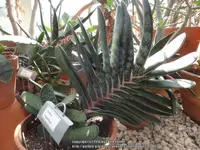
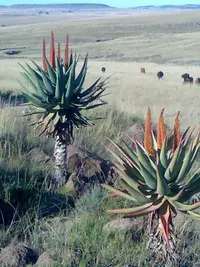
female karata Care (Furcraea tuberosa)

Also known as: Narrow-leaved Furcraea
female karata

About female karata

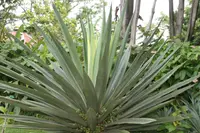
Furcraea tuberosa, often called female karata, is a succulent-like rosette plant with thick, sword-shaped leaves and a strong architectural form. It resembles an agave but is usually less spiny. Native to dry, rocky regions of Central and South America, it is adapted to heat, sun, and lean, well-drained soils. The plant forms a basal clump and can eventually send up very tall flowering spikes with many small plantlets. Its drought tolerance and slow to moderate growth rate make it relatively low-maintenance in suitable climates. Understanding how to care for female karata starts with providing bright light, infrequent watering, and a gritty, fast-draining substrate.

Main Plant Requirements

Care Difficulty

Easy Care

Light Preference

Full Sun

Water Requirements

Low Water

Temperature Preference

Tropical / Frost Sensitive

Hardiness Zone

10–12

Soil Texture

Sandy, Loamy, Rocky

Soil pH

Slightly acidic (6.5–7.0), Neutral (7.0)

Soil Drainage

Well-drained

Fertilization

Minimal (feed rarely)

Get Personalized Care Plan

Scan your plant to receive care tips personalized for your specific plant

Available on iOS and Android

How to Care for the female karata

Furcraea tuberosa prefers strong light similar to arid or coastal habitats.

  • Provide 6–8 hours of direct sun daily; full sun is ideal, especially morning to early afternoon light.
  • Plant can tolerate light partial shade (2–4 hours direct sun) but rosettes may elongate and variegation fade with too little light, especially in female karata plantings.
  • In very hot regions, give slight afternoon shade in summer to reduce leaf scorch and sunburn, especially on young or recently transplanted plants.

This succulent agave relative needs infrequent, deep watering and excellent drainage.

  • Outdoors in well-drained soil, water only when the top 5–8 cm are completely dry; in many warm climates this means every 10–21 days in the growing season.
  • Reduce watering sharply in cool or cloudy weather; wrinkling lower leaves suggest slight underwatering, while soft, yellowing bases signal excess moisture or rot risk.
  • Ensure sharply draining, gritty soil or a sloped site so water never stands around the roots, especially during heavy seasonal rains affecting Furcraea tuberosa.

This species thrives in warm, frost-free climates with hot summers and mild winters.

  • Optimal growth occurs around 70–90°F (21–32°C), typical of warm subtropical or tropical zones with strong sun and low humidity.
  • Plants tolerate brief heat up to about 100–105°F (38–41°C) if soil drains well and roots are not waterlogged during hot periods.
  • Minimum safe temperature is about 30–32°F (-1–0°C); foliage is very sensitive to frost, so protect or cover plants during cold snaps and avoid sites with frequent freezes.

Humidity is a minor factor for Furcraea tuberosa, which thrives in dry, arid-style air.

  • Target 30–50% humidity, similar to average heated or air-conditioned homes, as higher levels are unnecessary.
  • The plant tolerates very dry air; only extreme dryness with intense heat may cause leaf-tip browning.
  • If leaf edges crisp and curl, increase humidity slightly by grouping plants or placing a shallow water tray nearby.

This species needs fast-draining, mineral-rich soil that mimics rocky, semi-arid habitats.

  • Use a gritty, sandy mix such as 50–60% coarse sand or fine gravel with 40–50% cactus/succulent mix for Furcraea tuberosa.
  • Aim for slightly acidic to neutral pH, around 6.0–7.2, to keep nutrients available without encouraging rot.
  • Improve aeration by adding perlite or pumice; these components keep pores open and roots oxygenated after watering.
  • Avoid dense, water-retentive mixes with high peat or clay content, which hold moisture around the roots and promote fungal rot.

This species is suitable for container growing, especially in regions with cool or wet winters.

  • Choose a wide, heavy pot to counter the top-heavy rosette and prevent the container from tipping in wind.
  • Select a mineral, free-draining mix and elevate the pot slightly so drainage holes never sit in collected water.
  • In hot climates, use thick-walled terracotta to reduce overheating of the root zone while still allowing excess moisture to evaporate.

Furcraea tuberosa is adapted to low-nutrient soils and needs only light feeding in cultivation.

  • Use a diluted balanced liquid fertilizer (around 10-10-10 at 1/4–1/2 strength) or well-aged compost during active spring–summer growth.
  • Feed every 6–8 weeks in the growing season for container plants; in-ground plants often need even less.
  • Stop feeding in fall and winter when growth slows or stops to avoid weak, soft tissue.
  • Female karata in pots benefits from a slow-release granular fertilizer mixed lightly into the topsoil once per year.

Furcraea tuberosa needs minimal pruning, mainly for cleanliness and safety around its sharp leaves.

  • Best timing is late winter or early spring before strong new growth starts.
  • Remove dead, damaged, or heavily spotted leaves at the base using clean, sharp bypass pruners or a knife.
  • Thin out crowded or downward-pointing leaves only when needed to improve access and airflow without altering the natural rosette shape.
  • Cut spent flower stalks back to the base once they dry to maintain appearance and reduce self-seeding.

This species is usually grown in the ground, with transplanting done infrequently due to its large, fibrous root system.

  • Transplant in late spring or early summer when soil is warm and the plant is actively growing.
  • Look for roots circling the planting hole or pot, soil drying extremely fast, or noticeably slowed growth as signs it has outgrown its space.
  • Plan on moving container-grown plants only every 3–4 years into a pot just 2–5 cm wider, using very free-draining gritty mix.
  • Reduce root stress by watering well 1–2 days before moving, handling the root ball gently, and shading for 3–5 days after transplanting.

Furcraea tuberosa is commonly propagated vegetatively from offsets and bulbils rather than from seed.

  • Best season for starting new plants is late spring to early summer, when temperatures are warm and stable.
  • Separate basal offsets with a clean knife, allow cut surfaces to callus for 2–3 days, then plant in a sharply drained succulent mix.
  • Plant bulbils shallowly, keep slightly moist but never wet, and provide bright, indirect light for steady rooting.
  • For seed, use fresh seed in a sandy, free-draining medium kept around 70–80°F with lightly moist conditions until germination.

This plant is frost sensitive and requires thoughtful winter care in cool climates.

  • In USDA zones below 9, grow in containers so plants can be moved indoors before nights drop near 32°F.
  • For in-ground plants in mild climates, apply a 5–8 cm dry mulch around the root zone, keeping it away from the crown.
  • Use frost cloth or breathable covers during short cold snaps to limit leaf damage and tissue collapse.

Care Tips

Container weight planning

Use a wide, heavy container or add bricks at the base before planting to prevent top-heavy tipping as the rosette enlarges and offsets form.

Offset management

Once pups reach about 10–15 cm, remove a few at a time with a clean, sharp knife and replant or discard them to prevent overcrowding and to keep airflow around the mother plant.

Winter rain protection

In regions with cool, wet winters, place container plants under a roof overhang or use a simple clear cover to keep the crown dry and reduce the risk of rot.

Controlled root restriction

For compact growth in pots, choose a container that is only 3–5 cm wider than the root ball and repot gradually, as slight root restriction helps maintain a stable, upright plant.

Safe handling routine

Always handle the plant with thick gloves and long sleeves, and use tongs or folded newspaper to move leaves when caring for female karata to avoid injury from sharp leaf margins.

Common Pests and Diseases

Agave snout weevil

This pest bores into the stem and leaf bases, causing internal tunneling, plant collapse, and eventual death if not controlled. Symptoms include yellowing, wilting rosettes, and foul-smelling rot at the crown.

Solution

Remove and destroy any heavily infested plants to prevent spread, and promptly discard softened, foul-smelling crowns. For nearby plants, avoid wounding, keep the soil well-drained, and use a targeted systemic insecticide labeled for weevils as a soil drench at the base during the growing season, following label directions carefully.

Aloe mite

This pest causes abnormal tissue growths (galls) and warty, swollen areas on leaves and inflorescences. Symptoms include distorted, bumpy, or tumor-like patches that do not return to normal once damaged.

Solution

Cut off and discard affected leaves or entire rosettes well below the damaged tissue, using clean, disinfected tools. Isolate the plant, avoid overhead splashing that can spread mites, and in outdoor plantings consider applying a miticide labeled for eriophyid mites if new galls continue to appear.

Scale insects

These insects attach to leaves and stems, sucking sap and weakening the plant. Symptoms include yellowing patches, sticky honeydew, and small, shell-like bumps that do not rub off easily.

Solution

Physically remove scales with a soft brush or cloth dipped in soapy water or diluted isopropyl alcohol, focusing on leaf bases and midribs. For persistent infestations, apply a horticultural oil or insecticidal soap to all leaf surfaces, repeating as needed while improving light and airflow to support plant resilience.

Mealybugs

These insects hide in leaf axils and between tightly packed leaves, leaving cottony white clusters and sticky residue. Symptoms include slow growth, distorted new leaves, and sooty mold growing on honeydew deposits.

Solution

Inspect the rosette center and leaf bases regularly, dabbing individual mealybugs with a cotton swab dipped in 70% isopropyl alcohol to kill them on contact. For broader infestations, use insecticidal soap or horticultural oil, ensuring thorough coverage into crevices, and reduce excess nitrogen fertilizer that encourages soft, pest-prone growth.

Bacterial soft rot

This disease causes rapid tissue collapse, often starting at damaged leaf bases or the crown, with a watery, foul-smelling decay. Symptoms include mushy, discolored areas at the plant base and sudden collapse of outer leaves.

Solution

Remove and dispose of all affected plant tissue immediately, including severely rotted plants, and disinfect cutting tools between cuts. Improve drainage, avoid water sitting in the rosette, reduce overhead watering, and space plants to enhance airflow; in outdoor plantings, avoid mechanical injury that allows bacteria to enter.

Interesting Facts

Agave-like rosette

This species forms large, stiff, sword-shaped leaves in a tight rosette that can reach over 1 m across, giving it a strong visual resemblance to true agaves despite belonging to a different genus.

Clonal bulb offsets

It often produces underground tubers and bulb-like offsets around the base, allowing the plant to clone itself locally and gradually form dense clusters on dry slopes and rocky sites.

Traditional fiber source

In parts of its native range, the long, fibrous leaves have been traditionally used as a source of strong leaf fiber for making coarse ropes and cordage, though it is less commercially important than related fiber plants.

FAQs about female karata

Brown tips usually result from excess salts, fertilizer burn, or low humidity combined with underwatering. Flush the soil with clean water, reduce fertilizer, and maintain a stable watering routine. Remove only fully dead tissue to prevent further tearing.

Grow Healthy Plants with Botan Care

Keep your plants happy and healthy with plant identification, disease detection, and easy care guidance.

Botan plant care app — identify plants on mobile

Explore More Plants