
black huckleberry Identification (Gaylussacia baccata)

To recognize black huckleberry, look for a low, colony-forming shrub with many slender branches, alternate oval leaves, and small resin dots on the leaf undersides and young stems.

It is usually 1 to 3 feet (30 to 90 cm) tall, and its urn-shaped flowers hang singly or in short clusters from the leaf axils.

Gaylussacia baccata Identification

Identify Your Plant with Botan

Upload a clear photo to check your plant identification with Botan.

Clear images work best. Avoid photos taken too close or too far away

  • 1 free identification
  • No sign-up
  • 30,000+ plants in database

Check the shrub’s leaves, twig pattern, flowers, and berries.

  • A low, many-stemmed shrub, usually about 1 to 3 feet (0.3 to 0.9 m) tall.
  • Leaves are alternate, oval to elliptic, simple, and about 1 to 2 inches (2.5 to 5 cm) long.
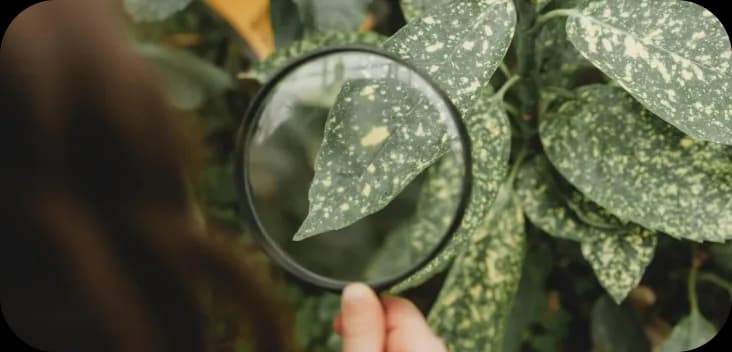
  • Leaf edges are smooth or finely toothed, with tiny yellow resin dots visible on the surface.
  • Flowers hang in short clusters and are small, urn-shaped, and pink to reddish.
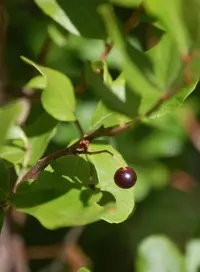
  • Berries are round, about 1/4 inch (6 mm) wide, and dull blue-black to black.

Resin dots on the leaves are one of the easiest close-up checks.

Black huckleberry shows clear visual shifts from low juvenile shoots to berry-bearing mature shrubs.

  • Juvenile plant: Young shoots are low and sparse, with simple alternate leaves on slender green twigs and little woody branching compared with older plants.
  • Mature plant: The plant becomes a dense, many-stemmed deciduous shrub, often 2-3 feet (0.6-0.9 m) tall, with twiggy branching and thicker woody stems.
  • Flowering stage: Small urn-shaped flowers hang from the leaf axils in short clusters, adding a finer, nodding structure not present on nonflowering shoots.
  • Fruiting stage: After flowering, rounded dark berries replace the hanging flowers, creating conspicuous fruit clusters that make branch tips look heavier and more pendant.

In spring to early summer, Gaylussacia baccata becomes easier to spot when its small, urn-shaped flowers hang along the stems. By later summer, those flowers give way to round berries that mature to a dark blue-black, a strong field mark. In fall, the leaves often shift from green to reddish tones before dropping. After leaf fall, the shrub shows a fine, twiggy outline with bare stems through winter.

A few blueberry relatives are regularly mistaken for black huckleberry.

highbush blueberry(Vaccinium corymbosum)

Both are deciduous shrubs with small oval leaves and dark berries. Highbush blueberry usually grows taller, often 6 feet (1.8 m) or more, and its berries lack the tiny resin dots found on huckleberry fruit and leaf undersides.

lowbush blueberry(Vaccinium angustifolium)

This species also forms colonies and bears blue-black berries. It is usually shorter, often under 2 feet (60 cm), with narrower leaves and smoother berries that do not show the small glandular dots typical of Gaylussacia baccata.

Gaylussacia baccata is native to eastern North America, from eastern Canada south through the northeastern and eastern United States into the Appalachians. That range helps narrow identification when a similar shrub is found in native barrens or woodland edges in that region. It is most often seen in dry to moist acidic habitats, including pine barrens, oak woods, heaths, sandy openings, and rocky slopes. In the field, a low shrub forming colonies in these acidic, often nutrient-poor sites supports identification.

Confirm It from a Photo

Use Botan to identify or verify the plant from a photo, which helps avoid mix-ups before labeling or comparing similar species.

FAQ

Leaves are arranged alternately, one per node along the stem, not opposite in pairs. They are simple, short-stalked leaves, a useful early check when identifying black huckleberry in the field.

More Plant Identification Guides

Find the Plant. Get the Details.

Identify it from a photo with Botan, then review species-specific plant details, care information, and common problems.

Botan app identifying a plant from a photo
Is Sugar Water Good for Plants?

4 min read · 14 Sept 2026

Is Sugar Water Good for Plants?

Sugar water may sound like an easy boost, but most rooted plants do not need extra sucrose. This guide explains how green tissues produce carbohydrates, when a sweetened solution can be useful, and why too much can cause problems.

Plant Care
Is Sugar Water Good for Plants?
What Do Plants Need to Grow – 5 Things Every Greenery Can't Live Without

8 min read · 31 Jul 2026

What Do Plants Need to Grow – 5 Things Every Greenery Can't Live Without

To keep plants healthy and thriving, provide the right balance of light, humidity, nutrients, airflow, and quality soil. This guide covers the essentials of year-round plant care.

Beginner Guides
What Do Plants Need to Grow – 5 Things Every Greenery Can't Live Without
12 Most Wanted Rare Houseplants to Grow at Home

6 min read · 21 Sept 2026

12 Most Wanted Rare Houseplants to Grow at Home

Rare houseplants can turn an ordinary corner in your apartment into a living botanical collection. This guide covers 12 most admired picks, what makes them special, and how to grow them successfully at home.

Plant Recommendations
12 Most Wanted Rare Houseplants to Grow at Home