Surface placement
Set the fungus on top of the soil or leaf litter rather than burying it, since the star-like rays open properly only when the fruiting body sits at the surface layer.

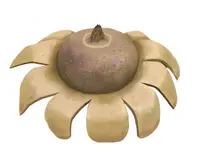
Weathered earthstar, Geastrum corollinum, is a small, star-shaped fungus rather than a traditional leafy plant. It belongs to the group of earthstar fungi that form distinctive spore sacs on the ground.
The outer layer splits into several pointed rays that lift and display a central puffball-like center. As it matures, the surface often cracks and looks aged or weathered, which gives it its common name.
This species is usually found in dry, sandy, or open woodland soils, often among leaf litter in temperate regions. It is not commonly cultivated, and attempts to care for weathered earthstar at home are challenging because it depends on complex soil fungi relationships and specific natural conditions.

Care Difficulty
Moderate Care

Light Preference
Partial Shade

Water Requirements
Moderate Water

Temperature Preference
Warm Climate

Hardiness Zone
Unknown

Soil Texture
Loamy, Sandy, Organic-rich

Soil pH
Acidic (5.5–6.5)

Soil Drainage
Well-drained

Fertilization
Minimal (feed rarely)
Scan your plant to receive care tips personalized for your specific plant
Available on iOS and Android
This saprobic fungus grows best in bright, dappled woodland light rather than full, open sun.
This ground-dwelling fungus prefers moist but not saturated soil, mimicking natural leaf-litter conditions.
This species favors mild climates and forms fruiting bodies once soil temperatures are neither very hot nor very cold.
This fungus tolerates a wide humidity range and usually does not need special humidity control outdoors.
This species prefers loose, gritty soil that drains rapidly and does not stay wet.
This species is generally unsuitable for container growing because it depends on complex soil fungi networks and natural decomposition in the ground.
Geastrum corollinum is a saprophytic fungus that gathers nutrients from decaying organic matter and usually needs no added fertilizer in gardens or naturalistic settings.
Geastrum corollinum requires no true pruning, but minimal clean‑up supports hygiene and observation in cultivated beds or display collections.
This earthstar is rarely grown in containers; management focuses on establishing and adjusting it in suitable outdoor substrate rather than classic repotting.
Propagation of Geastrum corollinum is specialized and usually left to natural spore dispersal in managed woodland or mulched beds.
This earthstar is naturally cold hardy in many temperate climates and usually needs no special winter care beyond stable habitat conditions.

Plant Health Check
Not sure what's wrong with your plant? Check your plant's health inside the app.
This species typically grows on dry, sandy or gravelly soils with sparse vegetation, often in open steppe, semi-desert, or degraded habitats where few other macrofungi fruit.
When the outer layer of the fruiting body splits into rays, these rays not only expose the spore sac but also become stiff and uplifted, raising the spore sac above the soil surface.
The spore sac usually has a clear, raised ring or collar around the pore at its top, a stable feature that helps distinguish this species from several closely related earthstars.
Growth is slow. From spore to recognizable star-shaped fruiting body usually takes 1–2 years in suitable outdoor conditions. After emerging, the structure reaches full size within days, then gradually weathers and collapses as spores disperse.
Keep your plants happy and healthy with plant identification, disease detection, and easy care guidance.