Spore release setup
Place mature earthstar specimens on a shallow tray of coarse sand or fine gravel so the star-shaped rays can fully open and elevate the spore sac above the surface for more effective natural spore dispersal.

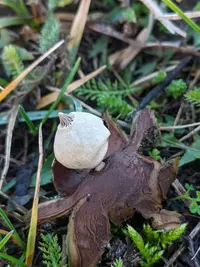
Geastrum nanum is a small earthstar fungus, not a typical leafy houseplant. It forms a round spore sac sitting on star-like rays that open from a buried fruiting body. This species is usually found on sandy or well-drained soils, often in dry, open woodland or heathland in temperate regions. It appears in nutrient-poor, undisturbed sites and is mainly of interest to fungus enthusiasts rather than casual gardeners. Because it is a decomposer, it does not grow like ornamental plants and is difficult to cultivate intentionally. Anyone wanting to learn how to care for Geastrum nanum should understand that it depends on very specific natural soil and habitat conditions that are hard to reproduce at home.

Care Difficulty
Moderate Care

Light Preference
Partial Shade

Water Requirements
Moderate Water

Temperature Preference
Cool Climate

Hardiness Zone
Unknown

Soil Texture
Loamy, Sandy, Organic-rich

Soil pH
Slightly acidic (6.5–7.0), Neutral (7.0)

Soil Drainage
Well-drained

Fertilization
Minimal (feed rarely)
Scan your plant to receive care tips personalized for your specific plant
Available on iOS and Android
This small earthstar fungus prefers low to moderate natural light levels similar to a lightly shaded forest floor.
This fungus grows best in consistently moist but not saturated soil, similar to the leaf-litter layer of a woodland.
This species favors cool to mild conditions typical of temperate woodlands.
Humidity is not a major factor for Geastrum nanum, which is adapted to dry, outdoor conditions rather than controlled indoor environments.
Geastrum nanum thrives in loose, well-aerated, free-draining mineral soils rather than rich, moisture-retentive mixes.
This species is not well suited to container growing because it depends on a broader soil ecosystem and underground fungal network than pots usually provide.
This small earthstar fungus naturally grows in nutrient-poor woodland soils and does not benefit from additional fertilizer in cultivation.
Geastrum nanum does not require pruning in the usual horticultural sense, since its fruiting bodies are short-lived fungal structures.
Transplanting is rarely needed, as this fungus depends on its natural soil community and is not suited to standard container culture.
Propagation of this earthstar is specialized and generally left to natural spore dispersal and expert mycologists rather than home growers.
In its natural range this earthstar is fully adapted to local winters and needs no targeted seasonal care from gardeners.

Plant Health Check
Not sure what's wrong with your plant? Check your plant's health inside the app.
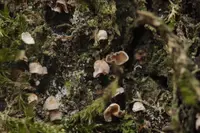
This species produces some of the smallest earthstar fruiting bodies, often only a few millimeters across when the rays are expanded, making it easy to overlook on soil or moss.
Geastrum nanum is strongly associated with base-rich, often calcareous soils, and is frequently recorded in old grasslands or open woodland with underlying limestone or chalk.
The fruiting bodies often develop among compact moss cushions, which help retain moisture around the tiny fungus and provide a stable microhabitat for its development.

Geastrum nanum is considered one of the least frequently recorded earthstar species in parts of Europe, and its scarcity has led some countries to list it as of conservation concern due to habitat loss and changes in traditional low-intensity land use.
This earthstar fungus is not considered edible. The fruiting body is small, tough, and lacks culinary value. There is limited data on its safety, so it should be treated as inedible and left for observation only.
Keep your plants happy and healthy with plant identification, disease detection, and easy care guidance.