white basket fungus Care (Ileodictyon cibarium)

Also known as: White Buckyball
white basket fungus

About white basket fungus

White basket fungus, Ileodictyon cibarium, is a saprophytic fungus, not a true plant, that feeds on decaying organic matter. It belongs to the stinkhorn group, known for strong odor used to attract insects for spore dispersal.

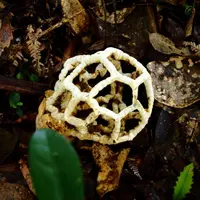
It typically starts as an egg-like structure, then expands into a hollow, white, cage-like sphere with irregular openings. The mature structure often collapses as it ages.

This species is native to New Zealand but has been introduced to parts of Australia and other mild, moist regions. It tends to appear in mulched beds, lawns, and gardens after rain.

Because it relies on organic debris, maintaining consistent moisture and rich, well-drained organic material is key if you want to care for white basket fungus in cultivated settings.

Main Plant Requirements

Care Difficulty

Hard Care

Light Preference

Partial Shade

Water Requirements

Keep Soil Moist

Temperature Preference

Warm Climate

Hardiness Zone

Unknown

Soil Texture

Loamy, Peaty, Organic-rich

Soil pH

Acidic (5.5–6.5)

Soil Drainage

Moist but well-drained

Fertilization

Minimal (feed rarely)

Get Personalized Care Plan

Scan your plant to receive care tips personalized for your specific plant

Available on iOS and Android

How to Care for the white basket fungus

This saprobic fungus develops best in stable, lightly shaded conditions that mimic a forest floor or sheltered garden bed.

  • Provide bright, indirect light or dappled shade, with 2–4 hours of soft morning sun and protection from harsh midday and afternoon sun to prevent drying of the substrate.
  • Allow partial shade under shrubs, low trees, or coarse mulch; white basket fungus often fruits where leaf litter or woody debris filters direct sunlight.
  • In hot summers, increase shade during heat waves to keep the substrate cool and moist, while in cooler seasons ensure some open sky so light can reach the fruiting area.

This species relies on consistently moist, but not waterlogged, organic substrate rather than a fixed watering schedule.

  • Before watering, check the top 2–5 cm of soil or mulch; it should feel evenly moist but not soggy, with no standing water pooling on the surface.
  • Use a loose, well-drained mix of leaf litter, compost, and bark so excess water can drain away, reducing the risk of rot and foul anaerobic smells around Ileodictyon cibarium mycelium.
  • In warm, dry weather, monitor daily for drying edges or crumbly substrate and water thoroughly, while in cool or rainy seasons reduce added water to avoid saturation.

This fungus prefers cool to mild temperatures and tends to fruit during seasons with moderate conditions and steady moisture.

  • Aim for an optimal range of 55–75°F (13–24°C), which supports vigorous mycelial activity and reliable fruiting in sheltered outdoor sites.
  • Protect from frost below 28°F (-2°C), which can damage developing fruiting bodies, and avoid locations exposed to repeated freeze–thaw cycles.
  • In hot periods above 80–85°F (27–29°C), increase shade and moisture retention with thicker mulch, as sustained heat and drying winds can halt growth and delay fruiting.

This fungus develops best in consistently moist, high-humidity environments around 70–90%.

  • Tolerates brief drops to 50–60% humidity if the substrate itself stays evenly moist, not soggy.
  • Low humidity causes quicker drying of fruiting bodies, shrinking, discoloration, and premature collapse.
  • Increase local humidity outdoors by using thick organic mulch and gentle, regular misting of the surrounding leaf litter.

Ileodictyon cibarium fruits on nutrient-rich, loose, well-drained organic substrates rather than typical potting soil.

  • Use a deep layer of crumbly, organic-rich material such as decomposed leaf litter, aged wood chips, and composted bark.
  • Aim for slightly acidic to neutral conditions, roughly pH 6.0–7.0, avoiding strongly alkaline garden lime or fresh ash.
  • Ensure rapid drainage by mixing coarse pieces (bark chips, twigs) into finer compost so water never pools or compacts the substrate.
  • Avoid heavy clay, dense turf, or plastic-lined areas that trap water and limit oxygen, since the fungal mycelium requires aerated pockets.

This species is generally unsuitable for traditional container growing because it prefers spreading through natural ground or thick outdoor substrates.

Ileodictyon cibarium, commonly called white basket fungus, usually needs no fertilizer when grown in naturally rich, organic ground.

Pruning is not a standard practice for Ileodictyon cibarium because the visible basket is a short-lived fruiting body, not a persistent plant structure.

Transplanting focuses on relocating the underlying fungal mycelium rather than the short-lived fruiting basket.

  • Consider moving it only when ground is disturbed or the host substrate will be removed, since frequent disturbance stresses the mycelium.
  • Transplant in cool, moist weather, lifting a generous plug of soil that includes visible white mycelial threads.
  • Shift the plug into similar, humus-rich, well-drained soil and keep the area evenly moist but not waterlogged afterward.
  • Avoid breaking or crumbling the soil block; minimal root and mycelium disturbance improves transplant success.

Propagation of Ileodictyon cibarium is specialized and usually left to natural spore dispersal or expert cultivation.

This fungus is generally left to natural seasonal cycles and usually needs no specific winter care interventions.

Care Tips

Use breathable containers

When attempting to grow white basket fungus in cultivation, place the colonized substrate in shallow, well‑aerated trays or mesh-sided baskets so air can move freely around the developing fruiting bodies and prevent deformation or rot.

Control odor exposure

Position culture trays downwind and away from doors, windows, or shared indoor spaces, since mature fruiting bodies produce a strong odor that attracts flies and can be unpleasant in enclosed areas.

Optimize spore dispersal

Allow access for flies and other insects to reach mature fruiting bodies if local regulations and hygiene allow, since their activity is the primary mechanism for spore dispersal and supports ongoing colony renewal.

Rotate colonized substrate

If growth slows in one area of the tray, gently break and redistribute some of the colonized substrate into fresh, pasteurized organic material to extend productivity without starting from scratch.

Monitor for competing molds

Inspect the substrate regularly for fuzzy, discolored, or powdery growth and promptly remove and discard contaminated sections to reduce competition and protect the main fungal colony.

Common Pests and Diseases

fungal gnat larvae

This pest often develops in the organic-rich, constantly moist substrate where the fungus fruiting body forms. Larvae feed in the substrate and can disturb developing mycelium and young basket structures.

Solution

Reduce excess surface moisture and improve drainage around the growing area so the substrate is damp but not waterlogged, and use fine mesh or sticky traps at the surface to limit adult gnats. Where infestation is heavy, a biological control such as Bacillus thuringiensis israelensis (BTI) in water can be applied to the substrate, following label directions for edible mushrooms, to suppress larvae without harming the fungal colony.

mold contamination

This disease appears as unwanted white, green, or gray fuzzy growth that competes with the basket fungus mycelium. Symptoms include weak, misshapen, or aborted fruiting bodies and uneven colonization of the substrate.

Solution

Isolate and remove heavily contaminated substrate and any deformed or collapsed fruiting bodies, then lower humidity slightly and increase fresh air exchange to discourage mold. When growing Ileodictyon cibarium in controlled conditions, use clean tools, pasteurized or sterilized substrate, and avoid splashing water that can spread mold spores between containers.

bacterial soft rot

This disease affects the mature fruiting body, especially once it begins to collapse, leading to slimy, foul-smelling tissue that breaks down rapidly. Symptoms include wet, mushy areas and accelerated decay compared with normal aging of the basket structure.

Solution

Promptly remove and discard decaying or collapsed fruiting bodies so bacterial populations do not build up in the growing area. Improve airflow, avoid overhead watering directly on the fruiting bodies, and maintain good site hygiene around the substrate to reduce bacterial spread and odor issues associated with caring for white basket fungus.

Interesting Facts

Unusual lattice structure

This fungus forms a hollow, white spherical cage made of interlaced arms that expand from an egg-like structure, a growth form that is rare among gasteroid fungi.

Fly-dispersed spores

The mature lattice emits a strong, foul odor from a slimy spore mass, attracting flies that feed on it and then transport the spores to new sites.

New Zealand food use

In Aotearoa New Zealand, Māori traditionally regarded the unopened egg stage as edible, though the mature, open fruiting body is considered inedible due to its strong smell.

Botan icon

Did you know?

Genetic and morphological studies indicate that this species is closely related to other so-called stinkhorn fungi, yet its fully open, basket-like fruiting body can detach and roll in the wind, potentially aiding spore dispersal beyond the range of insect visitors.

FAQs about white basket fungus

The immature egg stage is reportedly edible in some traditional uses, but it is not widely recommended. Identification errors, strong odor, and potential contamination risks make this species unsuitable for casual foraging or home consumption.

Grow Healthy Plants with Botan Care

Keep your plants happy and healthy with plant identification, disease detection, and easy care guidance.

Botan plant care app — identify plants on mobile

Explore More Plants