Substrate hygiene
Remove and discard any decayed organic debris around the fruiting bodies to limit mold competition and maintain a clean microhabitat for reliable sporocarp development.

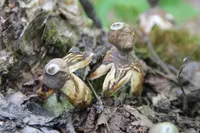
Four-rayed earthstar, Geastrum quadrifidum, is a small, star-shaped fungus rather than a leafy plant. It develops a round spore sac sitting on top of 4–5 pointed rays that open from a ball-like base.
This species grows on soil rich in decaying wood, usually in coniferous or mixed forests across parts of Europe, Asia, and North America. It is considered uncommon and is mostly appreciated for its unusual appearance rather than as a cultivated species.
Because it relies on complex relationships with soil fungi and decaying organic matter, it is difficult to grow at home, and guides on how to care for Four-rayed Earthstar are limited.

Care Difficulty
Hard Care

Light Preference
Partial Shade

Water Requirements
Regular Water

Temperature Preference
Cool Climate

Hardiness Zone
Unknown

Soil Texture
Loamy, Sandy, Organic-rich

Soil pH
Acidic (5.5–6.5), Slightly acidic (6.5–7.0)

Soil Drainage
Moist but well-drained

Fertilization
Minimal (feed rarely)
Scan your plant to receive care tips personalized for your specific plant
Available on iOS and Android
This fungus grows on the forest floor and prefers low, indirect light rather than direct sun.
This species grows on naturally decomposing, slightly moist forest litter rather than in regularly watered soil.
This forest-floor fungus prefers cool to mild conditions and avoids temperature extremes.
Humidity is not a major factor for Geastrum quadrifidum, which naturally tolerates varied outdoor conditions.
Geastrum quadrifidum develops best in loose, well-drained, organic-rich substrates that mimic forest litter.
This species is not well suited to conventional container growing and is usually best observed in natural or recreated woodland beds.
This fungus naturally extracts nutrients from decaying matter and usually needs no additional fertilizer in cultivation.
Geastrum quadrifidum does not require true pruning, only minimal hygiene in managed settings.
In cultivation, this earthstar should be disturbed as little as possible, since the main organism is the hidden mycelium.
Reproduction of this fungus is mainly left to natural spore dispersal rather than controlled propagation.
This species is naturally cold hardy across temperate climates and usually needs no special winter care outdoors.

Plant Health Check
Not sure what's wrong with your plant? Check your plant's health inside the app.
Mature fruiting bodies typically split into four stiff rays that bend downward and lift the spore sac above the substrate, which improves spore dispersal compared with many other earthstar species that open with more numerous rays.
When the rays reflex, the remains of the outer layer form a distinct, narrow collar or ring around the base of the spore sac, a diagnostic feature used by mycologists to separate this species from closely related earthstars.
This species is strongly associated with dry, sandy or nutrient-poor coniferous and mixed forests in temperate regions of Europe, Asia, and North America, where it helps decompose organic litter in relatively harsh soil conditions.

The spore-sac surface of this species is finely powdery and often develops a clearly visible, slightly raised ring around the pore at the top, a microscopic and macroscopic pattern that taxonomists use as a stable character when confirming identifications under variable field conditions.
This fungus is not considered edible. The fruiting body is tough, fibrous, and lacks culinary value. Some related earthstars have been used in traditional remedies, but ingestion is not recommended due to poor texture and unknown compounds.
Keep your plants happy and healthy with plant identification, disease detection, and easy care guidance.