

Leaf litter mulch
Maintain a thin, even layer of sterile hardwood leaf litter or fine bark chips around the fungus to mimic natural forest duff while avoiding heavy, wet mulch that can smother developing fruiting bodies.

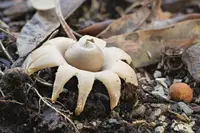
Collared earthstar, Geastrum triplex, is a small saprophytic fungus, not a leafy houseplant. It feeds on decaying organic matter on the forest floor. When mature, the outer layer splits into star-like rays that lift a central spore sac, giving it a distinct and easily recognizable shape.
This species occurs mainly in temperate woodlands, often in leaf litter under broadleaf trees. It does not behave like a typical potted plant and is rarely grown indoors. Those who care for Collared Earthstar usually aim to support it in naturalistic, shaded, moist woodland beds with rich, well-drained soil.
Its growth depends heavily on healthy soil life and stable moisture, so it is not an easy or predictable species to cultivate intentionally.

Care Difficulty
Hard Care

Light Preference
Shade

Water Requirements
Regular Water

Temperature Preference
Cool Climate

Hardiness Zone
Unknown

Soil Texture
Loamy, Silty, Organic-rich

Soil pH
Acidic (5.5–6.5), Slightly acidic (6.5–7.0)

Soil Drainage
Moist but well-drained

Fertilization
Minimal (feed rarely)
Scan your plant to receive care tips personalized for your specific plant
Available on iOS and Android
This fungus naturally grows on shaded forest floors and does best in low to moderate light outdoors.
This saprobic fungus relies on naturally moist, well-drained woodland soil rather than frequent direct watering.
This species fruits best in cool to mild conditions typical of temperate woodland autumns.
Humidity is usually not a limiting factor for Collared Earthstar in cultivation.
Geastrum triplex grows best in loose, humus-rich, well-drained soil that mimics a forest floor.
This species is not well suited to standard container growing and is rarely maintained long term in pots.
Geastrum triplex is a saprophytic fungus that generally does not benefit from added fertilizer in normal garden or woodland conditions.
Geastrum triplex needs almost no pruning, since fruiting bodies are short-lived and decay naturally.
This earthstar is rarely grown in containers, so care focuses on transplanting or relocating suitable habitat rather than individual fruiting bodies.
In gardens, caring for Collared Earthstar focuses on maintaining habitat rather than direct propagation, which is mainly by wind-dispersed spores.
This woodland fungus is naturally cold hardy in temperate climates and usually needs no special winter care.

Plant Health Check
Not sure what's wrong with your plant? Check your plant's health inside the app.
When mature, this earthstar forms a distinct raised collar around the central spore sac, created by splitting of the outer tissue layer, which is a key feature distinguishing it from other Geastrum species.
The outer layers of the fruiting body open into star-like rays as they dry, lifting the spore sac above the ground surface, and this hygroscopic movement is thought to improve spore dispersal.
This fungus grows as a saprobe on rich leaf litter and decaying wood in broadleaf and mixed forests, contributing to decomposition and nutrient cycling in temperate woodland ecosystems.

The species was first described scientifically in 1840 by the mycologist Elias Magnus Fries, and its name triplex refers to the three-layered structure of its outer covering, which becomes evident as the fruiting body matures and splits.
This fungus performs best outdoors in humus-rich, undisturbed soil, often in woodlands or shaded garden beds. Indoors it usually fails long-term, so Collared Earthstar indoor care is mainly limited to short-lived display of collected fruiting bodies.
Keep your plants happy and healthy with plant identification, disease detection, and easy care guidance.

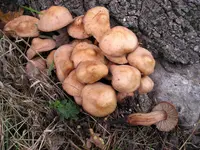
Spindleshank
Gymnopus fusipes
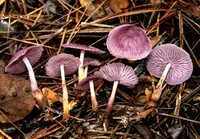
Gymnopus iocephalus
Gymnopus iocephalus
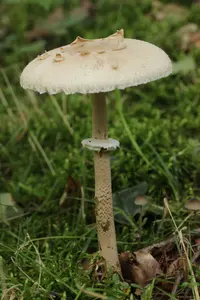
Macrolepiota fuliginosa
Macrolepiota fuliginosa
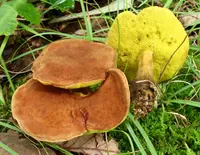
clustered brown bolete
Aureoboletus innixus
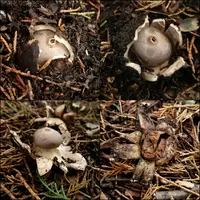
crowned earthstar
Geastrum coronatum
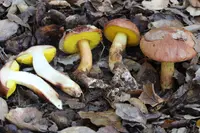
viscid bolete
Aureoboletus flaviporus
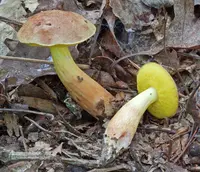
sour gold-pored bolete
Aureoboletus auriporus
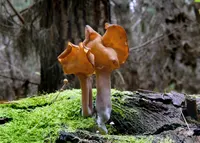
Southern False Morel
Gyromitra tasmanica