Moisture-retentive mulch
Apply a thin layer (0.5–1 cm) of fine, composted leaf litter over the substrate to keep the upper soil horizon evenly moist and to mimic the humus-rich forest floor where this fungus naturally fruits.

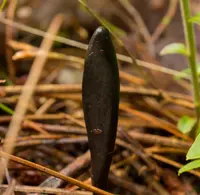
Slimy earthtongue, Geoglossum difforme, is a small soil-dwelling fungus rather than a leafy plant. It produces narrow, tongue-shaped fruiting bodies with a dark, often shiny or slimy surface emerging from the ground.
This species typically grows in mossy grasslands, lawns, and light woodlands, especially in undisturbed, moist soils with good organic content. It tends to appear in small groups, giving a subtle but distinctive texture to low vegetation.
Moist, cool conditions and stable soil structure make it more likely to persist, while heavy disturbance or drying can reduce its presence. Gardeners who want to care for Slimy Earthtongue usually focus on maintaining a low-input, undisturbed, and consistently damp habitat rather than direct cultivation.

Care Difficulty
Hard Care

Light Preference
Partial Shade

Water Requirements
Keep Soil Moist

Temperature Preference
Cool Climate

Hardiness Zone
Unknown

Soil Texture
Loamy, Silty, Organic-rich

Soil pH
Acidic (5.5–6.5)

Soil Drainage
Moist but well-drained

Fertilization
Minimal (feed rarely)
Scan your plant to receive care tips personalized for your specific plant
Available on iOS and Android
This fungus grows in low, filtered woodland light rather than direct, open sun.
This species depends on consistently moist, but not waterlogged, soil in its natural habitat.
This organism is adapted to cool, temperate conditions and often fruits in autumn.
This fungus prefers consistently moist air and substrate, similar to a damp forest floor.
Geoglossum difforme grows best in cool, moist, organic-rich soil with steady but not stagnant moisture.
This species is challenging and generally unsuitable for long-term container growing outside specialized culture.
Geoglossum difforme, or Slimy Earthtongue, naturally grows in low-nutrient soils and usually needs no fertilization in gardens or containers.
Geoglossum difforme needs almost no pruning because the fruiting bodies are short-lived and decay naturally.
This fungus is best left undisturbed, but limited transplanting of its habitat is sometimes attempted for study or conservation.
Propagation of Geoglossum difforme is specialized and rarely attempted by home growers, as it depends on complex soil and microbial relationships.
Geoglossum difforme is cold hardy in temperate climates and needs no special winter care in the ground.

Plant Health Check
Not sure what's wrong with your plant? Check your plant's health inside the app.
The fertile spore-bearing surface of this species is notably gelatinous and shiny when moist, which helps distinguish it from similar black earthtongues with drier, more velvety heads.
In the wild, this fungus is most often recorded in moist, shaded habitats such as wet woodland edges and damp mossy ground, rather than the drier grasslands favored by some related earthtongue species.
Mature fruiting bodies form dark olive-brown to almost black, smooth clubs with only a slight distinction between head and stalk, giving a more uniform, tapered appearance than many other earthtongues.

Molecular studies have shown that specimens once lumped together under the name Geoglossum difforme can represent several distinct but closely related lineages, which has led to recent taxonomic re-evaluation of this complex earthtongue group.
This fungus performs best outdoors in cool, moist, undisturbed soil rich in organic matter. Slimy Earthtongue indoor care is very challenging, because it depends on complex soil fungi relationships that are difficult to recreate in containers or terrariums.
Keep your plants happy and healthy with plant identification, disease detection, and easy care guidance.