

Leave Host Vegetation
Retain a low, permanent cover of mosses, short grasses, or leaf litter around fruiting sites, since this species depends on undisturbed ground-layer vegetation and declines where areas are frequently raked or mowed bare.

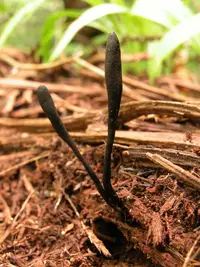
Deceptive earthtongue, Geoglossum fallax, is a small, club-shaped fungus rather than a typical leafy plant. It forms dark, slender fruiting bodies that resemble tiny black tongues emerging from the soil or moss.
This species usually appears in damp, mossy grasslands, woodland edges, and heathlands, often in undisturbed or semi-natural habitats. It tends to grow in small groups, making it easy to overlook.
Geoglossum fallax can be challenging to maintain in cultivation because it depends on specific soil communities and stable moisture conditions. Anyone wanting to learn how to care for deceptive earthtongue should understand that it is best appreciated in habitat-like, low-disturbance settings with consistently cool, moist, well-drained soil.

Care Difficulty
Hard Care

Light Preference
Partial Shade

Water Requirements
Keep Soil Moist

Temperature Preference
Cool Climate

Hardiness Zone
Unknown

Soil Texture
Loamy, Silty, Organic-rich

Soil pH
Strongly acidic (4.5–5.5), Acidic (5.5–6.5)

Soil Drainage
Moist but well-drained

Fertilization
Minimal (feed rarely)
Scan your plant to receive care tips personalized for your specific plant
Available on iOS and Android
This fungus prefers low, cool light conditions typical of shaded woodland floors.
Moist, cool soil is essential for stable development of Geoglossum fallax fruiting bodies.
This species is adapted to cool to mild conditions typical of temperate forests and grasslands.
This fungus prefers consistently moist conditions rather than a specific indoor humidity range and is not suited to typical household air.
This species develops best in cool, consistently moist, organic-rich ground rather than standard potting substrates.
This species is generally unsuitable for container growing because it relies on complex soil and habitat conditions that are difficult to reproduce in pots.
This fungus is adapted to nutrient-poor soils and usually performs best with minimal or no fertilization.
Geoglossum fallax does not benefit from horticultural pruning and is usually left undisturbed.
This species is a soil-dwelling fungus that is not suited to normal container culture, so transplanting is rarely appropriate.
Geoglossum fallax is not typically propagated in gardens, as it depends on complex soil and root relationships.
This temperate woodland fungus is naturally cold hardy and usually requires no special winter care in the ground.

Plant Health Check
Not sure what's wrong with your plant? Check your plant's health inside the app.
This species produces dark brown to nearly black spores, which are ellipsoid and finely roughened under a microscope, a feature that helps distinguish it from several similar Geoglossum species.
It typically fruits among mosses on nutrient-poor, often somewhat disturbed soils, such as paths and compacted ground in woodlands and grasslands, rather than in rich undisturbed forest litter.
Geoglossum fallax has a long history of being confused with other black earthtongues, and careful study of spore size, ornamentation, and microscopic tissue structure was needed to define it as a distinct species in modern taxonomic treatments.
This fungus is not considered edible. It is small, tough, and lacks culinary value, and its chemistry is not well studied. Treat it as inedible and avoid collecting it for food or experimenting with consumption.
Keep your plants happy and healthy with plant identification, disease detection, and easy care guidance.

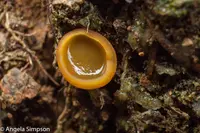
fleshy cup fungus
Aleurina ferruginea
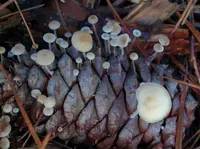
Conifercone Cap
Baeospora myosura
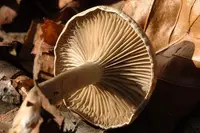
Entoloma undatum
Entoloma undatum
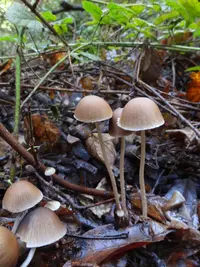
red edge brittlestem
Psathyrella corrugis
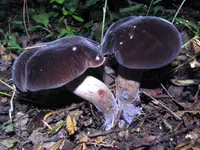
Black Velvet Bolete
Tylopilus alboater
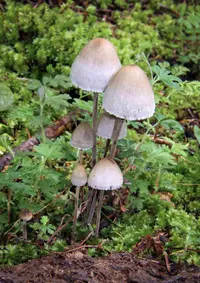
Petticoat Mottlegill
Panaeolus papilionaceus
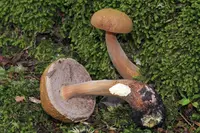
Graceful Bolete
Austroboletus gracilis
Auricularia fuscosuccinea
Auricularia fuscosuccinea