

Host root management
Plant young cedar cup near established cedar or other compatible conifers and avoid disturbing or severing their fine feeder roots, since this fungus depends on a stable mycorrhizal partnership to fruit reliably.

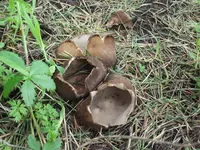
Cedar cup, Geopora sumneriana, is a cup fungus rather than a typical leafy plant. It forms rounded, underground fruiting bodies that open into shallow cups at the soil surface. The cups are usually pale to tan and often appear near the roots of cedar or cypress trees.
This species is native to parts of Europe and has been recorded in some other temperate regions, always linked to conifer hosts. It is specialized and not commonly cultivated, so it is considered challenging to grow on purpose. For anyone who wants to care for cedar cup in a garden setting, stable moisture, undisturbed soil, and the presence of suitable conifer partners are usually important.

Care Difficulty
Hard Care

Light Preference
Partial Shade

Water Requirements
Moderate Water

Temperature Preference
Cold Hardy

Hardiness Zone
6–9

Soil Texture
Sandy, Loamy, Organic-rich

Soil pH
Slightly acidic (6.5–7.0)

Soil Drainage
Well-drained

Fertilization
Minimal (feed rarely)
Scan your plant to receive care tips personalized for your specific plant
Available on iOS and Android
This soil-dwelling fungus prefers cool, woodland-type light rather than direct open exposure.
Geopora sumneriana relies on consistently moist but not saturated soil around host tree roots.
This species is adapted to cool to mild climates with distinct seasonal fluctuations.
Humidity is not a significant factor for Geopora sumneriana, which is primarily a soil-dwelling fungus linked to cedar roots.
This species relies on specific outdoor soil conditions rather than potting media.
This fungus is not suitable for standard container growing, as it depends on natural soil and living host roots rather than isolated pot culture.
Geopora sumneriana is a mycorrhizal fungus linked to cedar roots and usually needs no direct fertilization in gardens.
Geopora sumneriana forms underground structures and small surface fruiting bodies, so intentional pruning is not part of its care.
This fungus is not suited to normal container culture; management focuses on the host tree and soil rather than moving the organism itself.
Propagation of Geopora sumneriana is specialist work and not a practical home task, since the fungus depends on living conifer roots.
This species is naturally cold hardy in temperate climates and generally needs no dedicated winter care from gardeners.

Plant Health Check
Not sure what's wrong with your plant? Check your plant's health inside the app.
This species is a true truffle relative that produces its fruiting bodies in early spring, often around the time daffodils and other bulbs emerge near its host tree.
It forms ectomycorrhizal partnerships specifically with cedar trees such as Cedrus deodara, exchanging mineral nutrients from the soil for sugars from the tree roots.
The ascocarps typically develop underground and only split the soil surface as shallow, cup-shaped structures when mature, leaving much of the fruit body still buried in the substrate.

This fungus was historically known almost exclusively from plantings of introduced Himalayan and Lebanon cedars in western Europe, making it a notable example of a symbiotic fungus spreading internationally along with its ornamental tree hosts.
This species is not considered edible and is generally avoided. Identification of truffle-like fungi is complex, and many similar species are unsafe. Do not eat it; treat it as a non-edible, purely ornamental curiosity.
Keep your plants happy and healthy with plant identification, disease detection, and easy care guidance.

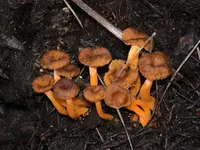
Cantharellus xanthopus
Cantharellus lutescens
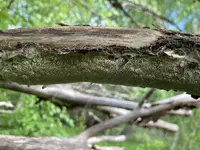
Cerioporus mollis
Cerioporus mollis
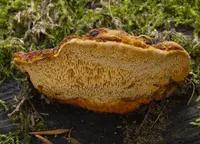
Anise Mazegill
Gloeophyllum odoratum
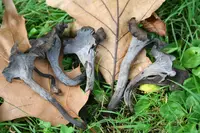
Horn-of-plenty
Craterellus cornucopioides
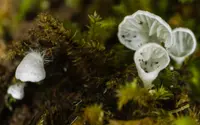
veined mossear
Rimbachia bryophila
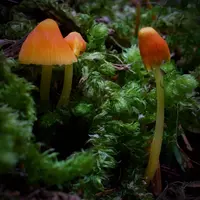
tangerine bonnet
Atheniella aurantiidisca
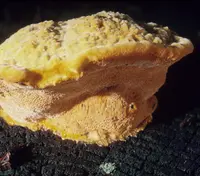
Hapalopilus croceus
Hapalopilus croceus
Great Funnel-Veil Amanita
Amanita velatipes